
I've spent the last decade observing a predictable pattern as partnerships mature across the tech industry: companies scale beautifully from $10M to $50M, sometimes even to $100M. Then they hit a wall.
At our recent Sales Partnership Summit, we brought together leaders from AWS, Deloitte, and Cisco to explore how they've built multiple billion-dollar partnerships. Interestingly, they've stopped thinking about partnerships as relationships to manage and started thinking about them as business models to architect.
Here are three of my most valuable takeaways.
The $100M Ceiling Has Three Root Causes
1. You're Trading Time for Money
Brian Bohan (Director, Global Lead) runs the consulting partner Center of Excellence at AWS. Before that, he built AWS's partnership with Accenture from zero to over a billion dollars. When I asked him about breaking through growth barriers, he identified how most companies rely on individual excellence rather than systematized capability.
"You've got a great partner that just comes in and wows the customer, and so you're looking to them to always bring the magic. But that doesn't scale. That gets you to $100 million. That doesn't get you to $1 billion."
- Brain Bohan, Director, Global Lead, Consulting Partner COE at AWS
If your best consultant or partner manager leaves tomorrow and your capability leaves with them, you haven't built anything that scales.
When Deloitte works with partners like Salesforce, they're doing more than training consultants. They're building industry-specific solutions (like their life sciences framework) that can be deployed repeatedly across dozens of customers.
Todd DeBasio (Principal, US Growth Platforms) from Deloitte described this shift as moving from selling expertise by the hour to "industrializing the things we're bringing to market into repeatable solutions."
2. You're Trying to Do Everything
When building the Accenture partnership, Brian's team started with five focus areas. Two didn't work, so they killed them. Not paused them, killed them.
The discipline is more than picking where to play. Having the courage to stop playing in areas that aren't working, even if they're generating some revenue, separates companies that break through from those that stall.
Todd echoed the need for focus, citing how Deloitte’s practices across every sector and functional domain can create a temptation to pursue everything.
“If we don't pick the two or three where we know we can create momentum, and instead we try to do a little bit in 100 places, it very quickly starts to break."
- Todd DeBasio, Principal, US Growth Platforms at Deloitte
I see this impulse constantly. When partnerships plateau, the instinct is to add more: more partner types, more solutions, more markets. This almost always makes things worse.
3. You're Managing Manually
Brian was emphatic about automation as a necessity to scale.
"In this agentic world, we have to move beyond humans only talking to humans around sharing capabilities, sharing pipeline, sharing target accounts—that's a bottleneck. That doesn’t scale."
- Brain Bohan, Director, Global Lead, Consulting Partner COE at AWS
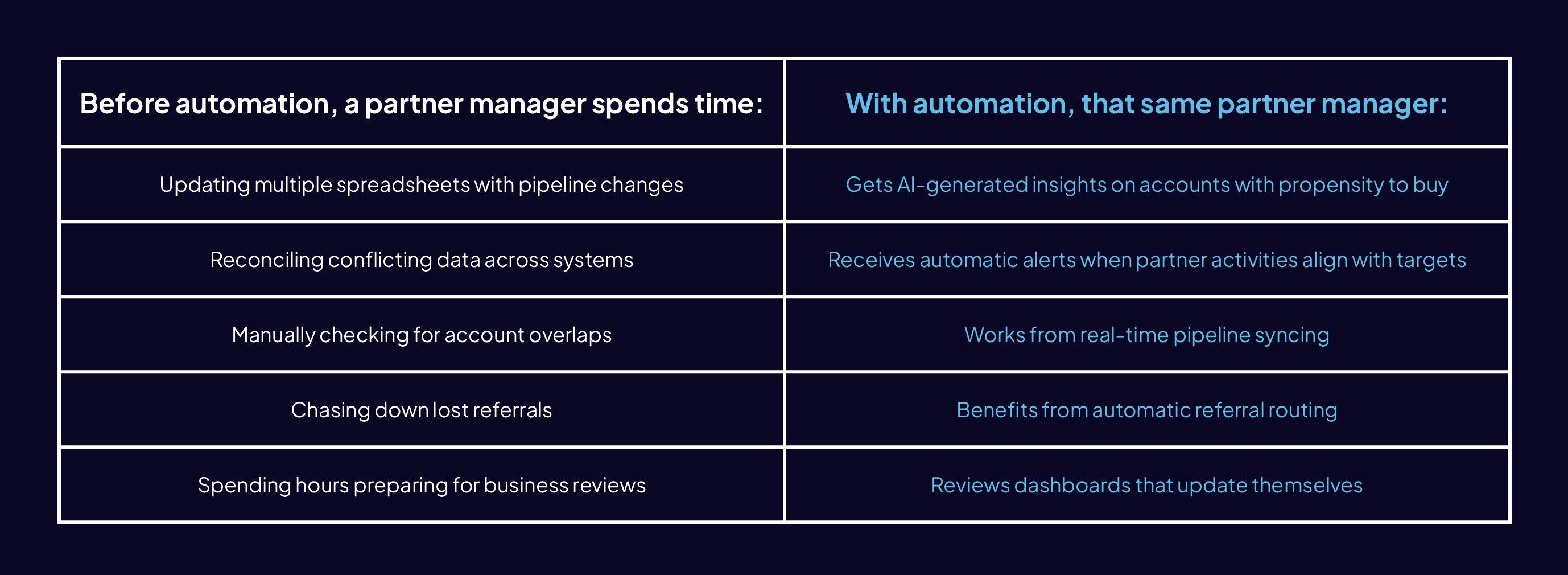
The difference is between managing logistics and driving strategy.
AWS built recommendation engines that suggest partners based on customer needs. Deloitte automated referral flows and pipeline sharing. And Jason Gallo (GVP, Partner Value Acceleration) from Cisco emphasized how automation and AI enablement were foundational in designing their new Cisco 360 program.
“[AI] was a very clear and funded part of how we were going to build the program…We've now been able to build and structure the data so that there is a Cisco AI assistant for partners within our partner portal.”
- Jason W. Gallo, GVP Partner Acceleration at Deloitte
Companies that break through do three things differently: They build intellectual property instead of selling time, they focus ruthlessly on 2-3 plays instead of spreading thin, and they treat automation as infrastructure instead of a future project.
Your Partners Are Innovation Labs
One striking insight was how these companies actually learn from their ecosystems. They aren’t just pushing programs out. They're watching what partners do and letting that shape their strategy.
Co-Design Creates Buy-In and Better Programs
Jason led Cisco's transformation to their new Cisco 360 program through a 15-month co-design process. Cisco did something unusual: they announced the redesign before it was complete and invited partners to help build it. The key, Jason emphasized, was genuine openness.
"We were going to be open and transparent about the feedback we took. It was not going to be a marketing roadshow. We were genuinely going to listen."
- Jason W. Gallo, GVP Partner Acceleration at Deloitte
Partners were initially confused. They were conditioned to expect finished programs. But once they understood Cisco was serious, something shifted. Jason could count on one hand how many partners complained at launch. Most said they appreciated being heard, even when they didn't get everything they wanted.
Pattern Partners Show You the Future
Co-design isn't just about getting buy-in. Your partners operate at the edge of innovation and can show you the future.
Brian described AWS's Pattern Partner program, where they work closely with small, innovative firms that represent emerging models. Companies like Scan.ai and Rhino.ai use AI agents to conduct discovery and map processes in ways traditional consulting firms don't. These firms show up at client sites not with teams of analysts, but with agents that can build ontologies from existing systems.
AWS created SWAT teams to work with these partners closely, even though they're not in AWS's direct portfolio. As Brian put it, "They're helping us understand the direction of traffic," which informs where AWS invests across their entire ecosystem.
Co-Creation Unlocks Unique Value
Todd described the same dynamic. Working with Salesforce in life sciences, Deloitte co-created solutions neither company could have built alone, leveraging what Salesforce does well as a base and adding Deloitte's industry IP.
And increasingly, the biggest wins come from three-way collaboration. Brian described a pattern he sees constantly: a customer needs cloud infrastructure (AWS), industry-specific implementation expertise (Deloitte or Accenture), and specialized software (Salesforce or SAP). The solution only works when all three are involved.
Example: A pharmaceutical company wants to modernize clinical trial management. They need cloud infrastructure, regulatory expertise, and specialized life sciences software. In the old model, the customer negotiates three separate contracts and hopes everything integrates. In the new model, the three companies pre-package the solution: one contract, one implementation plan, shared accountability.
AWS just launched multi-product solutions in their Marketplace to enable exactly this, bundling SI services, ISV software, and AWS infrastructure into a single purchasable solution.
The companies breaking through have stopped thinking about partnerships as bilateral relationships. The customer wants an integrated solution over separate partnerships.
Three Levels of Partnership Thinking
Jason shared a framework that crystallizes the transformation required to reach billion-dollar partnerships.
Most partnership leaders operate at one of three levels. Each builds on the previous one, but the elite companies operate at the third level where partnerships become indistinguishable from business strategy.
Level 1: Channel Management
This is where most partnership teams live. You're building relationships, supporting deals, and enabling partners.
Jason was clear: "This is critical for anyone to be successful, period." You need these foundational skills, but they're not sufficient to break through the $100M ceiling.
Level 2: Partner Programs
Some leaders elevate to this level, where you're designing rebates, certifications, deal registration systems, and operational frameworks.
This is better. You're thinking more systematically, but you're focused on mechanics, not strategy.
Level 3: Business Strategy
The elite operate here. At this level, Jason said, leaders "blur the lines between how building and designing true go-to-markets are part of the business structure and the culture itself."
You're no longer asking program questions. You're asking business questions:
- How do subscription models change economics for our partners?
- What competitive moats can we build by embedding deeper into partners' operations?
- How do regulatory shifts in different countries affect partners' ability to deliver value?
- What does our partnership strategy need to look like in an AI-first world versus a cloud-first world?
Jason described it as appreciating "concepts like platform economics, competitive differentiation, or even how some of the global transformation of sovereigns around the world are impacting our partners' businesses and profitability." These become C-suite level conversations.
What Level 3 Looks Like in Practice: Measuring Outcomes
One clear indicator of Level 3 thinking is how you measure success.Jason explained that Cisco 360 doesn't just ask if a partner made the sale. They ask whether customers are "getting out of that product or platform what was originally intended."
Here's how Cisco's lifecycle incentives work:
When a partner sells a $500K security platform:
- They get 30% of their rebate when the deal closes
- Another 30% when implementation is complete
- Another 20% when customer usage hits defined thresholds
- The final 20% when the customer renews
If the customer never actually uses the product? The partner leaves 70% of their rebate on the table.
This aligns everyone's incentives: Cisco wants happy customers, partners want full rebates, customers want value. Level 1 and 2 thinking aligns the first two but ignores the third. Level 3 thinking aligns all three.
Todd described Deloitte's similar shift toward measuring "not just sales numbers but where we're co-investing in clients and solutions."
"We're trying to drive towards creating a single trusted view of our partners’ performance. We're really leaning into our work together with WorkSpan and trying to develop a holistic picture.”
- Todd DeBasio, Principal, US Growth Platforms at Deloitte
And Brian noted the uptick in outcome-based pricing models across AWS's ecosystem: “It makes sense, right? You're a customer and you're wanting to move to this agentic world, but there's so much uncertainty.“
“We're seeing more line-of-business leaders at the table making these decisions. And line-of-business leaders want to buy outcomes. They don't want to buy a bunch of tools and people."
- Brain Bohan, Director, Global Lead, Consulting Partner COE at AWS
When buying decisions were IT-driven, customers bought products and features. Now they're buying business outcomes. Partnership programs designed for product sales don't work in an outcome-driven market.
The Transformations Required
Getting to Level 3 requires fundamental changes:
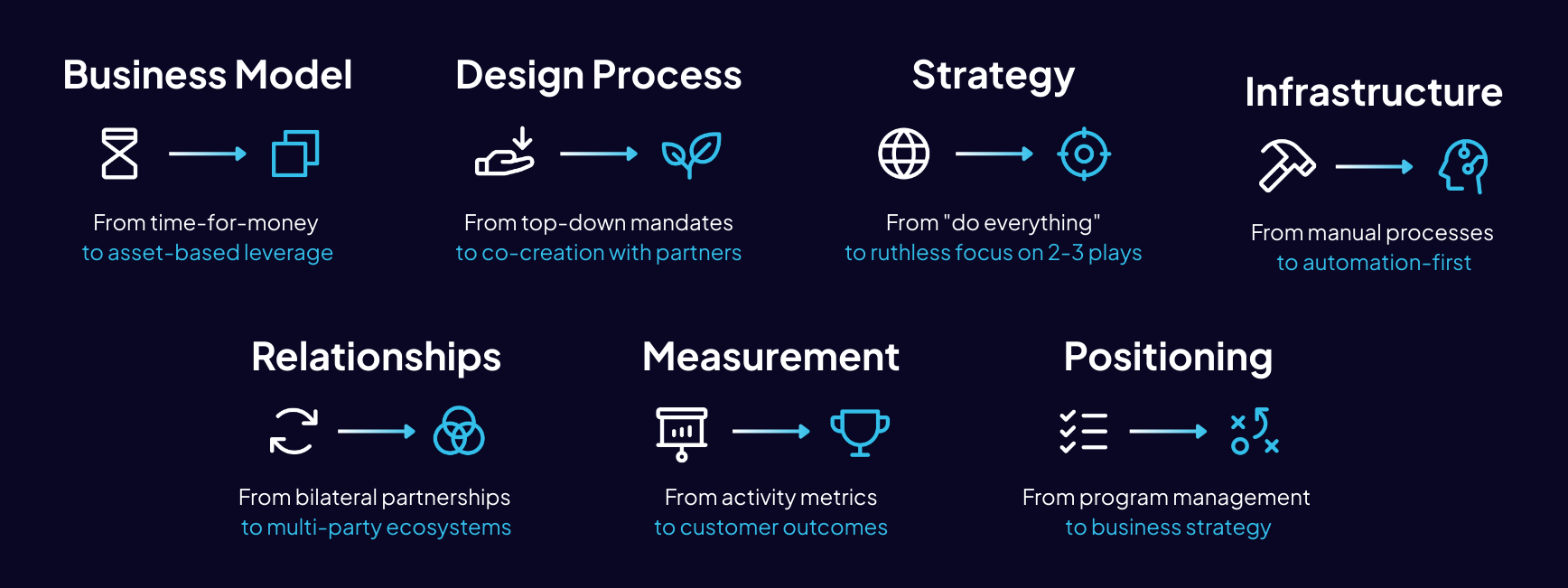
The companies with billion-dollar partnerships have elevated partnership leaders to the executive table where business strategy gets decided. When your Head of Partnerships reports to Sales, you're probably at Level 1 or 2. When they sit at the executive table as a peer to your Chief Product Officer and Chief Revenue Officer, you're probably at Level 3.
The Path Forward
The $100M wall isn't about working harder. Every partnership team I know is already working incredibly hard.
What separates the companies that break through is how they fundamentally rethink what partnerships mean. They build intellectual property instead of selling time. They co-create with partners instead of dictating terms. They focus ruthlessly on a few plays instead of spreading thin. They treat automation as infrastructure. They orchestrate ecosystems instead of managing bilateral relationships. And they measure customer outcomes instead of just activity.
Most importantly, they've elevated partnership thinking from program management to business strategy.
The playbook exists. AWS, Deloitte, and Cisco have each built multiple billion-dollar partnerships by making these transformations. You can watch them share their approaches openly in our Sales Partnership Summit replay.
Are you ready to transform how you partner to break through the $100M wall?
Take the Next Step
At WorkSpan, we've worked with hundreds of companies building and scaling partnerships, from emerging tech companies to global enterprises. We've seen what works, what breaks, and what it takes to break through.
Book a Demo and we'll walk through:
- Where you are today
- Where bottlenecks will likely emerge as you scale
- What transformation looks like for your situation
- How companies like AWS, Deloitte, MongoDB, and Palo Alto Networks have built automation and intelligence into their operations
You can build billion-dollar partnerships. Are you ready to transform how you partner to get there?
These insights come from our Sales Partnership Summit on January 22, 2026, featuring Brian Bohan (AWS), Todd DeBasio (Deloitte), and Jason Gallo (Cisco).

Amit is passionate about driving ecosystem growth through co-selling programs. He co-founded WorkSpan after experiencing firsthand the success of SAP HANA's ecosystem approach, which led to it becoming the fastest-growing SAP product to reach $1B in sales. He now oversees all Sales, Marketing, Services, Partnering, Customer Success, and Support teams at WorkSpan.
Heading
Heading 1
Heading 2
Heading 3
Heading 4
Heading 5
Heading 6
Lorem ipsum dolor sit amet, consectetur adipiscing elit, sed do eiusmod tempor incididunt ut labore et dolore magna aliqua. Ut enim ad minim veniam, quis nostrud exercitation ullamco laboris nisi ut aliquip ex ea commodo consequat. Duis aute irure dolor in reprehenderit in voluptate velit esse cillum dolore eu fugiat nulla pariatur.
Block quote
Ordered list
- Item 1
- Item 2
- Item 3
Unordered list
- Item A
- Item B
- Item C
Bold text
Emphasis
Superscript
Subscript

%20(1).jpg)
%20(1).jpg)
%20(1).jpg)