Partnership programs often stall because the right foundation wasn't in place from the start.
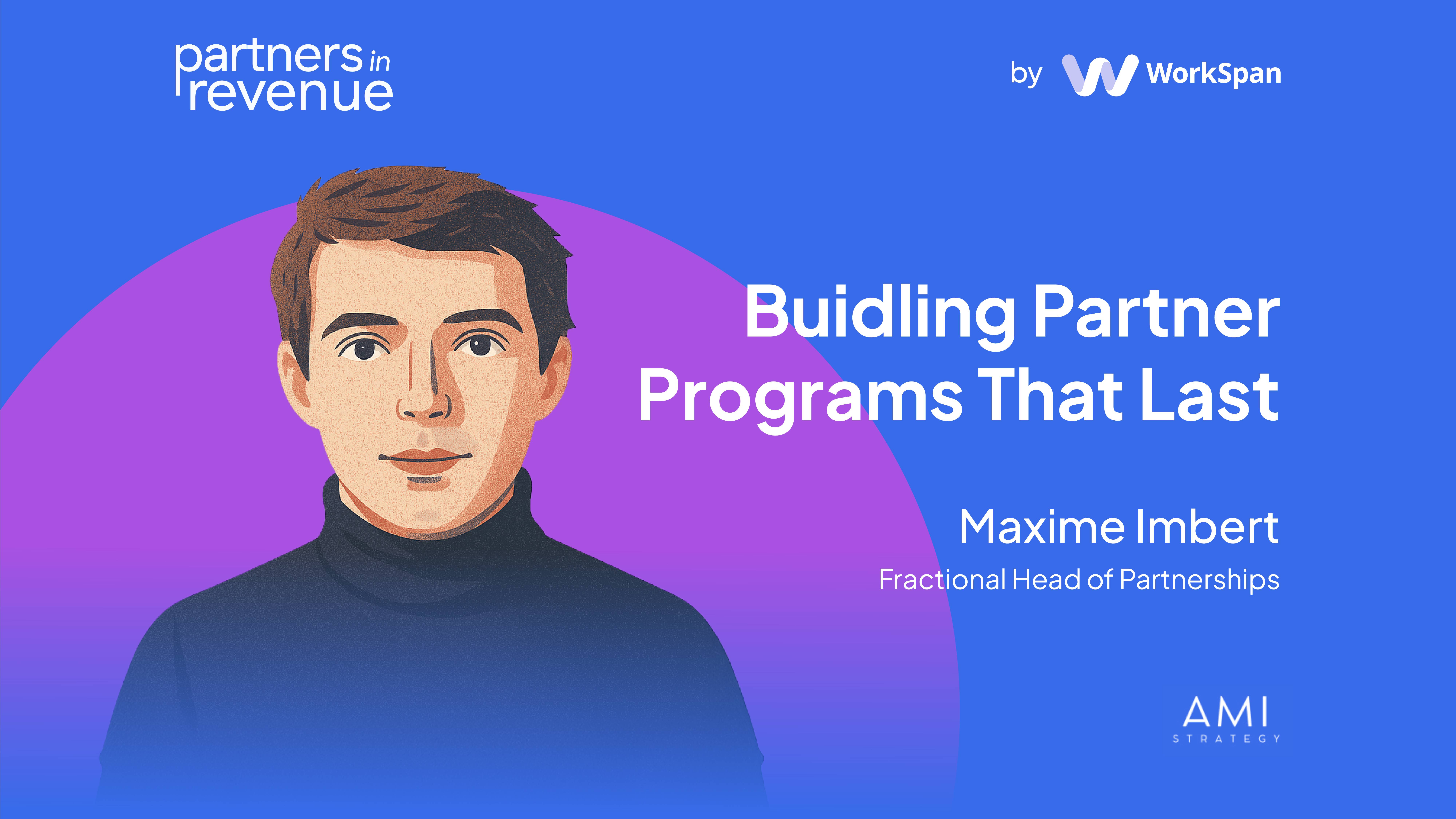
As a fractional head of partnerships at AMI Strategy, Maxime Imbert works with B2B SaaS and fintech companies to audit their partner programs, build the strategy, and generate the first revenue. Because he moves between companies, he has a clear view of where things can easily go wrong.
"Partnerships is also a sales job, but not only a sales job," Maxime says. "You have to work with many departments and if you don't have the right mindset, you get lost."
Here's what he's learned.
1. Set clear expectations with leadership
The most common mistake Maxime sees when he joins a new organization is unrealistic expectations around how quickly partnerships will produce revenue.
"Some of them are seeing a plateau in their growth and they want to accelerate," he says. "They say, okay, my competitor is doing 20 or 30% of revenue through strategic partnerships. I want the same and I want it fast."
He understands why. But his take is clear.
"If you expect 20 or 30% of growth through strategic partnerships in year one, that's a massive mistake. It could be possible in year two or three. But at the beginning, you must set the right expectations."
2. Gather input from the entire team
Before Maxime commits to a single partner, he spends time gathering information from every direction. He interviews the C-suite, spends time with their teams, and talks to customers, both those with a good NPS and those with a bad one.
"A very good question is to know which integrations they need before and after you," he says. "And when they name someone that comes before you, that's something very positive, because we know that if you're coming after a solution, they can refer you a lot of leads."
He also mines the CRM for signals that don't lie.
"You just take the CRM, have a look at the lost deals, and see if an integration is missing or if a competitor won a lot against you last year and why," he says. "All the information you can collect from the CRM is very positive because it can give you ideas on how to establish the partnership strategy."
From there, he builds a longlist of 100 to 200 potential partners, evaluates them on fit across ICP, pricing, and persona, and commits deeply to four or five.
"I just want to sign four to five partners and make sure that we succeed together," he says. "That's my only goal. And then once we have generated the first revenue, we can accelerate and scale the program."
3. Get internal alignment early and often
Getting buy-in from the CEO is a good start. But Maxime is clear that it's not enough.
"It's good to have the CEO, but you need to involve other departments like marketing, sales, customer success," he says. "You need to have the buy-in from the C-suite, but also internal alignment."
To build that alignment, Maxime holds biweekly one-on-ones with sales, customer success, and product. The conversations aren't just about partnerships. He tries to understand what each person is dealing with day to day and where he can help.
"I'm spending a lot of time with people, building trust, and making sure that I understand their daily business operations and see how I can help them," he says.
The goal is to make sure partnerships doesn't feel like a separate function that occasionally asks for things. He gives the example of speaking with a CFO about how partnerships could lower CAC, or with an operations leader about how an SI partner could save time on implementation.
"I'm working with them during weeks and months to make sure that partnerships is not seen as a department, but as a company strategy."
5. Communicate your partner strategy
Even when a partner program is well designed, it can quietly die if the people inside the organization don't know what's happening.
"You never communicate enough inside an organization," Maxime says. "Partnerships is not a department, it's a company strategy, and all the team must be involved."
In practice, this means making sure customer success knows which partners to highlight to customers, and that sales knows which integrations are available to bring into deals.
"Sales teams must know: we are working with this partner, so we can have this integration in store," he says. "It's a USP to have strong partners, and you must align them externally, but also internally."
For Maxime, internal communication isn't a one-time announcement. It's an ongoing part of the job, and one that's easy to deprioritize when things get busy.
"Spend time with your partners, but also spend time internally sharing and communicating what your partner strategy is," he says. "Always communicate. I think you never communicate enough."
The takeaway
Maxime's approach comes down to one core principle: go slow to go fast. Sign fewer partners, go deeper with them, and make sure the whole organization knows what you're doing and why.
"Sign a few partners, maybe three or four, but go deep with them," he says. "The results will be bigger than signing 50 or 100 partners in the first year."
The challenge is that even the best partner strategy breaks down when the operational infrastructure isn't there to support it. Tracking partner activity, surfacing the right intelligence to sellers, and keeping internal teams aligned across a growing program is hard to do manually. WorkSpan helps partner teams operationalize exactly this kind of motion, connecting partner data to seller workflows so the right plays happen at the right time, without relying on spreadsheets or tribal knowledge.