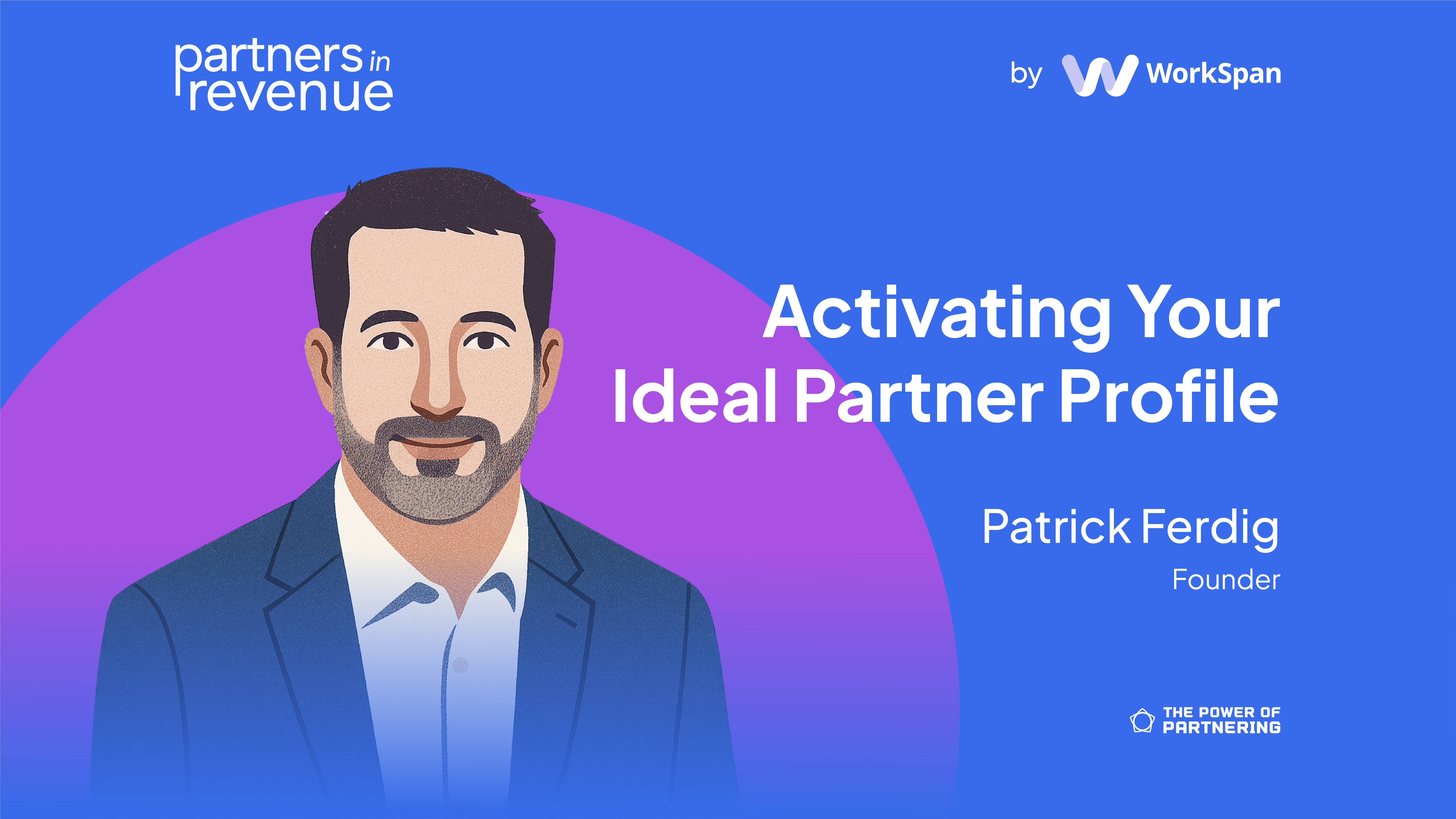
Most teams create an ideal partner profile once and never touch it again. Patrick Ferdig built an AI-powered framework that turns a static document into a living assessment engine, so partner teams can evaluate, prioritize, and engage partners consistently and at scale.
Every partner program starts with the same exercise: define the ideal partner profile. What verticals do they serve? What skills do they bring? How do they go to market?
It is an important exercise. For most teams, it is also the last time that document ever gets used.
Patrick Ferdig has spent 15 years building partner programs and ecosystems on the vendor side with SaaS companies in e-commerce and content management. Now, as the founder of The Power of Partnering, he helps organizations fix one of the most overlooked gaps in partner operations: the distance between defining your ideal partner and actually using that definition every day.
His approach uses AI to turn the IPP into a living operational tool.
The Document That Gets Stuck on a Shelf
The pattern is familiar. A program launches, the team defines what an ideal partner looks like, and the deliverable gets filed away.
"More often than not, it's a one-time exercise and that deliverable gets stuck on a shelf somewhere. It's not something that we utilize and activate on a day-to-day basis."
The consequences show up fast. Inbound partner requests arrive from website forms. Sales reps push for new partnerships to access specific accounts.
Without a consistent evaluation framework, partner managers have no basis to make objective decisions.
"If we don't have a basis to assess and evaluate, we don't have a basis to push back even if we think maybe that's not the best idea, maybe not the best partner for us."
The result is a partner roster that grows based on internal politics rather than strategic alignment.
"Just Kind of Holding Up a Thumb"
Partner teams operate with limited budgets, headcount, and technology support. Every partnership that does not deliver takes resources from the ones that could.
"Every logo we add to that website is going to consume more resources for me. It's opportunity cost. I'm spending time with partners that aren't going to deliver, that's taking me away from focusing on the ones who will."
Without an objective framework, every partner evaluation becomes a negotiation. A sales rep says they need a partnership. The partner manager has a gut feeling it is not the right fit. But a gut feeling is hard to defend.
"It makes it an objective assessment rather than just kind of holding up a thumb and calling it one way or the other as a partner manager."
The IPP already contains the answer. The criteria exist. What is missing is a system that applies them consistently, every time a decision needs to be made.
Patrick's Playbook for Activating the Ideal Partner Profile
Patrick has helped multiple organizations build AI-powered assessment workflows that turn a static IPP into a repeatable evaluation engine. The process follows a clear sequence.
1. Define Evaluation Criteria Around Three Core Categories
The foundation is getting the right evaluation categories in place. Patrick starts with three.
Target market alignment. "Do we really share the same target account framework? Are we going after the same market segment? Are we aligned from a vertical standpoint?"
Skill set. "If we believe they're going to drive a bunch of new business for us, do they even have those types of resources? If they're going to deliver a bunch of projects for us, do they have the right types of resources?"
Ecosystem affinity. "Do we have some natural affinity with other technologies and other partners? Is there a triangulation effect? Are we in the same ecosystems?"
2. Translate Your IPP into an AI-Consumable Format
Once the categories are defined in prose, the next step is converting them into a format AI can work with.
"The criteria have to be clearly articulated. And then you want to turn that into actually a scoring rubric as well. That's something that AI does very well. If you can give it a model to assess and score, you can get very interesting output."
This means moving from narrative descriptions to structured criteria with clear scoring dimensions. The rubric becomes the operating system for every evaluation.
3. Build an AI-Based Assessment Flow
With the rubric in place, the system does more than score. It gathers data, identifies gaps, and reaches out for missing information automatically.
"I've helped a couple organizations build out an AI-based flow that takes into account what we know about a partner, even goes back out as an agent to do the research, compiles all that information, and then assesses everything against what you've defined as that ideal profile."
This removes the bottleneck of manual research and subjective evaluation.
If your team is building partner evaluation into a repeatable system, WorkSpan helps embed partner intelligence and scoring into the workflows revenue teams already use. See how it works →
4. Run the Assessment on Both New Prospects and Existing Partners
Activating the IPP is not just about evaluating new requests. The same framework should cover the entire existing partner base.
"It's very hard and time consuming to do on a manual basis to gather the data, to do the scoring, to really create the assessment. And that's something that AI does very well."
Every partner gets evaluated against the same criteria. And because the framework is built for AI, it can be rerun whenever the strategy shifts.
"It gives you the ability to tweak that IPP year over year. Hey, we moved up market. Maybe we need to change the way we look at and define our ideal partners. Update the IPP, activate it again, and assess all of the current partners."
5. Make Partner Engagement the Measure of Activation
Identifying the right partners is only half the equation. The next challenge is making sure those partnerships produce real engagement.
"I'm a big believer in the fact that your partners, meaning all of the individuals within the organization that you partner with, rarely think about you. I believe partner engagement is a core metric we all need to be focusing on."
The default model of meeting a counterpart once a month and asking for leads does not create engagement. Neither does a newsletter.
"A lot of partner organizations have fallen back and they're just going to sign everybody up for a newsletter. That's not engagement. That's not relevant contact."
Real engagement means personalized, value-driven outreach to the individual reps, CSMs, and operators inside a partner organization. Patrick has seen organizations double their referrals within three months by making this shift.
What Changes When the IPP Becomes Operational
The outcomes compound over time.
Every partner evaluation becomes objective and defensible. "If I have an objective evaluation that I have published and socialized and shared, and let people know that this is how we go about making these decisions," Patrick says, the conversation changes entirely.
Resources concentrate where they matter. Partner teams stop spreading effort across logos that will never deliver and start investing in partnerships with the highest alignment.
The IPP becomes a living document. Moving upmarket, entering a new vertical, or expanding into a new cloud ecosystem all trigger a reassessment, not a rewrite.
And the shift from evaluation to engagement means the right partners are not just identified but activated.
Making Partner Evaluation Repeatable
Patrick's playbook shows what becomes possible when partner teams stop treating the IPP as a one-time exercise and start treating it as an operational system. The strategic thinking already exists. The evaluation criteria already exist. What changes everything is building a process that applies them consistently, scores partners objectively, and adapts as the business evolves.
For teams ready to activate their own IPP at scale, WorkSpan embeds partner evaluation criteria, scoring, and assessment workflows directly into the CRM systems sellers and partner managers already work in.
Ready to operationalize your partner motions? Book a demo to see how WorkSpan can help.
WorkSpan's series spotlighting expert partner leaders in the industry and the valuable insights and proven playbooks that helped them drive scalable. partner-driven revenue
Heading
Heading 1
Heading 2
Heading 3
Heading 4
Heading 5
Heading 6
Lorem ipsum dolor sit amet, consectetur adipiscing elit, sed do eiusmod tempor incididunt ut labore et dolore magna aliqua. Ut enim ad minim veniam, quis nostrud exercitation ullamco laboris nisi ut aliquip ex ea commodo consequat. Duis aute irure dolor in reprehenderit in voluptate velit esse cillum dolore eu fugiat nulla pariatur.
Block quote
Ordered list
- Item 1
- Item 2
- Item 3
Unordered list
- Item A
- Item B
- Item C
Bold text
Emphasis
Superscript
Subscript

%20(1).jpg)
%20(1).jpg)
%20(1).jpg)