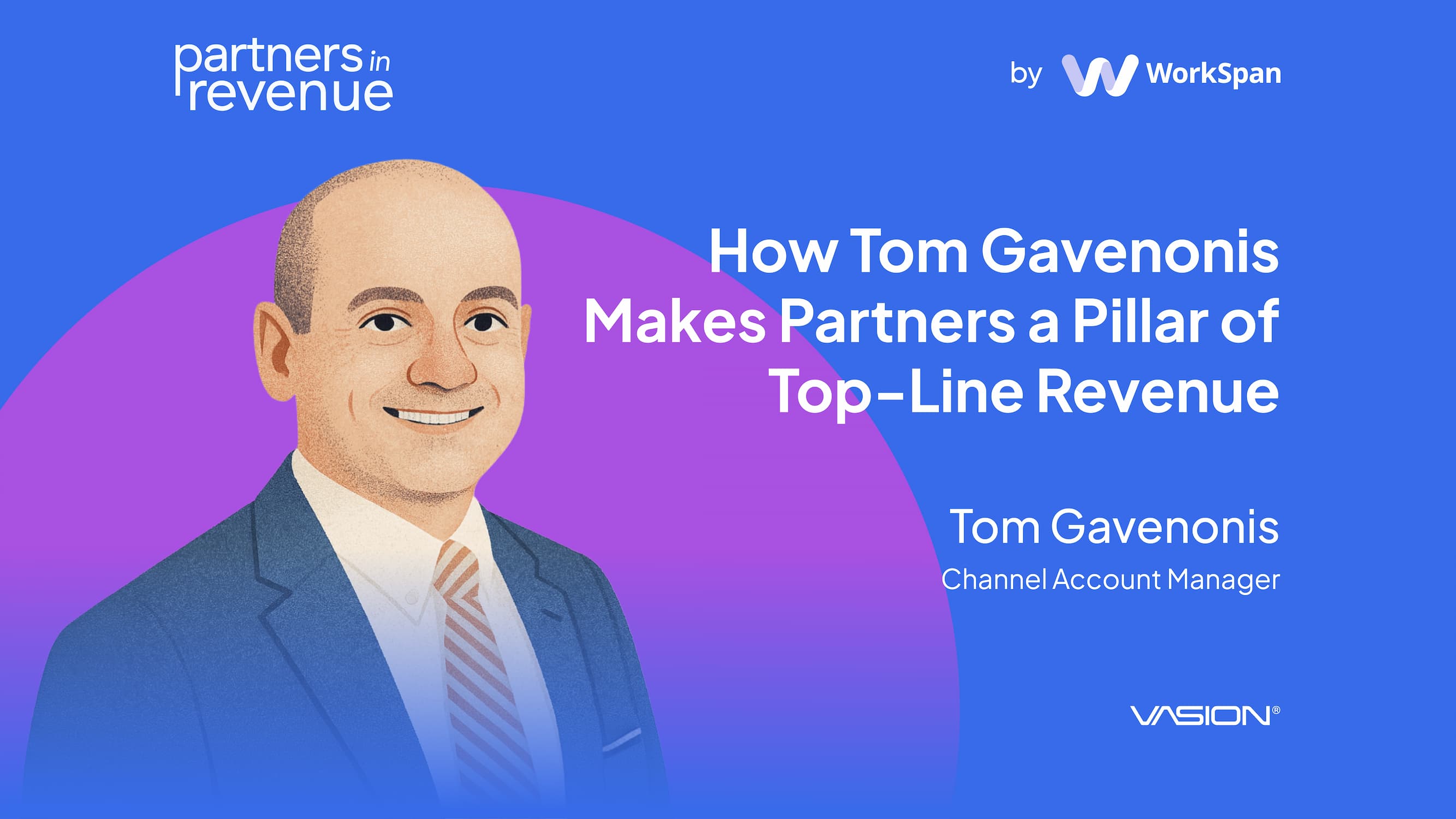
Tom Gavenonis, Channel Account Manager at Vasion, on what it takes to move partners from a side conversation to a core driver of revenue, drawn from years of building partner motions in the field.
For a long time, partnerships lived on the edge of the sales conversation. A logo on a slide. A relationship someone owned but few understood. A line item that got cut when the quarter got tight.
That era is ending. Across more and more sales organizations, partners have moved from a side conversation to a pillar of the number. Tom Gavenonis has watched the shift happen from inside the motion, and he is clear about what is driving it.
"I don't think that we will scale to the way that we want to as an organization unless we completely embrace how critical partners are to that success and to those growth objectives."
What follows is his view of the work that turns that belief into revenue: how to activate a partner's sellers and earn the trust that compounds, why showing up is still the most underrated strategy in the channel, and how partners move from a side conversation to a pillar of the number.
Activation Is the Job, Not the Agreement
Most teams treat a signed agreement as the finish line, but Tom treats it as the starting gun.
A partner's sellers are busy, quota-carrying, and rarely thinking about you. If you want them to position you, the burden is on you to make it effortless. That means handing them the customer profile in plain language, the moment to bring you in, the talk track, and the proof, with every reason to hesitate removed. Meeting them inside the tools they already use rather than asking them to get credentialed into your partner portal.
The goal is not to turn partner reps into experts on your product. It is to lower the activation energy until saying your name is the easy choice. That is also how a partner motion scales. Not by signing more logos, but by making the partners you already have able to act without thinking twice.
Activation only sticks, though, when it is backed by trust, and Tom's framing of trust is blunt: it is earned in drips and lost in buckets. You build it slowly through fast responses, follow-through, and small promises kept, then one missed handoff or ignored intro drains months of goodwill at once. That is why responsiveness is the whole game, not a nice-to-have. Reinforce the brand in the little things, close the loop fast even when the answer is not ready, and never let a warm handoff sit. People are hungry for that kind of commitment, and it is what earns the next opportunity.
Showing Up Is a Strategy
Ask Tom what actually drove growth, and he does not point to a program. He points to presence.
His team grew its CDW business 48% year over year, and the biggest reason was showing up. Partner work in the field looks closer to guerrilla warfare than to a clean playbook. It happens in branch offices, on ride-alongs, and in hallway conversations, earning attention one rep at a time. None of it scales neatly in a spreadsheet. All of it compounds.
The partner who is there when the opportunity appears is the one who wins it. The one waiting for inbound is invisible. Presence, repeated until the message sticks across the organization, is what turns a relationship into a number.
From Side Conversation to Revenue Pillar
Put activation, trust, and presence together, and you get the shift Tom sees across the industry: sales leaders are embracing partners as a pillar of top-line revenue.
The hard line between direct and partner selling is disappearing. A large share of business now runs through the channel, and the sellers who win are the ones who move fluidly across both motions. Reps who once resisted co-sell now ask for it, usually after closing a deal they could not have won alone.
Sustaining that belief means measuring partner influence honestly. A single partner-influenced deal can carry 8 to 12 touchpoints before it closes — an intro, a reference, a warm handoff, a co-sell call — and the partner who helped may not be the one who books the win. Compress all of that into a last-touch line of credit and you will be wrong every time. Partners rarely win the deal alone; they make it winnable, and the teams that measure that honestly are the ones that keep earning investment.
"All of our sales leaders are embracing this pillar of partners as a key piece of top-line revenue, of generating that pipeline."
That change does not happen by accident. It happens when partner teams do the unglamorous work of activation, protect trust like the asset it is, measure their influence with honesty, and keep showing up.
The Operating Layer Behind a Partner Motion
The pattern underneath Tom's entire approach is a shift from activity to system. Activation, trust, presence, and honest measurement only scale when partner intelligence reaches every seller, not just the reps a partner manager has time to brief.
That is the gap WorkSpan closes. WorkSpan embeds partner intelligence and co-sell workflows directly into CRM, so the work Tom describes, activating partner sellers, tracking real influence, capitalizing on every win, and focusing on the highest-potential opportunities, becomes repeatable infrastructure across every seller, account, and deal.
Ready to make partners a pillar of your top-line revenue? See how WorkSpan operationalizes partner revenue →
WorkSpan's series spotlighting expert partner leaders in the industry and the valuable insights and proven playbooks that helped them drive scalable. partner-driven revenue
Heading
Heading 1
Heading 2
Heading 3
Heading 4
Heading 5
Heading 6
Lorem ipsum dolor sit amet, consectetur adipiscing elit, sed do eiusmod tempor incididunt ut labore et dolore magna aliqua. Ut enim ad minim veniam, quis nostrud exercitation ullamco laboris nisi ut aliquip ex ea commodo consequat. Duis aute irure dolor in reprehenderit in voluptate velit esse cillum dolore eu fugiat nulla pariatur.
Block quote
Ordered list
- Item 1
- Item 2
- Item 3
Unordered list
- Item A
- Item B
- Item C
Bold text
Emphasis
Superscript
Subscript

%20(1).jpg)
%20(1).jpg)
%20(1).jpg)