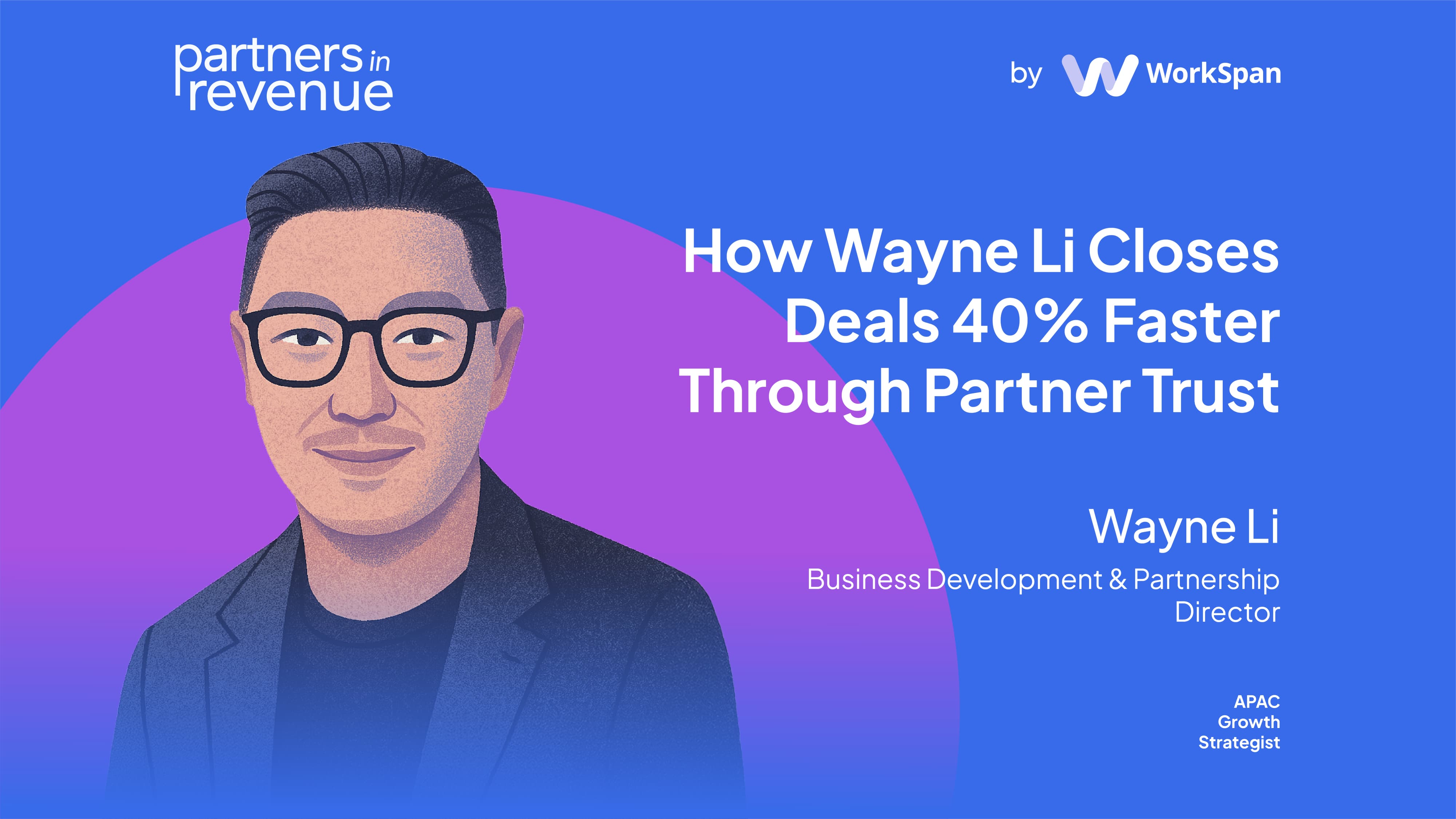
Wayne Li is a Business Development & Partnership Director and APAC Growth Strategist who has scaled regional expansions across Indonesia, Thailand, Malaysia, and Vietnam. His approach to ecosystem-led GTM unsticks the most complex deals by treating partners as the trust layer the global playbook can't replicate.
The standard global GTM playbook assumes that if you've nailed product-market fit and built a competitive pricing strategy, the rest is execution. In most APAC markets, that assumption breaks before the first sales call.
Wayne sees this every time a new technology tries to enter a market like Thailand. The deal doesn't stall because the product is wrong. It stalls because three invisible walls block the buyer from ever reaching a serious conversation with the seller.
He's built a partner-led GTM model that systematically gets through those walls. It starts with diagnosing what's actually blocking the deal, replaces price-pushing with trust transfer, and uses local partners as the operational layer that makes the rest of the motion work.
Why Global Playbooks Stall in APAC
Most teams treat APAC as a region where standard outbound just needs to be louder, more localized, or more aggressive. Wayne's experience contradicts that.
"Even if you have a very solid product-market fit, you've got the right pricing strategy, we will hit what we call the invisible walls."
Those walls have nothing to do with the product. They have everything to do with how trust, communication, and internal priorities work in markets where the rep is operating as an outsider.
Three of them show up consistently.
1. The Trust Gap
Most global tech companies expand into APAC with lean teams based out of Singapore. There's no local office, no local accountability, and no one a buyer can find if something goes wrong.
"As a global brand, when there's no local office, our team is pretty lean. Our sales team based in Singapore, we expand into Thailand. Buyers are afraid that if anything goes wrong, I couldn't find a local person to hold accountable."
That fear is structural. It doesn't get fixed with a better deck.
2. The Communication Gap
Even with English-fluent buyers, key context gets lost in translation, and the real decision maker often isn't who the org chart says it is.
"A lot of times when you speak to a Thai in English, they might not understand you, but they keep nodding. The information actually gets lost in translation."
The deeper issue: the real gatekeeper often doesn't appear on the org chart at all. In family-led Thai organizations, the owner above the CEO calls the shot, often only speaking Thai. Without a local partner inside the relationship, the seller never finds them.
3. The Internal-Priority Gap
Even when the product fits and the relationship is warm, there's still an invisible competitor the seller never sees.
"Resources are quite scarce in the organization, especially the tech team. We are not competing with other competitors. We're actually competing with the existing relationship internally."
The buyer's tech team already has a roadmap. That roadmap is owned by someone they trust. Until the seller can show how the new product unblocks something on that internal list, the deal sits in a polite holding pattern.
The Discount Trap
The most common mistake Wayne sees is reps responding to deal friction with the wrong lever: more aggressive outreach and bigger discounts.
"I'll send email telling them I offer them 20% discount. I keep on sending emails, but it doesn't work. Even you offer a 20% discount, it doesn't really solve the risk. And only trust does."
In Western contexts, persistent follow-up reads as professional drive. In Thailand, it reads as something very different.
"They might think this is called persistence, but to them, this is actually called lack of respect. You don't respect my time. I silently reject you, but yet you keep on pushing."
The discount is worse. It actively damages the seller's position.
"Pushing price is not gonna solve the issues itself. It is actually devaluing your brand. It makes you look desperate. You don't look like a strategic advisor. You're just devaluing yourself." — Wayne Li
The takeaway: when the deal is stuck in APAC, the rep's instinct to lean harder on the standard global playbook usually makes the situation worse, not better.
Wayne Li's Playbook for Unsticking APAC Deals
Instead of pushing harder, Wayne's model is to step back and let a local partner carry the relationship into rooms the seller can't access alone.
1. Treat the Partner as Robin, Not as a Channel
Wayne uses a clear mental model for how the relationship between the seller and the local partner should work.
"You probably is a Batman who owns the thing, but you definitely have Robin to help you as a sidekick who can speak the language of theirs and help you to be wary of what exactly is the involvement, what is lacking behind you."
The seller still owns the product, the strategy, and the commercial relationship. The partner owns the room. They handle cultural translation, surface internal context, and quietly reposition the deal in conversations the seller will never sit in.
2. Use Partners for Intel, Not Just Introductions
A warm intro is the lowest-value version of partner help. Wayne uses partners as the operational intelligence layer for the entire account.
"They know the company inside out. They know the people who is pregnant, who is not, who's taking maternity leave. You can actually speak to someone else instead. You need that intel where they can identify who exactly is capable."
That same partner relationship surfaces the real gatekeeper, including the owner who outranks the CEO and only speaks Thai. Without that, the seller can spend months pushing emails to people who never had decision authority in the first place.
3. Go Top-Down Through Trusted Endorsement
Once the partner has built credibility inside the account, the path through procurement changes shape entirely.
"With the right partners, we actually top-down approach. We spoke to the bosses through our partners. You actually bypass months of documentation vetting, because the trust from the partner was being transferred to us. And we actually close the deal 40% faster than average."
That's not a sales rep working harder. That's trust moving from one relationship into another, with the partner doing the work that procurement and security review would otherwise gate for months.
4. Treat Partner Endorsement as the Most Credible Asset You Have
Wayne is direct about the relative weight of partner-driven proof versus sales-led proof.
"When a partner says this is a product that I can trust to a potential customer, it actually holds 10 times more weight than any sales deck. Whatever sales that you put, all the different case study, it happens. But whether it applies to me or not, no one knows. Unless you have someone like a partner who actually comes in and says, look, I enjoy this product itself."
In high-contract-value APAC markets, that's not a tactic. It's the license to operate.
"When you do business in the West, we sell to a business. But in APAC, we sell to a person, through a person." — Wayne Li
5. Operate the Partner Relationship as a Real Process
Wayne's partner motion isn't loose. It runs through a structured pattern.
He works with senior business consultants and referral partners who already sit inside the account. They follow a checklist for what intel they pass back, how they introduce, and how they participate in early meetings. After the informal introduction, the seller takes over the product conversation while the partner stays active behind the scenes, influencing decision makers and reinforcing trust top-down.
The result: the partner is not a lead source. The partner is the trust transfer mechanism that makes every other GTM motion in the account work faster.
Why This Approach Compounds
By replacing brute-force outbound with partner-led trust transfer, Wayne avoids the cycle that traps most APAC GTM teams: more outreach, more discounts, more cultural friction, slower deals.
His framing for why this works in non-English-language markets is direct.
"It's very important to have partners so that they can provide us as social proof. It's not a nice to have. It's a kind of license you must have."
The 40% faster close cycle on the Thai enterprise deal isn't an isolated case. It's the predictable outcome of building the partner motion as the primary GTM motion, not as a side channel.
Want to operationalize partner-led GTM across your APAC pipeline? See how WorkSpan makes it systematic →
Turning Partner-Led GTM Into a Repeatable Motion
Wayne's playbook reinforces a reality every GTM team eventually faces in APAC: the deals don't get unstuck through the seller working harder. They get unstuck when a trusted local partner is operating inside the account with the right context, the right relationships, and the right intel.
The challenge isn't recognizing this. It's making it repeatable. Most teams build partner-led motions one heroic relationship at a time, with no shared visibility into where each partner is most useful, what intel they've surfaced, or which deals they're actively unsticking.
WorkSpan helps partner teams operationalize exactly this: turning partner relationships into measurable revenue motions, embedding partner intelligence into seller workflows, and giving partner managers the visibility to scale the motion across regions, accounts, and partner types.
See how WorkSpan helps partner teams turn ecosystem trust into measurable pipeline →
WorkSpan's series spotlighting expert partner leaders in the industry and the valuable insights and proven playbooks that helped them drive scalable. partner-driven revenue
Heading
Heading 1
Heading 2
Heading 3
Heading 4
Heading 5
Heading 6
Lorem ipsum dolor sit amet, consectetur adipiscing elit, sed do eiusmod tempor incididunt ut labore et dolore magna aliqua. Ut enim ad minim veniam, quis nostrud exercitation ullamco laboris nisi ut aliquip ex ea commodo consequat. Duis aute irure dolor in reprehenderit in voluptate velit esse cillum dolore eu fugiat nulla pariatur.
Block quote
Ordered list
- Item 1
- Item 2
- Item 3
Unordered list
- Item A
- Item B
- Item C
Bold text
Emphasis
Superscript
Subscript

%20(1).jpg)
%20(1).jpg)
%20(1).jpg)