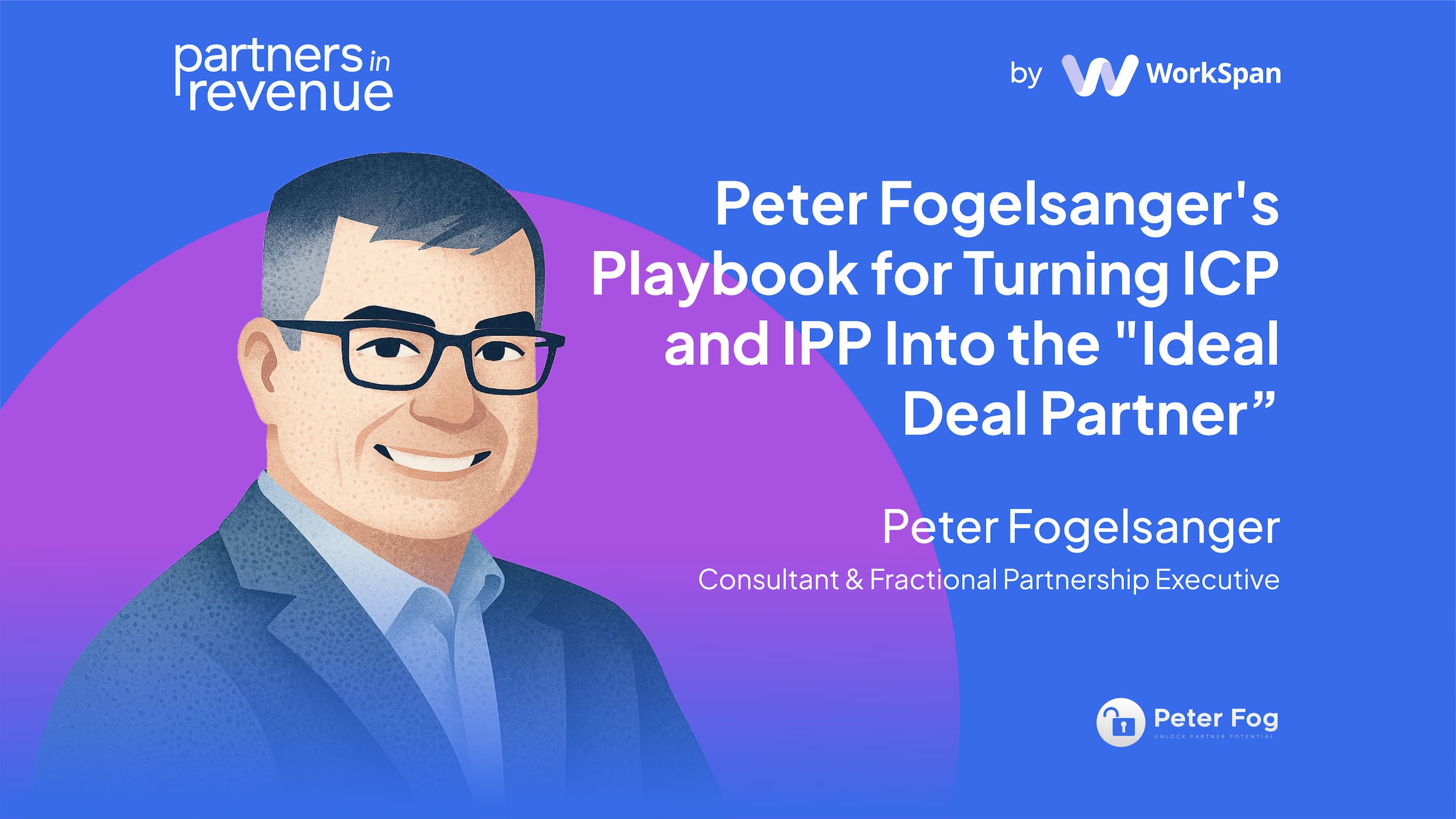
Peter Fogelsanger, Consultant & Fractional Partnership Executive at Peter Fog LLC, shares the operating model he uses to move partner programs from static lists to deal-level activation.
Most partner programs were built for a world where the answer to "who should we partner with?" was settled once a year in a slide deck. Peter Fogelsanger thinks that world is gone.
"We have ICPs. We have IPPs. We have not built the systems to operationalize either of them at the deal level."
As Consultant & Fractional Partnership Executive at Peter Fog LLC, Peter has spent years inside the gap between partner strategy and partner execution. The strategy is well understood. The execution is not.
His core argument is that the next generation of partner programs will not be defined by who you partner with. It will be defined by whether your sellers know which partner to bring into which deal at the moment that deal appears in pipeline.
What follows is the operating model he uses to close that gap, and the case for why most partner organizations are about to be rebuilt around it.
Why Most Partner Programs Stall at the Deal Level
The most common failure Peter sees is not a lack of partner strategy, but rather a lack of partner execution.
Companies invest heavily in defining who their ideal partners are. They publish IPP frameworks. They tier their partners. They sign MOUs. And then a deal lands in pipeline and the seller has no idea which partner to engage.
“Most partner programs end at the IPP. The seller's workflow is where the program is actually supposed to start.”
The result is what Peter calls the "paper partner" problem. The partner directory is full. The dashboard shows growth. But the deal-level data tells a different story: a small number of partners are responsible for almost all of the revenue, and the seller's pipeline doesn't reflect any partner intelligence at all.
"Paper partners don't drive revenue. Activated partners do. And the only way to activate a partner is to put them in the right deal at the right time."
From ICP to IPP to the Ideal Deal Partner
Peter has a name for what he believes is missing: the Ideal Deal Partner, or IDP.
"We need a system that can automatically identify an ideal deal partner the moment an opportunity is created."
The IDP is not a category, it’s a per-deal answer. For this customer, in this segment, at this stage, with this set of objections, which partner gives the seller the highest probability of winning?
Peter argues that this is the question the seller actually needs answered, and the question that no current partner ops process answers in real time.
“ICP tells you who to sell to. IPP tells you who to partner with. IDP tells you which partner to bring into this specific deal. You need all three.”
The shift from IPP to IDP is the shift from a static list to a real-time recommendation. It is the shift from a partner directory to partner intelligence embedded inside the seller's workflow.
Peter Fogelsanger's Playbook for Operationalizing Partner-Led Growth
With the IDP as the operating frame, Peter's approach comes down to four operating priorities: protecting the first deal, separating paper partners from activated partners, embedding partner intelligence at the point of decision, and using AI to close the operationalization gap.
1. Protect the First Deal Like It's the Whole Relationship
Before any system or framework, Peter starts with what he calls the trajectory problem.
"The first deal you close with a new partner sets the trajectory for everything that follows. If it goes well, you get the next ten. If it goes badly, you don't get a second one."
Most partner programs don't treat the first deal differently than any other deal in pipeline. Peter argues this is the most common and most expensive mistake in partner ops.
"It's not a transaction. It's an audition. The partner is betting their reputation on whether your team can execute. If you make them look bad in front of their customer, no QBR cadence is going to repair that."
The fix is operational. Peter recommends a different motion for first deals: tighter communication cadence, executive sponsorship on both sides, and a structured debrief regardless of outcome.
“Win or lose, do a debrief. The deal is finite. The relationship is what you're actually building.”
2. Separate Paper Partners From Activated Partners
The second priority is measurement honesty. Peter pushes partner leaders to stop counting signed partners and start counting activated ones.
"Most partner dashboards are vanity metrics. Logos, agreements, MOUs. Almost none of it correlates with revenue."
He defines an activated partner narrowly: a partner with a closed deal in the last 90 days, or a partner with a current opportunity in pipeline that the seller is actively co-selling. Everything else is paper.
“If your top ten partners are responsible for 80% of partner-sourced revenue, your real partner program is ten partners. The rest is noise.”
This is not a license to shut down the rest of the program. It is a redirection of where the partner team's time should go. Peter argues that most partner organizations spend disproportionate time managing inactive partners and not enough time deepening the activated ones.
The data, when teams actually segment it, almost always tells the same story. A small group of partners produces most of the revenue, and the relationships that produce it are the ones that get the most operational attention.
3. Embed Partner Intelligence in the Seller's Workflow
With the activated partners identified, Peter's next move is structural. Partner intelligence has to live where the seller actually works.
"Partner ops can't be a Slack channel and a Notion doc. The seller needs the right partner surfaced inside the CRM record at the moment they're working the deal."
He draws a hard line between a partner directory and partner intelligence. A directory is a list of who you work with. Intelligence is a real-time recommendation that maps the deal to the partner most likely to help win it.
“Partner attribution comes after the fact. Partner activation has to happen before the deal is lost.”
This is where most partner programs underinvest. The IPP work happens in strategy. The MOU work happens in legal. The activation work has to happen in the CRM, and most partner orgs don't have the tooling or the ops process to make that real.
The companies that get this right, Peter argues, will look operationally different from the companies that don't. Their sellers will see a partner recommendation alongside the customer record. Their partner teams will track activation by deal, not by directory.
WorkSpan embeds partner intelligence, co-sell workflows, and attribution directly into CRM, helping partner teams operationalize the IDP at the deal level. See how →
4. Use AI to Match the Right Partner to the Right Deal
The fourth priority is where Peter believes the next decade of partner ops will be won.
"Use AI to surface the right partner the moment a deal appears in your pipeline."
Peter's argument is that the IDP problem is fundamentally a matching problem, and matching at scale is what AI does best. A seller working a mid-market healthcare deal in the Northeast doesn't need a partner directory. They need an answer.
"Great agents, great LLMs, perfect application for co-selling. Match the partner to the deal at the moment of opportunity creation."
This is not a future-state vision in his view. It is operationally viable now, and the partner organizations that build it first will compound their advantage faster than the ones that stay on static lists.
“The goal isn't a smarter directory. The goal is a system that tells the seller, on this deal, here is the partner most likely to help you win.”
The economics of this shift, Peter argues, are not subtle. Activated partners produce larger deals, faster cycles, and higher win rates. If AI can move more deals from "no partner attached" to "the right partner attached," the impact compounds across the entire partner-sourced book.
What Operationalized Partner-Led Growth Produces
When the operating model is in place, Peter argues, the metrics that matter shift fundamentally.
The conversation moves away from logos signed and toward partners activated. Away from partner directories and toward deal-level recommendations. Away from quarterly partner reviews and toward real-time partner intelligence inside the seller's CRM.
"Once you operationalize the IDP, the seller stops treating partners as a separate motion. The partner becomes part of how they win the deal."
This is the shift Peter believes the next generation of partner organizations will be measured on. Not how many partners they have. Not how well-defined their IPP is. But whether their sellers, on every deal, know which partner gives them the best chance of winning, and have that partner surfaced where they work.
“Channels help you close deals. Operationalized partnerships build the company.”
WorkSpan helps partner and revenue teams move from static partner lists to deal-level partner intelligence, embedding the IDP directly into the seller's workflow. See how it works →
Peter Fogelsanger is a Consultant & Fractional Partnership Executive at Peter Fog LLC. He advises partner and revenue teams on operationalizing partner-led growth, with deep experience building and scaling partner programs across the B2B SaaS ecosystem.
WorkSpan's series spotlighting expert partner leaders in the industry and the valuable insights and proven playbooks that helped them drive scalable. partner-driven revenue
Heading
Heading 1
Heading 2
Heading 3
Heading 4
Heading 5
Heading 6
Lorem ipsum dolor sit amet, consectetur adipiscing elit, sed do eiusmod tempor incididunt ut labore et dolore magna aliqua. Ut enim ad minim veniam, quis nostrud exercitation ullamco laboris nisi ut aliquip ex ea commodo consequat. Duis aute irure dolor in reprehenderit in voluptate velit esse cillum dolore eu fugiat nulla pariatur.
Block quote
Ordered list
- Item 1
- Item 2
- Item 3
Unordered list
- Item A
- Item B
- Item C
Bold text
Emphasis
Superscript
Subscript

%20(1).jpg)
%20(1).jpg)
%20(1).jpg)