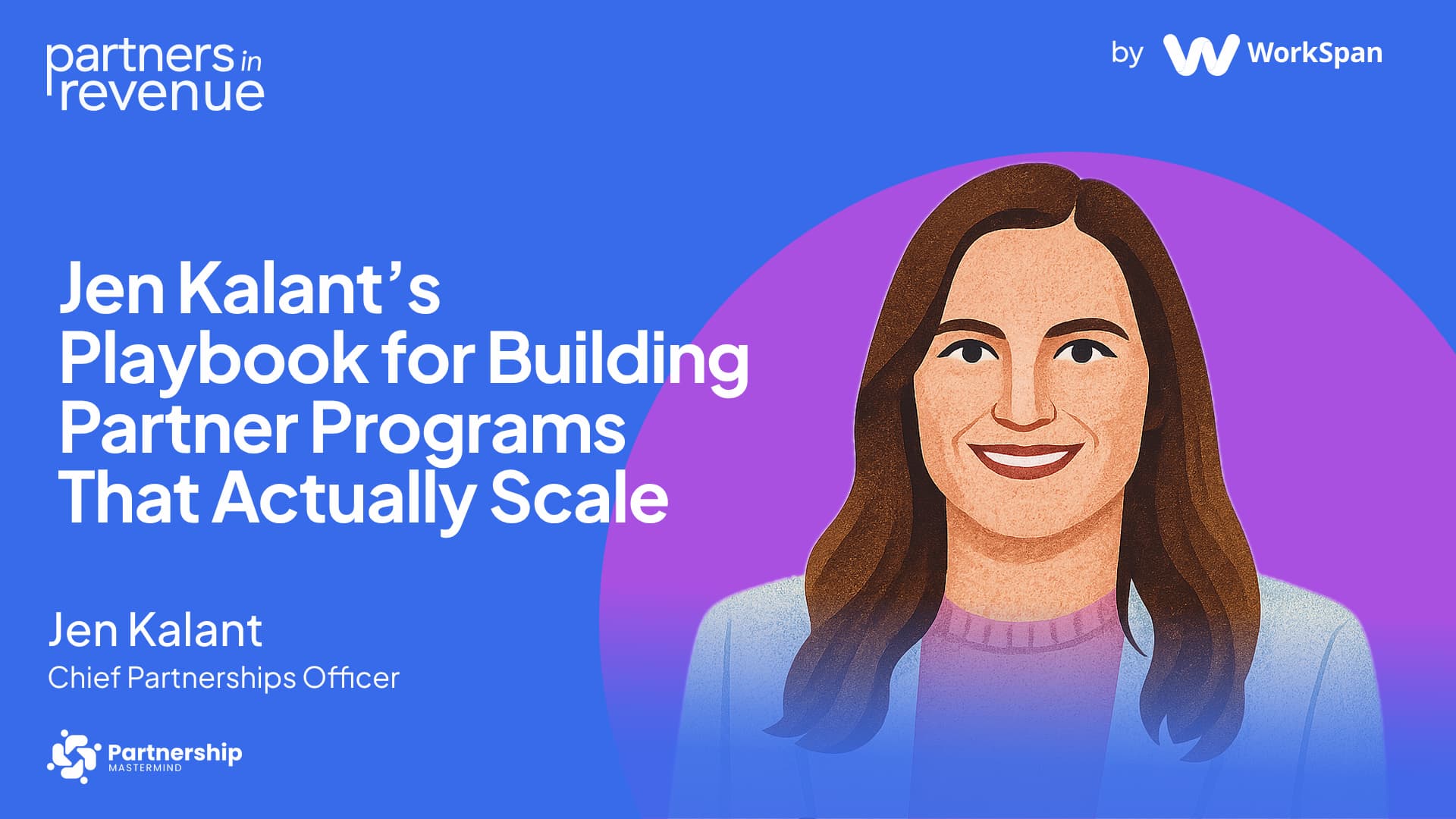
Jen Kalant's Playbook for Building Partner Programs That Actually Scale
Pick one motion, build the infrastructure behind it, then activate. Why the unglamorous work is what drives referrals.
A B2B software company at about $20 million in ARR watches its direct sales growth start to flatten. Internal teams push for a more meaningful channel program. There's no full-time partner role yet. A few people in sales handle partners on the side, and a handful of founder-led relationships sit in the mix. The big question on the table: do we go hire a VP of Partnerships?
It's a familiar moment, and it's where a lot of programs go wrong. Jen Kalant has a different sequence.
Kalant is Chief Partnerships Officer at Partnership Mastermind, where she also leads advisory, fractional, and partner talent placement services. She brings almost 15 years of B2B software partnerships experience across industries and go-to-market motions, and a very structured framework for building partner programs that last.
Start with your numbers
Kalant's first piece of advice is simple: know your numbers. The profession has moved away from loose, less numbers-focused KPIs over the last decade, and she has always been held to pipeline, revenue, and business impact targets.
"Really truly understanding, whether you're a team of one or on a team of multiple partner professionals, what your book of business within that partner team or your total partner business looks like within the total organization. What is the impact that you're making, and what does that impact mean to the total organization?" — Jen Kalant, Chief Partnerships Officer, Partnership Mastermind
That understanding shapes your talk track to leadership and to every other business unit you need on your side.
Launch one go-to-market motion first
Back to the $20M ARR company. Instead of answering the hiring question right away, Kalant's team ran a full diagnostic: direct sales, marketing funnels, and the existing partnerships that had never been formally structured. How were they managed? What value proposition, if any, had been put forward? The goal was to find the North Star and a simple path toward it, because of a pattern Kalant sees constantly.
"I think a lot of organizations jump into partnerships, and they're like, 'Okay, we have three different go-to-market motions. We're gonna have referral partners or channel. We're going to have our tech and integration partners. Then we'll have service partners or solution partners. And we're gonna launch all three at one time.'"
That works if you're ready to invest in a full team. Most early-stage companies aren't.
"When you're smaller and you don't have that team, you really need to figure out what's going to be the most impactful from a business standpoint first, and launch that go-to-market motion first and foremost, and then you can expand."
For most companies, Kalant says that first motion is a referral program, because it's the lowest lift and the fastest path to revenue. Integration partnerships come next, unless there's an immediate technology gap to fill.
Month one: treat partnerships as a banner across the business
Kalant's advisory work runs on a 90-day view. Month one is an audit, starting with stakeholder interviews across sales, marketing, leadership, product, and RevOps to learn what tools and bandwidth the partner team will really have.
It's also where she reframes a common early-stage debate: does partnerships belong in sales or marketing?
"Partnerships truly is like a banner that sits across your organization. It's going to touch every piece of your organization eventually."
It can report into either, but executives need to see its impact on product strategy, marketing plans, demand gen, and RevOps. Month one also includes a competitive landscape audit, and all of it feeds the decision on the initial go-to-market motion.
Month two: build the infrastructure before you sign 30 partners
This is the step clients most want to skip. Even teams with existing partner programs tell Kalant, "We have that already, let's jump into the meat." Her answer is to walk the full partner lifecycle anyway.
"Think through operationally, step by step, the entire partner journey with you, from initial outreach when you're prospecting into a prospective partner, into recruiting that partner, signing them up, onboarding them, activating them, and how you grow strategically with them. All of that has to have the actual operations, collateral, messaging, workflows built behind it to operate."
Too many teams, she says, dismiss the power of having that built before they go off and sign 30 partners. Month two builds it: messaging and workflows, in close collaboration with marketing and RevOps, so the end-to-end journey stands before the first new partner conversation.
Month three turns that structure into activation. If there's a team, train them. If there's one or two people, make sure they can actually carry the workload.
→ WorkSpan: Kalant's lifecycle view is the same one WorkSpan is built around. When the workflows for onboarding, activation, and co-sell live in a shared system tied to your CRM, a small partner team can run the motion at scale, and every partner touch shows up as attributable pipeline instead of a side spreadsheet.
Co-sell starts small and sets the stage
Once the motion is chosen, how do you get co-sell going? Kalant starts with the basics. If it's a referral partner, how are you collaborating on account mapping? What's the joint value proposition, even without an integration? If the partner offers consulting or agency services on top of your technology, how do you build a message around that and take it to a joint prospect list and to each other's customer bases?
"If you can start just initiating and activating the referral partners with light account mapping and touch base email campaigns into each other's bases, talking to each other's customer success teams that own and support those client relationships, and start to build co-sell pipeline in that motion first, oftentimes that's going to really set the stage to then do further marketing campaigns."
The bigger campaigns come later. They work better because the groundwork is already there.
Cookies for lawyers, and a 40x lift in referrals
One of those campaigns came from Kalant's time leading partnerships for a large legal practice management system, whose ICPs worked in office at large law firms.
"The one thing that lawyers do not get, they do not get fed by law firms."
Software teams get snacks and catered lunches. Law firms, whatever their size, usually offer a shared coffee pot. So her team sent co-branded cookies.
"Sounds really archaic to send direct mail, but when it's something tangible like that, it actually was really impactful."
The percentage of referrals from those partners increased by 40x. Kalant credits putting a well-known brand next to the partner's, a joint message on why the technology and the partner's services complemented each other, and covering what partners couldn't do alone with MDF, shared costs, and the marketing infrastructure to execute.
The leads from the campaign were only part of the return. The bigger effect was compounding.
"That's where we saw the compounding effect of referral generation, because the partners were then truly bought into the relationship. They were activated. They understood how much we were putting forward into the relationship and how much value they could see from it."
Once partners were bought in, referrals started coming in on a regular basis.
Thirty days, ten percent
The usual objection is time. Kalant's answer: it's not six months, or even the full 90 days. Thirty days is enough to audit the program and competitors, confirm your motions fit your business and market right now, and walk the full partner journey.
That review is also where she looks at AI.
"Where you can take the manual work out, leveraging that AI, so that you can spend more time doing the fun partner activations that drive deeper, meaningful relationships with those entities."
After spending 30 days on that work and activating it in months two and three, Kalant's team has started to see a 10% increase in the overall business impact from partnerships. When partners already drive anywhere from 5% to 40% of a company's business, that's a meaningful gain for a month of focus.
"It's worth that time in the long run. It's just oftentimes we don't wanna take that time."
The through-line
Kalant's playbook is about sequence. Know your numbers. Choose one motion instead of launching everything at once. Build the full lifecycle before signing partners. Then activate with light co-sell and earn the right to bigger campaigns that turn partners into true believers. None of it is flashy, but it's what separates a partner list from a partner program that drives revenue.
→ WorkSpan: The partner activations Kalant describes, account mapping, joint messaging, co-marketing that drives referrals, work best when they reach sellers in their flow of work and land as attributed pipeline in the CRM. WorkSpan helps partner teams run those co-sell plays at scale, with AI handling the manual work so people can focus on the relationships.
Jen Kalant is Chief Partnerships Officer at Partnership Mastermind, where she leads partnerships and professional services, including advisory, fractional, and partner talent recruitment and placement. She brings almost 15 years of B2B software partnerships experience across industries and go-to-market motions. Thanks to Jen for sharing her playbook with WorkSpan.
WorkSpan's series spotlighting expert partner leaders in the industry and the valuable insights and proven playbooks that helped them drive scalable. partner-driven revenue
Heading
Heading 1
Heading 2
Heading 3
Heading 4
Heading 5
Heading 6
Lorem ipsum dolor sit amet, consectetur adipiscing elit, sed do eiusmod tempor incididunt ut labore et dolore magna aliqua. Ut enim ad minim veniam, quis nostrud exercitation ullamco laboris nisi ut aliquip ex ea commodo consequat. Duis aute irure dolor in reprehenderit in voluptate velit esse cillum dolore eu fugiat nulla pariatur.
Block quote
Ordered list
- Item 1
- Item 2
- Item 3
Unordered list
- Item A
- Item B
- Item C
Bold text
Emphasis
Superscript
Subscript

.jpg)