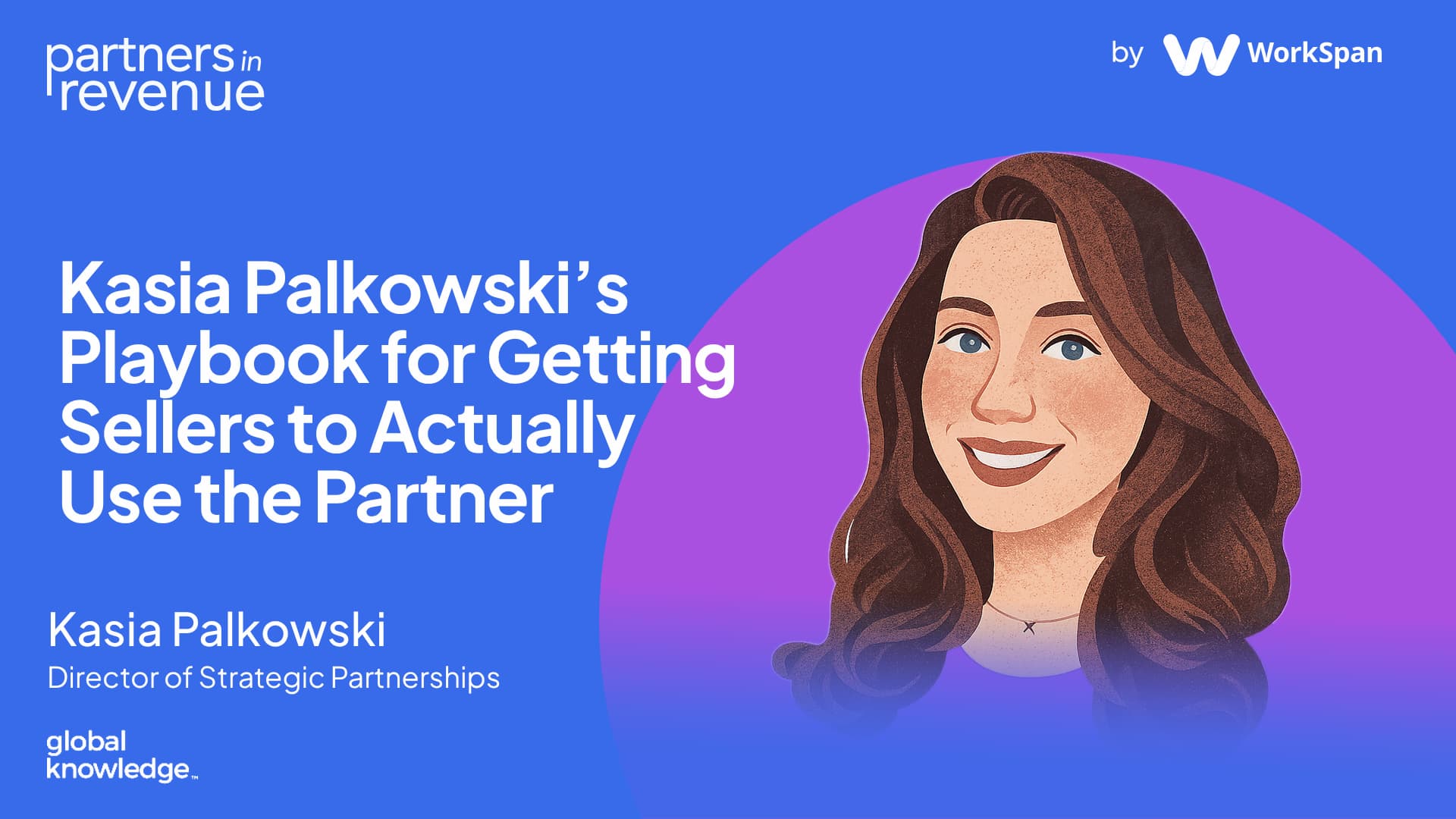
Kasia Palkowski's Playbook for Getting Sellers to Actually Use the Partner
A partner-registered deal isn't just a lead. Here's how to make sure your sales team knows it.
A partner registers a deal. The partner manager makes the intro. The rep gets on the call, sees a fresh opportunity, and starts asking about everything the product could possibly do. The partner already told everyone what the customer needed. Nobody listened.
Kasia Palkowski has watched that scene play out more than she'd like. Before becoming Director of Strategic Partnerships at Global Knowledge, she spent five to six years running software partnerships at Vena, a Toronto-based software company, where she sourced $2.5 million in partner-sourced revenue and made President's Club three times in a row. It was, in her words, "a very sales-focused partner world."
That world taught her that the hardest part of partnerships is often inside your own building. Getting a partner to send a deal is one thing. Getting your sellers to use everything that partner brings with it is another.
The problem: sellers see a lead, not a relationship
The core challenge, as Palkowski describes it, is getting sales teams to understand the value of a partner beyond the fact that a lead just showed up.
"It's not only a lead that now you get to work, it is a whole relationship that has been tried and trusted, and there's so much trust between your now prospect and this partner." — Kasia Palkowski, Director of Strategic Partnerships, Global Knowledge
That relationship carries context a rep can't get anywhere else, from what the partner has done with this customer recently to why they concluded this solution was the right next step. The partner often knows the prospect's business "in and out, probably deeper than you ever will."
And most partners don't want to hand off a deal and walk away. Palkowski points out that many of them want to co-sell, to "be in the seat with you," and to learn firsthand by being part of the sales cycle. When reps skip that, it's a missed opportunity on both sides.
What fails: data without leadership behind it
Partner teams usually have the numbers. At Vena, Palkowski's team pulled data showing that when a rep brought the right partner into the right opportunity at the right time, typically right before the demo, the deal had about a 60% higher chance of closing.
The reason was practical. Vena sold into every industry, so most reps didn't have deep credibility in any single one. A partner who knew the industry, the technology and the prospect's way of operating could fill that gap.
"They're almost like a translator in the sales cycle, and they're gonna know what to look for, what the risks are."
So why wasn't a 60% lift enough to change behavior? Because, as Palkowski puts it, the tone is set at the top.
Reps look to their leaders for best practice, and a stat from the partner team is just one more voice competing for attention. If directors and VPs aren't reinforcing partner engagement, and repeating what reps leave on the table when they skip it, the data stays on a slide.
"If that culture of leveraging partners in a sales cycle is not present from higher executive levels, it becomes harder to actually see it in practice. There's no consequences for not using them."
That makes culture a qualifier for partner managers themselves. Palkowski's questions are direct: Are the directors behind it? Are the VPs behind it? Are seller metrics tied to partner-sourced wins or to the number of partners in their pipeline? If yes, that's a huge motivator. If not, expect to push uphill.
→ WorkSpan: Palkowski's 60% stat only matters if the seller sees it at the moment of decision. WorkSpan surfaces partner plays and partner context inside the seller's flow of work and ties partner involvement to outcomes in the CRM, so leaders can reinforce partner engagement with their own pipeline data instead of a quarterly slide.
The process: know your partners well enough to predict where deals stall
Palkowski knew her partners deeply: their technologies, their strongest industries, where their clients sat and which use cases they leaned on Vena for. Over time, patterns emerged. When a certain partner registered a deal, she had a good idea of where it was likely to get stuck. She still validated her assumptions, but history told her where to look.
One pattern stood out. In one industry, deals kept stalling before demo. The partner saw Vena as the answer to a very specific problem: extracting reports out of an ERP and into Excel, where their clients were manipulating the data. That was the selling point the partner had identified. Then Vena's reps would show up and, instead of running crisp discovery on that one need, open with "well, what about this and what about that?"
"The sales team saw, 'Ooh, opportunity. We can do everything and anything. Let's have that conversation.' No. The strategy is keep it pointed, because you've already got a lot of what you need in that initial conversation."
So she started calling it out in the intro email itself: keep this focused, reporting is the issue, there will be time to explore other areas later, but to get this to demo, stay on the key problem.
Turning context into a cheat sheet
The mechanics were simple. When a deal registration came in, Palkowski connected the partner rep with the internal rep, shared any partner notes and recommended a next step. Before that, though, she did the part that made the difference. Because she knew each partner's nuances, down to how individual contacts preferred to work, she'd send the internal rep a Slack or Teams message, or set up a quick video sync, with her read on the deal.
"If I was in your shoes receiving this lead, knowing what I know, this is how I would approach it. Do with that what you will. Take it or leave it."
No mandate, just an invitation.
The outcome: a faster deal, an expansion and a reference
One customer stands out. The rep took Palkowski's advice, stayed focused on reporting and didn't try to boil the ocean.
The deal was a typical size for Vena at the time, around $35,000 to $40,000. Palkowski believes it closed in under 60 days, against a historical average of 90 to 100 days for partner-sourced leads. Within the first year, the rep landed a $50K expansion.
But for Palkowski, the real win was referenceability. The customer became a reference and spoke about their experience at one of Vena's in-person events.
"He had the cheat sheet right in front of him, and he listened and he executed."
Bring in the stories
One win doesn't change a sales culture. Repetition does. Palkowski credits her former team for consistently putting partner success stories in front of sellers at internal kickoffs and enablement sessions.
The stories usually followed the same profile: faster time to value, faster sales cycles, larger deals, less friction and more access to decision makers.
The deal above had its own after-effect. The rep started building his own relationship with the partner, collaborating on a webinar and comparing territories. That relationship grew outside Palkowski's direct management, which is exactly what a partner manager wants. She's candid that internal processes, like how leads were distributed, kept it from fully taking hold.
Give to get, human to human
Underneath all of this is the advice Palkowski would give anyone starting in partnerships today: it's human.
Some people treat partners as a source to extract from. Palkowski rejects that.
"We all know the golden rule in partnerships is give to get. At the end of the day, you're collaborating with the people."
She wishes she had invested earlier in people skills like trust building. Sales instincts helped, but "it's human to human, mammal to mammal."
She also stresses working under a leader who will fight for the ecosystem and understands that partnerships aren't just another sales motion. It's worth it because of the leverage.
"Instead of managing 10 deals really well, I wanted to manage 10 partners that were each gonna bring 10 deals, and be able to contribute 100 deals to my team over the long term."
The through-line
Palkowski's playbook is less about a single tactic and more about removing the gap between what the partner knows and what the seller does. Know your partners well enough to predict where deals stall. Hand reps that knowledge before the first call, as a suggestion rather than an order. Keep discovery pointed at the problem the partner already identified. Then tell the story of what happened, again and again, with leadership behind it. The 60% lift was real. It just needed a culture, a cheat sheet and trust to show up in the pipeline.
→ WorkSpan: The partner context Palkowski delivered by hand through Slack and video syncs is exactly what sellers need at scale. WorkSpan brings partner intelligence and plays into the seller's workflow and measures partner attribution in the CRM, so co-sell motions like hers can run across every rep and every partner, not just the ones a partner manager has time to coach.
Kasia Palkowski is Director of Strategic Partnerships at Global Knowledge. She previously spent five to six years in software partnerships at Vena, where she sourced $2.5 million in partner-sourced revenue and earned President's Club three years in a row. Thanks to Kasia for sharing her playbook with WorkSpan.
WorkSpan's series spotlighting expert partner leaders in the industry and the valuable insights and proven playbooks that helped them drive scalable. partner-driven revenue
Heading
Heading 1
Heading 2
Heading 3
Heading 4
Heading 5
Heading 6
Lorem ipsum dolor sit amet, consectetur adipiscing elit, sed do eiusmod tempor incididunt ut labore et dolore magna aliqua. Ut enim ad minim veniam, quis nostrud exercitation ullamco laboris nisi ut aliquip ex ea commodo consequat. Duis aute irure dolor in reprehenderit in voluptate velit esse cillum dolore eu fugiat nulla pariatur.
Block quote
Ordered list
- Item 1
- Item 2
- Item 3
Unordered list
- Item A
- Item B
- Item C
Bold text
Emphasis
Superscript
Subscript

.jpg)