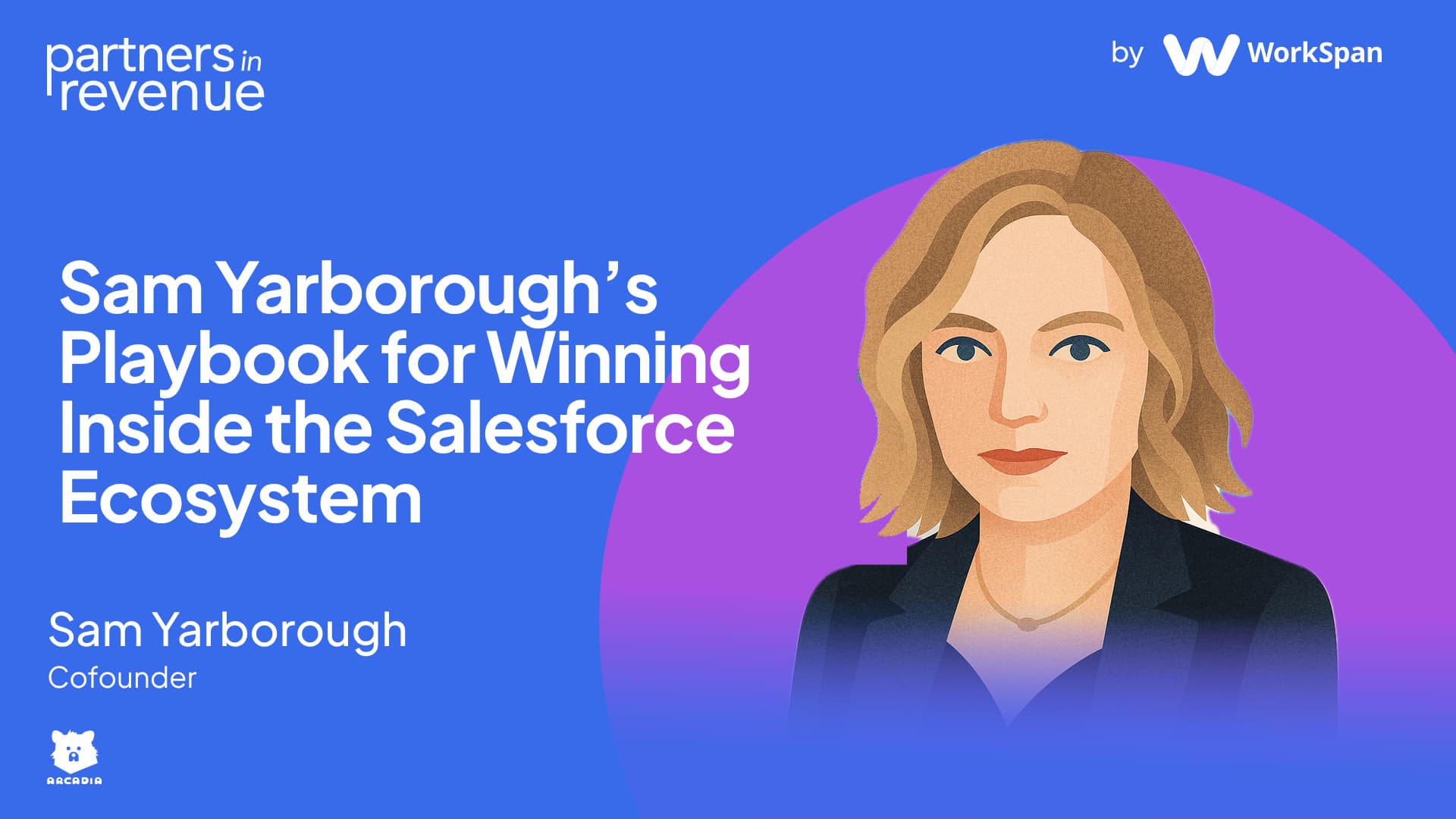
Sam Yarborough's Playbook for Winning Inside the Salesforce Ecosystem
Lead with the customer, start with one seller, and treat every win as the start of the work.
Walk into the Salesforce ecosystem as a new ISV and the numbers are against you. There are more than 5,000 ISV partners competing for attention and, by Sam Yarborough's count, upwards of 10,000 Salesforce sellers. Knowing where to start, in Yarborough's words, "can be really elusive and terrifying."
Most partner teams answer that uncertainty the same way. They treat the program as a lead generation channel, show up talking about their own product, and try to reach as many sellers as they can. Yarborough has watched that approach stall again and again.
Yarborough has spent most of a career in the Salesforce ecosystem building partner programs as an operator at PFL and later consulting ISVs, from companies like Stripe to partners just launching on the AppExchange. Today Yarborough is Cofounder of Arcadia. At PFL, the program Yarborough built went from roughly 2% of company revenue to 65% sourced revenue in 18 months. Here is the thinking behind it.
Start with the customer, not your features
The first mistake happens before a single meeting is booked. Teams launch a partner program with one goal: leads.
"People start a partner program with the sole goal of being a lead generation tool. And while that will happen, and while that is an outcome, that is not the way to start and to build." — Sam Yarborough, Cofounder, Arcadia
Yarborough's framing is simple. ISVs exist in the Salesforce ecosystem because Salesforce has gaps in its technology, and the ISV fills them to build a better end-user experience. That makes the customer the center of the conversation, not the ISV.
Yet many partners walk in and talk only about themselves.
"That doesn't matter to Salesforce. They don't care. There's 5,000 partners."
What does land with sellers is a clear story about how you make their customer's experience better, because that helps them do their job. Skip that, and you are just reciting features.
Niche down: it's not never, it's just not now
Broad positioning is the second trap. "We solve this pain point for anybody who needs it" doesn't land in an ecosystem the size of Salesforce, or AWS or GCP for that matter.
Yarborough's answer is to narrow hard. Pick the industries where you have a real, unique value proposition, then go further. Not just healthcare, but payers and providers within healthcare. That is a tough conversation to have with a CRO who sees opportunity being left on the table.
"It's not never, it's just not now."
The pattern Yarborough has seen work "time and time again" is messaging that is specific to an industry, a problem and a customer, followed by relationships with a handful of sellers who own those accounts. Not boiling the ocean. Finding a few champions, starting with influence deals, and letting the early wins snowball into introductions to their teams and peers. That beats spray and pray.
One seller, one book of business
At PFL, Yarborough started with a single Salesforce AE who covered mid-market financial services. Yarborough came in with a clear story for their joint accounts and a specific ask: a meeting to do account planning and see whether it made sense to bring PFL into the AE's deal cycles.
The AE liked it enough to go further. She had about 50 customers in her patch and offered to host a webinar with PFL presenting to all of them.
When Yarborough brought this to the executive team, PFL's CEO stopped and asked how long it would take a BDR to book 50 meetings. Yarborough guessed a month. His answer: at least two months for one BDR. "You did that in two weeks, and you're gonna do it at one time."
That moment changed how the company saw partnerships. The BDR team had the tools and the resources. Yarborough was a team of one, getting in front of 50 customers through one relationship.
"Starting with one can be overlooked because it's one person, but one person has a whole book of business."
Curiosity opens markets you didn't plan for
Healthcare wasn't a target industry for PFL, which did automated direct mail inside the Salesforce ecosystem. But by asking Salesforce AEs what their customers were struggling with, the team learned something it would never have found by pitching. Healthcare and financial services companies are required by law to send certain direct mail to their customers, and that business had never come into the Salesforce ecosystem because Salesforce didn't do direct mail.
The result was a new ICP for PFL, and a position as the only vendor that could do this within the Salesforce world.
"We really tried to understand the joint value prop rather than leading first with, 'We send swag boxes,' because we would've totally missed the whole point."
The way in was a win story. Yarborough told PFL's Blue Cross Blue Shield use case so often it's still memorized, complete with hard data and the technical details of the Salesforce integration. The approach: share what they did, why and how, then ask open-ended questions. Have you talked to your customers about direct mail? How manual is it for them? Many AEs had never thought to ask. When they did, some found customers sending a billion pieces of direct mail a year.
→ WorkSpan: Yarborough's win story worked because it was specific and ready when a seller needed it. WorkSpan helps partner teams put those plays, proof points and joint-account intelligence directly in the seller's flow of work, so the right partner story surfaces on the right deal without relying on one person's memory.
A win is the key to the kingdom. Don't drop it.
Most teams celebrate a co-sell win, maybe send the Salesforce rep a thank-you, and move on. For Yarborough, that is exactly when the real work begins.
Go back to the AE. Remind them how easy it was to work together. Ask who else in their book looks like that customer, which peers have a similar book, and whether they would introduce you to their RVP so you can join a team call and show how you help accelerate deals and open new use cases.
"Once you get a win, you have the key to the kingdom, and you just drop it."
Yarborough adds one underrated skill: follow up and do what you said you would do. People want to work with people who deliver. Once that foundation is in place, "all you have to do is say, 'Who else do you know?'" The introductions follow.
It's never going to be hands-off
Even once a segment is enabled and sending business, Yarborough's view, offered as a possible hot take, is that a partnership never runs on autopilot. Salesforce sees turnover every year, and sellers get new accounts. Partnerships are a relationship business.
The work shifts from enablement to relationship maintenance: checking in, sharing wins as they come, and showing up at events. At Dreamforce, set aside time to meet the AEs, see them in person and make time for their customers.
Then, once one flywheel is turning, pick the next industry and start from zero. Find the joint customer list, enable the sellers, ask for meetings, and build another flywheel.
What it adds up to
At PFL, the program was nascent at the start. Eighteen months later, 65% of all company revenue came through the Salesforce partnership. Sourced, not influenced. The team opened healthcare as a new ICP and grew the partner team from two people to five.
Yarborough is clear about the conditions. You need internal support. You need your messaging dialed. And you need a realistic timeline.
"Partner programs in six months are not going to really showcase the magic, and sometimes that's a hard thing to navigate with executive teams."
Messaging, Yarborough stresses, is the foundation teams skip most often, regardless of how mature the program is. And it isn't one message. What resonates with a Salesforce AE differs from what works for an SE, an SI or the customer. Leaning on customer marketing alone won't cover those partner personas.
The through-line
Every part of Yarborough's playbook comes back to the same idea: be specific and be useful to the person across the table. Lead with the customer's problem, not your features. Pick a narrow lane. Win with one seller, then use that win to reach their peers and leaders. Ask questions, including the ones that feel basic, because curiosity is what turned direct mail into a new healthcare market for PFL.
None of it is a one-time effort. The programs that grow are the ones that keep building relationships after the first deal closes and keep starting new flywheels once the first one turns.
→ WorkSpan: Scaling Yarborough's approach means more sellers, more segments and more relationships to keep warm. WorkSpan helps partner teams run co-sell execution at scale and track partner-sourced and influenced revenue in the CRM, so the impact that took 18 months to build is visible to the executives who need to back it.
Sam Yarborough is Cofounder of Arcadia, which creates community and experiences for tech leaders exploring the convergence of purpose and professional potential. Yarborough has spent most of a career building partner programs and growth functions in the Salesforce ecosystem and consulting ISVs on their partner strategy. Thanks to Sam for sharing this playbook with WorkSpan.
WorkSpan's series spotlighting expert partner leaders in the industry and the valuable insights and proven playbooks that helped them drive scalable. partner-driven revenue
Heading
Heading 1
Heading 2
Heading 3
Heading 4
Heading 5
Heading 6
Lorem ipsum dolor sit amet, consectetur adipiscing elit, sed do eiusmod tempor incididunt ut labore et dolore magna aliqua. Ut enim ad minim veniam, quis nostrud exercitation ullamco laboris nisi ut aliquip ex ea commodo consequat. Duis aute irure dolor in reprehenderit in voluptate velit esse cillum dolore eu fugiat nulla pariatur.
Block quote
Ordered list
- Item 1
- Item 2
- Item 3
Unordered list
- Item A
- Item B
- Item C
Bold text
Emphasis
Superscript
Subscript

.jpg)