The partner manager who can't talk pipeline isn't a partner manager anymore.
That sounds harsh. It isn't meant to be. For most of the history of this role, relationship-building was the job. You flew to the events, earned the trust, got the right people in the room, and trusted that revenue would follow the relationship. For a long time, that worked.
It doesn't work anymore. Not because relationships stopped mattering. But because the ecosystem has grown to a scale where trust without revenue conversion doesn't justify the headcount. The companies that invest in partner programs aren't asking whether you have a good relationship with your counterpart at AWS. They're asking what that relationship produced — how much pipeline, how much revenue, how many deals closed through the partnership.
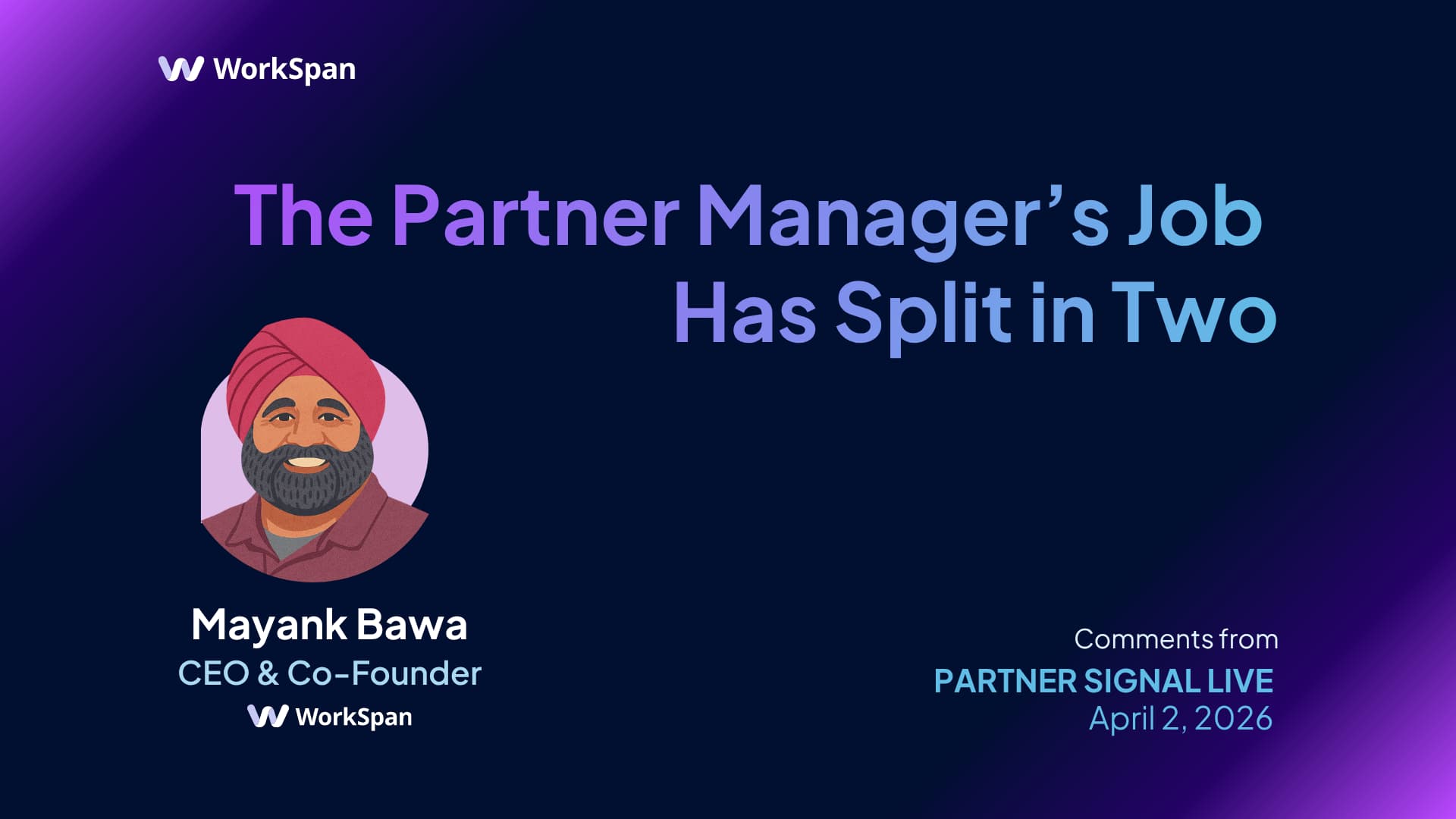
I made this case at Partner Signal Live in April, and I want to push the argument further. The shift isn't coming. It's already happened.
The Scale That Changed the Job
Across all the enterprise commits to the public clouds, committed spend flowing through marketplaces has reached $450 billion. Forrester found that two-thirds of B2B companies now rely on partnering as their primary growth engine. Even Anthropic — a company that builds foundation models — announced a $100 million investment in building its own partner ecosystem. When the companies defining the next era of enterprise technology are making nine-figure bets on partnerships, this isn't a trend. It's the operating environment.
And the motion driving this environment isn't just hyperscaler co-sell anymore. Co-sell used to be a specialty motion for cloud partnerships. It isn't anymore. We've seen companies co-selling with resellers, OEM partners, managed service providers, services companies, and ISVs. As I told the audience at Partner Signal Live, "co-selling mastery will help drive revenue across multiple partnering motions."
The partner manager who can co-sell with AWS should be able to co-sell with an SI, an ISV, or an OEM. That's a fundamentally different competency model than "I have a great relationship with our AWS PAM."
Two Skills, One Role
When I described what the best partner managers actually do now, I broke it into two skills.
The first is establishing trust across company boundaries — getting teams inside different organizations to feel that they share the same intent, that your interest and my interest are aligned. This is the relationship work partner managers have always done. It's still essential. But it's now table stakes, not the differentiator.
The second skill is where most partner organizations have a gap. The partner manager has to make sure the trust they've established results in actions that drive higher revenue. They have to own the number and drive revenue on the co-selling motion happening between the two partners. That means sharing opportunity context so both sides have the same perspective on what's happening at the customer. It means positioning your salespeople with respect to the partner's salespeople so both teams have the space to grow and add value.
These two skills aren't sequential — build trust first, monetize it later. They're concurrent. The partner manager who can only build trust is half the role. The one who can only talk pipeline without the relationship credibility to back it up won't get the calls returned.
Sellers show up to the same customer meeting without coordinated context and end up competing with each other instead of selling together. "Once they start undercutting each other, trust starts getting eroded. When trust starts getting eroded, win rates start dropping." The trust that took months to build gets destroyed in a single uncoordinated call.
Why No One Can Do This Alone Anymore
The second skill — revenue conversion — requires holding context that no single human can hold at scale.
David Meyer, who runs the AWS alliance at Qualtrics, showed what this looks like in practice at Partner Signal Live. His daily reality is knowing each account's AWS commit status, marketplace propensity, incentive eligibility, the relevant AWS services in play, the right contact on the AWS side — and connecting all of that to Qualtrics' AI platform offering.
He does this across hundreds of accounts in three regions while simultaneously running the alliance strategy. That's more than a workload problem. It's a structural one. No one can hold all of that context and still have time to build relationships.
The pattern David described is one I see across every partner organization we work with: the partner manager becomes the single point of context. Every question from the field — should I send this opportunity to the partner? What incentive applies? Who's the account manager? — routes through one person. That isn't a partner manager operating at scale. That's a bottleneck.
The data problem underneath makes it worse. When you go to a partner portal, it's their data. When you go to your own CRM, it's your data. The partner manager becomes the human bridge between two systems that don't talk to each other.
AI as the Operating System for the New Role
This is where the role fundamentally changes — not because AI replaces the relationship, but because AI makes the revenue-conversion skill possible at scale.
Every question David described fielding — the incentive, the contact, the positioning rationale — is context that AI can hold persistently, surfaced inside the CRM where sellers already work, updated in real time, available without routing through the partner manager. Institutional knowledge doesn't disappear when someone goes on vacation or switches roles. It lives in the system.
David showed this during his demo. The Partner Advantage Card surfaces inside Salesforce, trained on the specific partnership, giving sellers the context to act. Should I bring in the partner? What's the incentive? Who's my contact? The seller sees the recommendation and submits the referral in one click — without calling the partner manager.
"My sellers will know what to do," David said. "I'm no longer just evangelizing and running operations." And then he said something truly groundbreaking:
"I've spent my career trying to scale partnership programs. This is the first time I've seen something like this that actually changes what my workflow looks like."
That's why we built beyond process automation. As my co-founder Amit put it, "WorkSpan cannot just be a process automation layer... we should lean in and give the full AI stack of AI decision-making, AI intelligence gathering, and AI autonomous acting."
Three Questions for Your Program
Can your sellers co-sell without calling you? If every co-sell motion requires the partner manager to provide context, you are the bottleneck. The test isn't whether you have good relationships. It's whether those relationships have been operationalized into systems your sellers can act on independently.
Do you own a pipeline number, or just a relationship score? If your QBR slides are about meetings held and events attended, you're reporting on the trust skill. The executive team is asking about the revenue skill. What pipeline did your partnerships generate? What revenue closed through partner-influenced deals?
Is your co-sell motion transferable across partner types? If your AWS co-sell playbook is fundamentally different from your SI playbook, which is different from your ISV playbook, you don't have a co-sell competency. You have three separate programs.
The Role That Defines the Next Era
The partner manager role is one of the most consequential positions in enterprise go-to-market right now. And the infrastructure is being built for it.
AWS launched an MCP server for their partner portal — meaning they're ready to accept that in partnering, it won't just be humans who engage with their systems. They're allowing their partners' agents to engage with their agents so the scale of partnering can keep growing. Anthropic is investing $100 million in its partner ecosystem. The companies building the next generation of ecosystem infrastructure are building it for partner managers who operate with AI, not without it.
The partner managers who master both skills — trust across boundaries and revenue conversion — with AI as their operating system will define how enterprise deals get done from here. They won't just be better at the job. They'll be doing a different one entirely: orchestrating partnership intelligence across organizations, at a scale that wasn't possible before.
The ones who master only trust will still have great relationships. They just won't understand why the ecosystem moved without them.
Watch Mayank Bawa’s Partner Signal Live Session

Mayank has always believed in the importance of data, analytics, and applications in helping people make better decisions. Prior to founding WorkSpan, he founded Big Data pioneer Aster Data Systems, acquired by Teradata in 2011 where he served as Co-President of Teradata Aster division. He has a PhD in Computer Science from Stanford University and B.Tech from IIT Bombay.
Heading
Heading 1
Heading 2
Heading 3
Heading 4
Heading 5
Heading 6
Lorem ipsum dolor sit amet, consectetur adipiscing elit, sed do eiusmod tempor incididunt ut labore et dolore magna aliqua. Ut enim ad minim veniam, quis nostrud exercitation ullamco laboris nisi ut aliquip ex ea commodo consequat. Duis aute irure dolor in reprehenderit in voluptate velit esse cillum dolore eu fugiat nulla pariatur.
Block quote
Ordered list
- Item 1
- Item 2
- Item 3
Unordered list
- Item A
- Item B
- Item C
Bold text
Emphasis
Superscript
Subscript