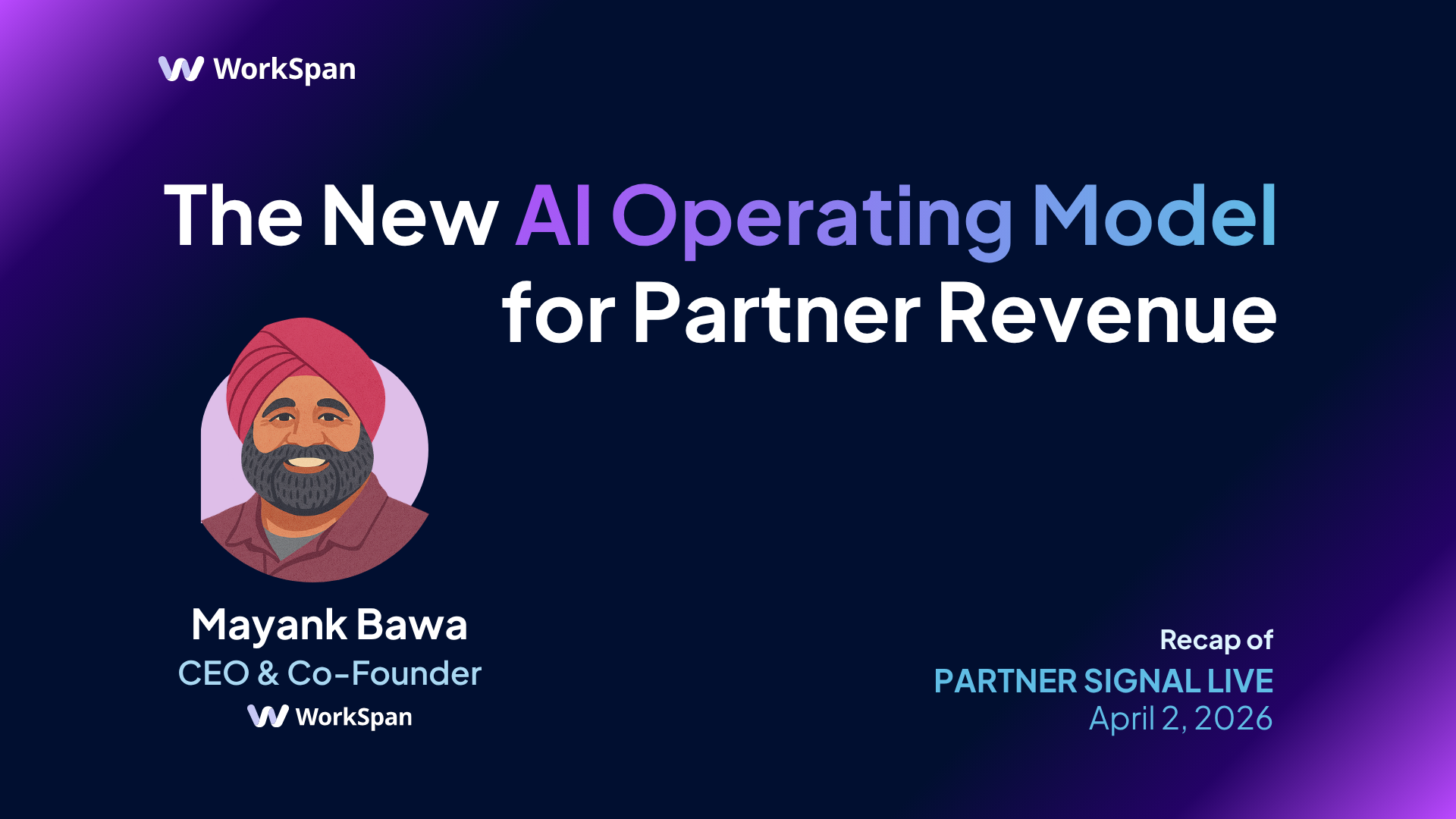
Every major partner program is running a 2019 operating model against a 2026 market. The complexity that partner leaders are feeling right now is not a bug. It is the signal that partnering has finally become the primary growth motion for enterprise technology, and the operating model we inherited was never built to carry what the market is now asking of it. The teams that see this clearly are building something new.
What We Heard at Partner Signal Live
At Partner Signal Live this spring, we heard from three of the most respected operators in our category: Nina Harding, CVP, Americas Enterprise Partner Solutions at Microsoft; David Meyer, Head of Global AWS Alliance at Qualtrics; and Bronwyn Hastings, GVP, Global Partners and Alliances at DocuSign. Between them, they are building, activating, and scaling some of the largest partner programs on the planet.
What came out of those conversations was not a set of best practices. It was a consistent diagnosis of where the work is headed — and a remarkably aligned view of what the next operating model has to look like.
The Gap Between Where Partner Programs Are Going and What Most Teams Can Execute
The reason is that every dimension of the work is expanding at once. Partnerships are accelerating on four fronts. The cloud marketplace is now a $150B channel. Forrester's most recent work has 67% of enterprises naming partner alliances their top growth priority for 2026. Anthropic has disclosed that partner-led ARR crossed $100M in under two years. And AWS's MCP server has become a forcing function pulling the entire AI ecosystem toward shared, agent-to-agent execution.
This is the moment the category has been working toward for a generation. It is also the moment that is breaking the operating model.
The teams I talk to are trying to cover more ecosystems, more motions, and more co-sell surface area with roughly the headcount they had three years ago. They are stitching together CRMs, PRMs, partner portals, and spreadsheets that were never designed to talk to each other. They are asking alliance managers to be strategists, operators, data analysts, and relationship owners — simultaneously. And they are being evaluated on pipeline, deal size, and win rate metrics that depend on execution quality their systems cannot produce.
David Meyer put it plainly at the summit:
"The challenge is not the strategy. I know exactly what a great partnership looks like. The challenge is the operational aspect of maintaining and managing the partnership."
Strategy is clear. Execution is the constraint.
Trust + Action = Revenue
Partner revenue rests on two things working together: trust between the companies involved, and aligned action on specific opportunities. When both are present, partnerships compound. When either is missing, they collapse into QBRs, marketplace listings, and pipeline that never closes.
Trust is not a slogan. It is the compounding effect of consistent, predictable, high-quality engagements between partner teams over time. Action is not a task. It is the coordinated execution of specific engagement plays — joint qualification, co-selling, attribution, renewal — across organizations that do not share systems, incentives, or leadership.
The reason partnering has been hard to scale is that trust scales through relationships and time, while action scales through systems — and those systems have historically been single-tenant. The partner's system and your system could not meet in the middle because there was no middle to meet in.
That is the part that has changed. The middle exists now. It is agentic, it is shared, and it is where the next decade of partner revenue gets built.
Why Most Programs Are Stuck
The shared layer exists — but most programs cannot reach it. Not because their leaders lack ambition. Because the legacy operating model has predictable failure modes, and most teams are hitting at least three of them simultaneously.
- Partner data lives in silos that cannot be joined cleanly across companies, which makes shared context impossible.
- Co-sell starts too late — usually after a deal is already in motion — which collapses the window where partnering actually moves the outcome.
- Alliance managers are overloaded with coordination work that software should be doing, which means strategic relationships get the leftover attention.
- Attribution is reconstructed after the fact from stitched-together records, which erodes trust with both internal finance teams and external partners.
- The tools in place were built for a single company's workflow, so every cross-company engagement requires a human to bridge the gap.
- Leadership measures partner programs against revenue outcomes the underlying operating model cannot reliably produce, which creates a credibility problem for the entire function.
Any one of these is survivable. All of them at once is why well-funded alliance teams feel like they are running uphill.
Three Principles for What Comes Next
Underneath those failure modes, the operators at Partner Signal Live converged on the same set of design constraints — the criteria partner teams should be stress-testing every tool, every workflow, and every vendor commitment against. They come down to three.
Shared context. Partners cannot coordinate from two different versions of the truth. Today, most alliance work begins with reconciliation — whose CRM is right, whose partner tier is current, whose pipeline report matches reality. That reconciliation is the single largest tax on partner productivity, and it is invisible in every budget. The agent that drives joint execution has to sit on a data layer that both sides trust and both sides can act on, so that reconciliation stops being step one of every motion.
Accretive value. Partners have to feel the value of showing up together from the first engagement, not after months of program work. Bronwyn framed this cleanly around DocuSign's approach to co-sell — design the motion to start as early as possible, because the partner who adds value in the first meeting is the partner who gets invited to the next one. Every week of delay between "partner engaged" and "partner adding value" is a week the customer is resolving the same question with someone else.
Always on AI, orchestrated, and performant. Partnering is not a quarterly cadence anymore. The work is continuous. The agent has to run in the background, orchestrate across systems, and produce outputs that hold up under audit — both internal finance and the partner's own reporting. Amit Sinha, my co-founder, put the architectural point most directly: the agent is not 'mine' or 'yours.' It is ours. It operates across both companies and is accountable to the joint outcome.
None of these three principles requires a new theory of partnering. They require a new operating model for delivering on the theory partner leaders already have.
The Framework: Activation, Automation, Attribution
The operational answer is not a single product. It is a framework that runs across three connected capabilities.
Activation is how partners show up together in front of customers, earlier and more prepared than either company could alone. At Partner Signal Live, Alex Pilson, our VP of Solution Business Consulting, walked through the Partner Advantage Card inside Salesforce — the ability to surface, at the moment an opportunity is created, which partners should be brought in, what context they need, and what actions the joint team should take first. That is accretive value, operationalized. The partner is not being onboarded to a motion that is already moving. The partner is shaping it.
AI Automation is the agent work between activation and attribution. Joint qualification, opportunity routing, co-sell updates, partner introductions, meeting prep, and the hundred small tasks that used to consume an alliance manager's week now run in the background. Nina Harding's framing of AI inside Microsoft's partner organization resonates: "AI is not a training, it's not three trainings, it's a way of life now." That is the register partner teams have to reach. Not a tool that gets rolled out. A way of working that is assumed, embedded in how the work gets done from the first minute of the day.
The second-order effect is more important than the productivity gain. When automation absorbs the coordination tax, alliance managers get their judgment back. The strategic work — which partners to invest in, which motions to build, which joint solutions to take to market — stops being the thing that happens after email triage and starts being the thing alliance managers actually do.
Attribution is the capability that makes the whole thing credible. If partnerships cannot show, in real time, which deals moved because of partner influence, which partner earned which share of the outcome, and which motions are generating the best return, the function stays on the defensive. Attribution done right is how partnering earns the investment the category now deserves — and how finance teams, GMs, and CROs stop treating partner revenue as a line item that needs explaining.
What the Operating Model Produces at Scale
The skeptical read would be that this is still theoretical. It is not.
Inside our customer base, partner programs running on WorkSpan AI are seeing 20% lift in partner-sourced pipeline, 84% increase in average deal size, and 27% higher win rates on co-sold opportunities, on average. Those numbers are what happens when activation, automation, and attribution run together inside a program that used to depend on heroic alliance managers and quarterly offsites.
Nina Harding described what Microsoft's Project ASCEND is producing with its top partners — 45,000 opportunities shared, $27B in joint pipeline, $5.2B in revenue, and 6x growth over the prior motion. That is what co-sell looks like when shared context, accretive value, and always-on orchestration are actually in place. That's the shape of a partner organization that has stopped apologizing for complexity and started operating through it.
McKinsey research reveals 96% of enterprise deals are surrounded by partners — upwards of 7 of them according to McKinsey & Company. That is what enterprise partnering now looks like at scale, and the alliance teams that cannot orchestrate six partners through a single opportunity are already losing deals to the teams that can.
The partner teams reading this post are not preparing for a future where AI is in the mix. They are already inside it.
Four Questions That Separate the Next Operating Model From the Old One
Before any partner leader spends another dollar on tooling, four questions are worth stress-testing.
- Can your team see, in one shared view, what is happening between your company and your top ten partners right now — without asking anyone to pull a report?
- Can a partner opportunity move from introduction to co-sell without an alliance manager manually brokering every step?
- When a deal closes, can you show attribution to the partner, the play, and the motion in under a minute, with data both sides trust?
- If one of your largest partners asked you today to operate across their agents and yours inside a shared workflow, could you say yes?
If the answer to any of these is no, the operating model is the constraint, not the strategy or team.
The Invitation
Partner leaders are standing at the moment our category has been waiting for. The market is finally treating partnerships as the primary growth motion. The technology is finally capable of carrying what the market is asking. And the partner teams that see it first are going to define what the next decade of this profession looks like.
Sam Gong, our SVP of Marketing, closed Partner Signal Live with a point worth repeating: the operational cost of running one-to-one with every partner, one motion at a time, is no longer tenable for any serious program. The teams that are winning have stopped trying. They have moved to a model where the agent does the coordination and the alliance manager does the judgment.
That is the model the next generation of partner leaders will inherit as the baseline. Start where your program is most constrained, and move.
Watch April's Partner Signal Live Replay

Mayank has always believed in the importance of data, analytics, and applications in helping people make better decisions. Prior to founding WorkSpan, he founded Big Data pioneer Aster Data Systems, acquired by Teradata in 2011 where he served as Co-President of Teradata Aster division. He has a PhD in Computer Science from Stanford University and B.Tech from IIT Bombay.
Heading
Heading 1
Heading 2
Heading 3
Heading 4
Heading 5
Heading 6
Lorem ipsum dolor sit amet, consectetur adipiscing elit, sed do eiusmod tempor incididunt ut labore et dolore magna aliqua. Ut enim ad minim veniam, quis nostrud exercitation ullamco laboris nisi ut aliquip ex ea commodo consequat. Duis aute irure dolor in reprehenderit in voluptate velit esse cillum dolore eu fugiat nulla pariatur.
Block quote
Ordered list
- Item 1
- Item 2
- Item 3
Unordered list
- Item A
- Item B
- Item C
Bold text
Emphasis
Superscript
Subscript

%20(1).jpg)
%20(1).jpg)
%20(1).jpg)