Why most partner programs don't fail from a lack of opportunity. They fail because no one ever actually committed to one.
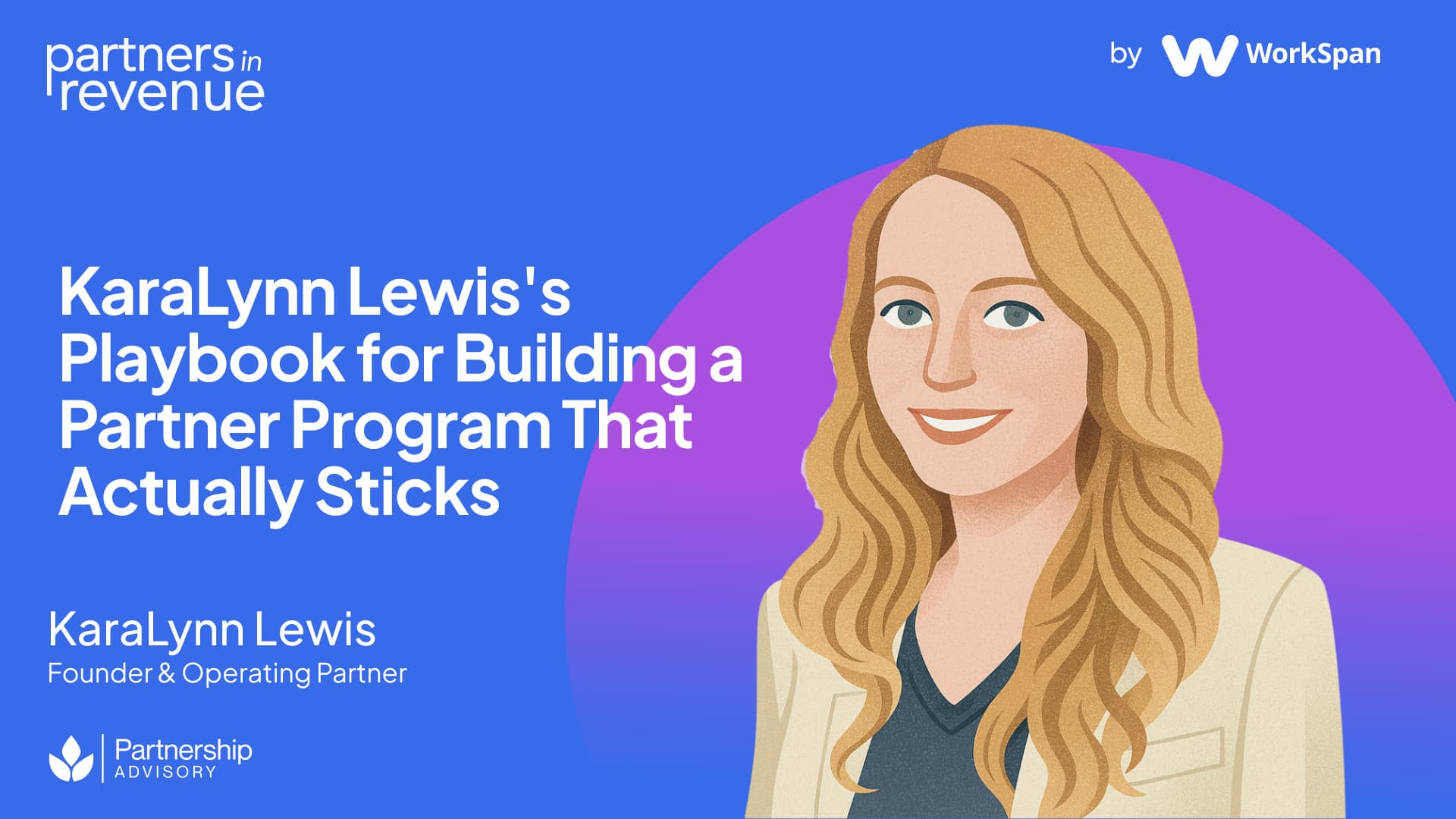
There is a specific story KaraLynn Lewis hears constantly. A company tried partnerships for a year. Nothing happened. It's a failure, they conclude, partnerships doesn't work for us. But when she looks closer, the pattern is almost never that partnerships failed. It's that the company never committed to partnerships in the first place.
Lewis has spent the past decade building partner functions from scratch - first inside operating companies, then, for the last three years, as the founder of Partnership Advisory, where she helps clients from seven-person AI startups to $550 million multinationals fix what they're doing wrong. The pattern she sees most often isn't a bad partner or a bad market. It's a fear of commitment, and it shows up everywhere from who owns the program to which partners actually get resourced.
"There seems to be a bit of a fear of commitment when it comes to partnerships." — KaraLynn Lewis, Founder, Partnership Advisory
The tell: signed agreements, no revenue
Commitment problems rarely announce themselves. They show up disguised as a resourcing decision, an org chart gap, or a partner list that's a little too long. Sometimes a company won't put a real partner manager on the motion - it's a side project for a founder or a salesperson. Sometimes there's a person in the seat, but no budget or headcount behind them. Sometimes the avoidance goes even deeper: a refusal to commit to any single partner type, so every door stays open and none of them get walked through.
The typical symptom, as Lewis puts it, is a lot of signed partner agreements and not much revenue. Part of that is structural: partnerships isn't linear like sales. You don't put in one output and get one output back - you put in ten outputs hoping to get a hundred back. Without real commitment, most organizations never stay in the game long enough to find out if the hundred was ever coming.
What it costs you twice
The damage from getting this wrong doesn't stay contained to the failed attempt. It spreads in two directions.
Internally, one bad experience calcifies into an organizational opinion: partnerships doesn't work for us. That opinion travels, often reaching AEs and customer success reps who never touched the original program. Meanwhile the actual opportunity in the channel hasn't gone anywhere - it's just been written off because the first attempt, or the wrong version of the attempt, didn't land. Reversing that verdict takes real internal convincing, and the second attempt starts from a deficit the first one never had.
Externally, the cost lands on the partners themselves. Staff turnover, a rotating cast of partner managers, promises that quietly evaporated - all of it erodes the one thing a partnership actually runs on.
"The trust that you need from them, which is the cornerstone of any partnership, has been broken already before essentially you've even started." — KaraLynn Lewis, Founder, Partnership Advisory
An ideal-fit partner who has watched a company burn through relationships before will be hesitant to devote real resources to a new one, even if the fit is obvious on paper. Rebuilding that trust, Lewis says, can be harder than starting from a completely new relationship. The longer the pattern of broken promises runs, the harder it is to undo.
Step zero: get everyone to agree on what partnership means
Before any strategy work, Lewis runs a step that's easy to skip: getting the whole organization, not just the partnerships team, aligned on what partnership actually means for this specific company.
The reason it matters is that the word means wildly different things to different departments. A marketing partnership might mean co-branding with a recognizable consumer brand. A product partnership might mean choosing AWS over Microsoft as an infrastructure vendor, or which company supplies the laptops. All of those are technically partnerships — with completely different implications, outcomes, and ways of working. Skip the alignment step, and an executive team can spend months arguing past each other without realizing they're describing different things.
"Partnerships is an underlying organizational strategy that supports an organization — not just a revenue channel or something that you tack on to the side." — KaraLynn Lewis, Founder, Partnership Advisory
One exercise Lewis runs to make this concrete: mapping the customer journey and layering partnerships underneath it, department by department. It surfaces where the real opportunities sit, and it makes the case, without anyone having to argue it directly, that partnerships is infrastructure the whole company leans on — not a side project someone happens to own.
Building the strategy before the business plan
Once the organization agrees on what it's building, the actual strategy work starts — and revenue is deliberately not the first question.
Lewis starts with an ecosystem overview: who the company works with, and where those relationships sit. For a lot of teams, this is a genuinely educational moment — most haven't clearly mapped the difference between a partner type and a partner motion, let alone which ones matter for their business. From there she builds a business case for each realistic partner option — a partner type, a partner motion, a specific initiative — so there's an honest outline of what pursuing that path looks like and why it should, or shouldn't, happen.
"Revenue is not the only metric that we can track — that's an oversimplification of building a truly interesting and scalable partner channel." — KaraLynn Lewis, Founder, Partnership Advisory
Only after that does the business plan get built: what revenue to expect, on what timeline, and what resourcing it takes to get there. And even the business plan isn't the finish line. What collateral does the team need to actually enable partners? Where in the customer journey should partners be brought in? Those are real milestones, Lewis argues — not footnotes underneath the revenue number.
The discipline of saying no
Execution surfaces a second, quieter kind of commitment problem: partner managers who can't bring themselves to close a door.
Lewis's advice to her earlier self is blunt: don't get distracted by every potential opportunity, and don't be afraid to say no. Partner managers, in her experience, aren't people-pleasers exactly — they're friendly, open, and genuinely excited about potential, which makes it hard to shut down a conversation that isn't going anywhere. But a calendar full of great meetings that never convert into anything is its own version of the fear-of-commitment problem, just at the individual level instead of the org level.
"Being able to lift above and have that maturity to say, this is a great idea, but not right now — people appreciate that on the other side more than you would think." — KaraLynn Lewis, Founder, Partnership Advisory
Saying no, done well, does two things at once: it protects a partner manager's workload, and it increases the actual impact they can have, because effort concentrates on the two or three relationships that matter instead of spreading across ten that don't.
Track metrics before you have a benchmark
Lewis is direct about one more common mistake: waiting for an industry benchmark before you start measuring anything.
The metrics she tracks are not exotic — time to revenue per partner, time to onboard a partner, partner performance relative to other partners, percentage of overall revenue from partners, and partner attach rate, or how many deals overall get attributed to partners. What's missing for most companies isn't the metric list. It's the willingness to start tracking before there's a clean external benchmark to compare against.
"You don't necessarily know if your partner needs three months to get onboarded or if they can onboard in a week — these are always educated guesses, and the most important thing is to start tracking these things so that you can improve upon them in the future." — KaraLynn Lewis, Founder, Partnership Advisory
Her recommendation is to go deep with a handful of real partners rather than staying theoretical across a broad list — execute well with a few, find out what a benchmark actually looks like for this specific program, and only then start optimizing.
What committing actually looks like
One past client makes the whole argument concrete. They came to Lewis with multiple partnership opportunities already in motion and no structure behind any of them. The first move wasn't sourcing more partners — it was stepping back to define twelve-month priorities and choosing, deliberately, which single partner type to focus on.
Even though the company had live opportunities across several partner types, including technology partnerships, they chose to double down on service partnerships specifically, because that's where the organic momentum already was. And within that one partner type, they narrowed further — from more than thirty potential partners down to five.
"Even within that, we went from over thirty different potential partners to only five. We were able to really build trust with those individual players, and that already opened doors to enterprise clients that weren't necessarily accessible if they had just gone in on their own." — KaraLynn Lewis, Founder, Partnership Advisory
That narrowing is what made the trust-building possible, and the trust is what unlocked enterprise access the company couldn't have earned solo. Once that first cohort proved the model, expanding to additional, less-flexible partners became far easier — because there was now a demonstrated, repeatable success story to point to instead of a pitch.
The sequence that's actually being protected
Strip away the specifics and Lewis's playbook is defending against one thing: a partner program that gets judged as a failure before it was ever actually tried.
Org-wide alignment fixes the definition problem before it starts an argument. An ecosystem overview and a real business case replace guesswork with an honest map of where the opportunity actually is. Committing to fewer partner types, not more, is what makes trust — and the enterprise access that follows it — possible in the first place. And tracking metrics from day one, without waiting for a benchmark that may not exist, is what turns a first attempt into a program that compounds instead of one that just gets tried once and shelved.
Commit to all of it, done in the right order, and the outcome isn't just avoiding failure. It's reaching the same goals faster and more effectively than a program built haphazardly ever could.
That's the same discipline WorkSpan is built to support once a partner program is running: making partner-sourced and partner-influenced revenue visible and attributable inside the CRM, so the metrics Lewis describes — time to revenue, attach rate, percentage of revenue from partners — don't have to be rebuilt by hand every quarter. For a partner leader trying to prove the channel is working before the org fully believes it yet, that visibility is what turns an educated guess into an argument finance can't dismiss.
If your team is working through the same commitment problem Lewis describes, see how WorkSpan makes that case for you.
KaraLynn Lewis is the Founder of Partnership Advisory, where she helps B2B SaaS companies — from seven-person AI startups to $550 million multinationals — build new partner programs and fix the ones that already exist. Thanks to KaraLynn for sharing her playbook with WorkSpan.