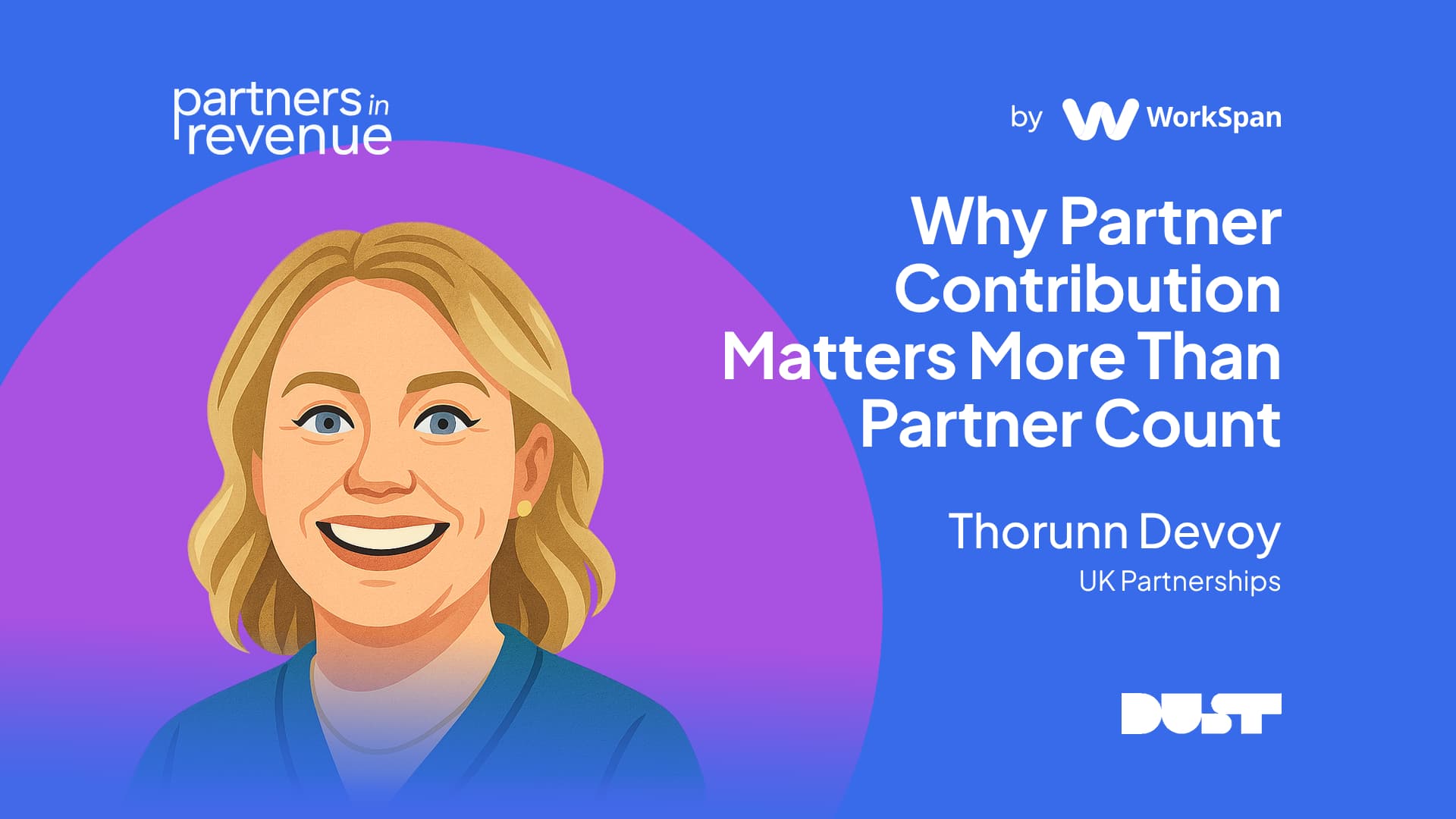
Thorunn Devoy, UK Partnerships at Dust, shares why joint value and customer-level contribution are a stronger foundation for partner growth than the number of agreements signed.
A growing partner list can make a program look successful before it changes a single customer decision.
For partner leaders, the harder question is what those relationships make possible. Can a partner help a customer understand the solution, reduce the work required to buy, or help the business compete in a market where it has struggled?
Thorunn Devoy, UK Partnerships at Dust, brings that distinction to life through examples from her career. Her perspective points to a more useful standard for partnership growth: focus on what partners contribute, not simply how many appear on paper.
Partners on Paper Are Not the Same as Partners Producing Results
The instinct to prioritize volume is understandable. People moving into partnerships from sales or business development are often used to measuring meetings booked, introductions made, and activity completed.
Thorunn sees that habit carry into partner programs, particularly when an organization is still developing its approach. Signing more partners becomes an easy way to show movement.
But an agreement does not establish why two businesses should work together, which customers they should pursue, or what each side will contribute.
As Thorunn puts it:
"A ton of partners on paper, but not actually partners that are producing or generating results."
The consequence is not just an unproductive partner list. It is time spent trying to create traction in relationships whose commercial foundation remains unclear. Each new relationship competes for attention, whether or not both sides know what to do next.
Joint Value Gives a Partnership Somewhere to Go
Thorunn's advice starts before the first opportunity. Looking back on her career, she would spend more time qualifying the partnership, understanding the partner's business, and clarifying the value the two companies can bring to market together.
The important question is not simply whether a partner can introduce potential customers. It is why a customer would benefit from the two businesses working together.
That means getting specific about the joint value proposition or solution, the prospects or brands both sides want to target, and how the teams will work together.
"Once you have that strong foundation, you know who you're going after, you know how you're gonna work together."
That alignment gives the relationship a practical direction. Instead of starting with a signed agreement and searching for a reason to collaborate, both sides have a basis for pursuing the first opportunities.
This does not make every subsequent deal easy. It does address the ambiguity that can leave a new partnership stuck before meaningful work begins.
The Most Valuable Contribution May Happen Before Your Sales Team Arrives
One of Thorunn's examples shows what substantive partner involvement can look like inside an enterprise deal.
The customer was a well-known quick-service restaurant brand. By the time Thorunn's team joined, the partner had already demonstrated the product, validated the solution, and started building part of the customer's program using it.
"They had even started building out some of the client's program, using the product, and really brought it to life."
The vendor team was not entering a conversation at the beginning of the customer's evaluation. The partner had already helped the customer see how the solution could work for its business.
Thorunn recalls that the customer needed only one demo from her team before the deal moved into contracting. From memory, she puts the value above 250,000 and the sales cycle within a quarter, roughly a third to a quarter of the company's typical enterprise cycle. The deal was also larger than its typical initial deals.
Those are her recollections of one deal, not a benchmark for every partner-led opportunity. The mechanism is the more useful lesson: the partner did meaningful evaluation work with the customer before the vendor's team arrived.
An introduction alone would not capture that contribution. The partner helped turn a product into something concrete for the buyer, changing the work left to do in the sales process.
Making partner contribution useful at scale requires connecting it to live opportunities. Explore how WorkSpan brings partner intelligence and co-sell workflows into the sales process.
Ecosystem Value Can Extend Beyond the Deal Itself
A second example broadens the meaning of partner impact.
Thorunn describes a company trying to enter an industry where another vendor had a stronger presence and more customer references. The business wanted to establish itself there, but typically lost opportunities to the better-established competitor.
A customer then issued an RFP covering both software and services. Eight solution partners responded, and every one recommended Thorunn's company as the software vendor.
"All of them included our company as the vendor that they would recommend."
The company won a deal worth close to €1 million. Just as importantly, it gained a lighthouse customer in an industry outside its usual strengths.
The significance was not that eight recommendations guarantee a win. It was that an ecosystem contributed to a result the business had struggled to achieve on its own: winning a meaningful customer in a less-established market.
That creates a broader way to assess partnership value. Revenue from the individual opportunity matters, but so does whether the win helps the company establish a foothold beyond its strongest industries.
These two stories illustrate different contributions. In one, a partner helped a buyer move through evaluation. In the other, multiple partners recommended the vendor in a market where its own references were limited. A partner count alone explains neither result.
More Capacity Still Requires a Decision About Where to Focus
Focusing on contribution also changes how partner teams think about their own time.
Thorunn describes a role that has expanded as go-to-market has become more complex. There are more opportunities to pursue, but a partner manager still has limited attention.
AI can help with administrative work. Her recommendation is hands-on learning in a safe environment, with internal testing before making anything available to partners.
"I would try them internally first before you make them available to the partner."
But productivity is only part of the answer. Reducing administration does not decide which relationship or opportunity deserves the capacity gained.
Thorunn treats that prioritization as equally important:
"Where are you gonna be spending the time where you are going to see the most impact of your work?"
For partner leaders, that brings the argument back to joint value. Capacity is most useful when the team has a clear reason to invest it: a relevant customer problem, an aligned partner, and a specific contribution the two businesses can make together.
The goal is not to fill the time saved with more undifferentiated activity. It is to make room for the work that gives a partnership commercial substance.
Build Around the Contribution You Want to Repeat
Thorunn's examples offer a clear distinction between expanding a program and strengthening its ability to create revenue impact.
A signed agreement is a starting point. Joint value gives the relationship direction. Meaningful work with customers makes that value visible.
For leaders looking to scale that approach, the next challenge is making partner context, collaboration, and contribution part of everyday revenue execution rather than leaving them disconnected from the sales process.
WorkSpan supports that shift by connecting partner intelligence, co-sell workflows, and attribution to the systems revenue teams already use. The aim is to help teams act on relevant partner opportunities and understand their impact.
The better growth question is not just, "How many partners did we add?" It is, "What can our partners help customers achieve, and how do we make that contribution easier to repeat?"
See how WorkSpan helps teams turn partner collaboration into measurable revenue execution.