Why segmenting partner motions, meeting partners where they are, and building multi-partner plays can turn activity into more usable, measurable partner revenue.
Most partner programs do not fail because they lack activity. They fail because the activity is not relevant enough for the partners, sellers, or buyers expected to act on it.
When every partner type receives the same campaign, the same incentive, and the same request, aggregate engagement can look healthy while specific segments quietly stall. Affiliates may want to distribute content through their communities. Technology partners may want a joint solution story. Venture capital partners may respond to a different kind of event altogether.
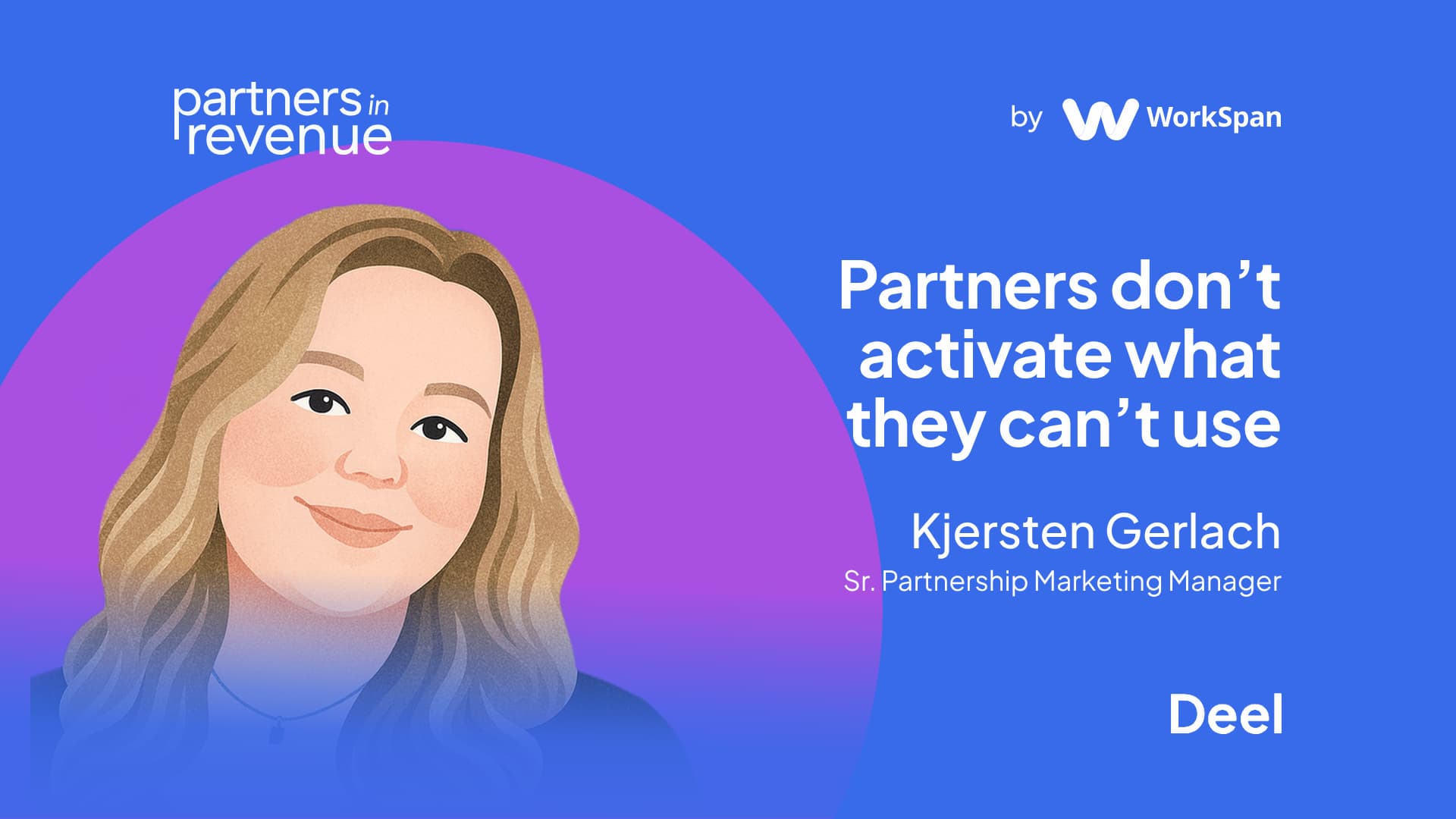
Kjersten Gerlach, Sr. Partnership Marketing Manager at Deel, has seen that distinction play out across partner programs. Her approach is straightforward: understand what each partner can use, design the motion around that reality, and connect partners to the revenue workflows buyers already have in place. We pulled three short clips from the conversation to anchor the play.
Start with the friction aggregate engagement hides
"Partners will not activate what they cannot use."
That line is the foundation for Kjersten's approach to partner marketing. Teams may look at the total number of campaigns, activities, or engagements and conclude that the program is working. But a program total does not tell you which partner types are participating, which motions they find useful, or where the experience is creating friction.
Kjersten gives a simple example. Venture capital partners may not invest in events, while affiliates may be more likely to engage with an event or a content challenge. If those behaviors are blended into a single engagement number, the overall picture can look strong while an entire partner segment is missing the mark.
"When you start to break it down, it kind of uncovers where you're missing the mark across those segments."
The first move, then, is not to launch more activity. It is to make the activity legible. Break engagement down by partner type. Look for the channels and actions that produce participation. Then use those signals to understand where the program is useful and where it needs to change.
Segment the partner before you scale the program
Kjersten's affiliate example shows what happens when a team moves from broad activity to partner-specific relevance.
When she joined an affiliate program, different types of affiliates were grouped together. The team then saw a need to distinguish a true accelerator affiliate from a content creator, influencer, or brand-deal affiliate. Those partners could all contribute to growth, but they were not motivated by the same things or positioned to create value in the same way.
"We saw this need for what is considered a true accelerator affiliate, and then what is considered ... a content influencer, creative, like, brand deal affiliate."
The team began separating those groups and aligning incentives to what each one actually cared about. That made it easier to motivate content creation and distribution through the networks affiliates already understood.
Some affiliates had broad Reddit communities. Others had newsletter audiences. The opportunity was not simply to ask them to share a message. It was to give them a relevant way to use their reach.
Kjersten described the result as a major turnaround once the program connected content creation and distribution to the right partner groups. She also noted that the program was still developing, so the lesson is not that one segmentation exercise solves partner marketing permanently. The lesson is that relevance gives a program somewhere to improve.
A practical version of that playbook looks like this:
- Separate partner types by how they create value. A referral partner, content creator, technology partner, and community builder may all influence revenue differently.
- Match the ask to the partner's existing behavior. Build on the channels, audiences, and incentives a partner already understands.
- Measure the segment, not just the program. Program totals show activity. Segment-level data shows adoption, friction, and the next decision to make.
👉 WorkSpan: A relevant partner motion is only the beginning. Partner teams also need a way to surface that context to sellers, so the right play can be used in the right opportunity. WorkSpan helps operationalize partner intelligence and execution inside the revenue workflow. See how WorkSpan supports partner-led revenue.
Build the play around the buyer's existing stack
Relevance matters on the customer side of the motion, too. Buyers rarely evaluate a new partner solution in isolation. They already have a technology stack, established relationships, and internal expectations about how those tools work together.
That is why Kjersten is such a strong advocate for multi-partner plays.
"I love a multi-partner play, and I don't think we do it enough in the industry."
Her point is not that every deal needs more partners. It is that a partner motion becomes more compelling when it starts from the ecosystem the customer already trusts. If one or two other partners are already integrated into the buyer's environment, those relationships can become part of the path forward rather than obstacles to overcome.
"They want to work with people that they know. They don't want to rip and replace."
For sellers, this changes the conversation. Instead of asking a buyer to abandon familiar systems, the team can show how a solution fits into the tools the customer is already using. Instead of presenting a partnership as an additional layer of complexity, the motion can demonstrate how several partners work together to solve a business problem.
Kjersten also describes using affiliate partners to help fill seats for events with other partners. In that model, each partner contributes a different form of leverage: one brings the event or solution, another brings access to the right audience, and the combined motion creates a more relevant reason for the customer to engage.
Make partner relevance visible to sellers
The strongest partner programs do more than create useful campaigns. They make it easier for sellers to understand when a partner matters and how to use that relationship in a live opportunity.
Kjersten describes partners as an extension of what a company is trying to do. They can help reach customers the company could not reach alone, connect to a specific audience, or strengthen a deal through an existing integration.
"I need a partner to win this deal" is only one way to think about partner value. Kjersten's broader framing is: "I need a partner to reach that audience."
That distinction moves partner involvement upstream. Partners are not only brought into a deal when something is stuck. They can shape who the company reaches, how the message travels, and why the solution is relevant to a buyer's current environment.
For that to happen consistently, partner context cannot remain trapped in a partner team's memory, a campaign spreadsheet, or a separate set of relationships. Sellers need to know which partners are relevant, what the partner adds, how the solutions fit together, and when to bring the partner into the conversation.
This requires partner marketing to work in lockstep with partner managers, sales, product marketing, and field marketing. Kjersten's own approach includes meeting partners directly, joining partner kickoffs and QBRs, and making sure partner marketing is moving in the same direction as the broader program.
"The more resources that you can bring in ... the less friction that you're going to see when you do need that additional support."
That is also why she rejects a siloed view of partner marketing. A campaign may start with marketing, but its value depends on how well it connects to partner goals, seller behavior, customer needs, and measurable revenue outcomes.
Turn partner activity into a repeatable revenue motion
Kjersten's examples point to a broader operating model for partner-led growth. The goal is not to maximize activity for its own sake. It is to create a partner motion that is useful enough to adopt, specific enough to measure, and connected enough to revenue execution that sellers and partners can act on it.
The sequence is simple:
- Design for relevance. Start with what a specific partner type, seller, or buyer can use.
- Build with the ecosystem, not around it. Use existing integrations, relationships, audiences, and workflows to make the motion easier to enter.
- Make the value visible. Show how partners expand reach, improve the customer conversation, influence pipeline, or help move a deal forward.
The common thread is that partner growth does not scale through a one-size-fits-all program. It scales when teams can turn differences across partners and opportunities into better decisions, then make those decisions executable across the organization.
Kjersten's advice to people entering partnerships captures the mindset behind the playbook:
"Do not shy away or get stuck in just a marketing scope."
Partner marketers need to understand the drivers behind the partner program, the goals of the partnership team, and the revenue outcomes the broader organization is trying to create.
"You can't do that in a silo."
The through-line for partner teams
The next stage of partner-led growth will not be defined by how many activities a team can launch. It will be defined by how consistently partners and sellers can recognize where they fit, what they can contribute, and why the motion matters to the customer.
That is the difference between partner activity and partner execution.
Teams that can segment engagement, tailor the motion, connect partners around the buyer's existing ecosystem, and surface the right context inside revenue workflows will be better positioned to turn partnerships into measurable, repeatable growth.
👉 WorkSpan: WorkSpan helps partner teams turn partner plays into repeatable execution, giving sellers the partner intelligence they need in the flow of work and giving leaders the visibility to understand partner impact. See how WorkSpan operationalizes partner revenue.
Kjersten Gerlach is Sr. Partnership Marketing Manager at Deel, where she works across global partnerships and emerging markets. Thanks to Kjersten for sharing her perspective with WorkSpan's Partners in Revenue series.