The co-sell motion most partner teams run was designed for a seller population small enough to reach by hand. Here's what replaces it.
There is a version of co-sell that almost every partner team has run. You appoint someone on each side to sit in the middle. They run joint pipeline calls, build messaging docs together, and push enablement through both organizations in parallel. It works. It is also entirely dependent on that person's calendar.
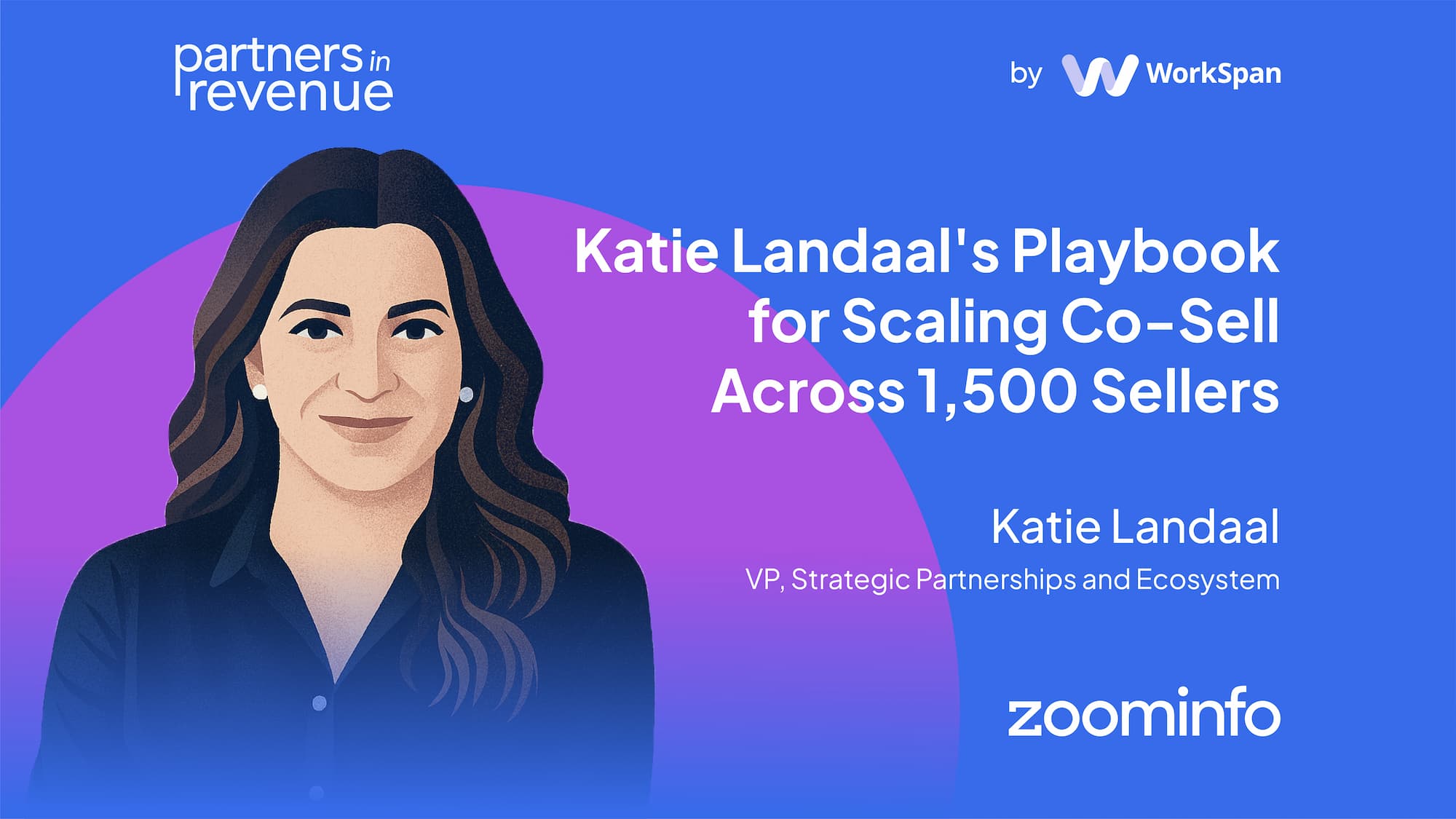
Katie Landaal leads the partner ecosystem at ZoomInfo, which means every indirect motion outside direct sales runs through her organisation. She also has roughly 1,500 sales reps to cover.
"Having over 1,500 sales reps, you can't just hand-hold every single rep through the process, especially when you get to this scale." — Katie Landaal, ZoomInfo
That's not a complaint about headcount. It's a structural observation, and it is the reason her team rebuilt the motion rather than staffing it harder. What follows is the playbook: how ZoomInfo moved co-sell from a hand-holding exercise to something closer to a machine, without flattening it into a blanket script.
First, be honest about why sellers resist
Before the automation, the diagnosis. And Landaal's is more generous to sellers than most partner leaders manage.
Reps like to own the complete experience with their customer. That is exactly what they should do — they are that customer's business partner. But the same ownership instinct creates a bubble, and inside the bubble there are blind spots where a partner could genuinely help.
What that looks like from the partner side is familiar: I've got this relationship, I don't want to introduce anybody else, I don't want to slow down the sale. Partner managers get held at arm's length. It reads as channel conflict, but the underlying cause is simpler. The rep has no evidence that involving a partner improves their outcome.
Which means the fix isn't pressure. It's proof, delivered in a form the rep can act on.
Then understand what the manual version was actually costing
The old approach to finding co-sell opportunities was two spreadsheets and a hopeful merge. Grab your account list, grab the partner's, blend them, look for overlap, start there.
Landaal is direct about why that fails, and the reason is not effort. It's that overlap is a blunt instrument. Two customers can share the same trouble area and still need completely different partners, because they don't share the same story. Approach both with the same recommendation and neither reacts well.
That is the real ceiling on manual co-sell. Not that it doesn't scale. That the only way to make it scale is to make it generic, and generic is the thing customers reject.
Build the signals on behaviour, not just mentions
ZoomInfo's answer was to build agents that listen across customer emails, calls, and booked meetings for signals the partner team defines — then surface the accounts that are genuinely good co-sell candidates.
The important design decision is what counts as a signal. It isn't only what a customer said out loud. Landaal's team also reads behaviour: how the customer is consuming data, how they're using the product, whether usage is trending toward risk, whether seats are filled or sitting empty and why. And it reads publicly available context, including whether the account is going through a reorg or a reduction.
Assembled together, that produces something more useful than an intent keyword. It produces a customer view specific to partner fit — what this account needs, and which partner could come alongside to deliver it.
In practice a signal fires like this: this account was talking about needing a data orchestration tool, they have nothing built in, here is the partner who solves that. The two reps get connected, they talk through the account, and then they take a real better together story to the customer.
Put the recommendation where the seller already works
A recommendation nobody sees is not a recommendation. So the partner layer lives inside the workflow ZoomInfo's sellers already run — the same CRM where they're documenting qualification and managing accounts, with partner-specific sections surfaced alongside everything else.
This is the part partner teams most often underestimate. It doesn't matter how good the partner match is if acting on it requires the seller to leave the system they work in, remember a separate tool, or wait for a partner manager to reply. Partner intelligence has to arrive in the same place, at the same moment, as everything else the seller is deciding on.
Keep the matchmaking human
Automation moved the bottleneck. It did not remove the partner manager.
Partner managers still get the same alerts and still join the calls. They also still run regular reviews across the customer base, looking at where partner fit is strongest. And they still do the judgment work that no signal resolves: ZoomInfo is deliberately partner-agnostic, so when two competing partners could both serve an account, someone has to read what the customer actually said and pick. Landaal calls that matchmaking, and it stays human.
Alongside it runs enablement in both directions. Emphasis on the partner motion comes top-down, while her team works bottom-up — round robins and individual team calls with field reps covering what exists today, what the benefits are, which win stories to point at, and how to use it practically. Automation makes the recommendation reachable. Enablement makes the rep willing to take it.
The numbers that made the case
The strategy underneath all of it is a decision about where the product should live: customers work everywhere, so ZoomInfo's data should be available wherever they already are, not only inside ZoomInfo's own interface.
In six months, data consumption through newly added partners grew 5X.
On the hyperscaler side, the outcomes are the kind that don't require interpretation. Multiple seven-figure deals were either de-risked at renewal or expanded with additional dollars, through marketplace offerings and drawdown on existing commits. Snowflake, Google, and AWS all show up in that column, with enterprise win stories and repeat partner awards attached.
Across the ecosystem, ZoomInfo is pacing at 140% versus last year. Landaal would like it to be 200%.
"It just shows that our customers work everywhere. And you should really be cognizant of that — always allowing them to work where they want to work." — Katie Landaal, ZoomInfo
Then go and befriend finance and product
The last part of the playbook is the least expected, and Landaal treats it as foundational rather than optional.
The closer a partner leader is to the CFO and the finance team, the better positioned they are — because it pulls the conversation out of the sales motion and into numbers. When you can show finance the ROI you're getting with a partner versus through the direct organisation, support for indirect motions follows. And it isn't only self-interest: a CFO who can demonstrate strong returns across channels outside direct sales has something the board, the CEO, and the analysts all want to hear.
Her cadence is not ceremonial. She meets the CFO at least twice a quarter, and works with his direct reports — controller, AR, accounting — close to daily. Part of the point is to make the indirect motion easy for them. If revenue flows cleanly with no extra reconciliation work, finance becomes an advocate. If it creates mess, it becomes a tax on every partner deal.
Product is the second relationship, and she spends more time with the chief product officer's team than with the rest of direct sales. Products now change on a daily and hourly basis rather than sprint to sprint, and product leadership is measured on exactly what partners drive: adoption, utilisation, consumption.
"The closer you are with the CFO and the whole finance team, the better off you are as a partner leader and in the partner ecosystem." — Katie Landaal, ZoomInfo
The throughline for partner teams
Strip out ZoomInfo's scale and one idea holds Landaal's playbook together. Co-sell doesn't stall because partner teams lack conviction. It stalls because the only version that reaches every seller is the generic version, and the generic version is the one customers ignore.
Her sequence resolves that tension rather than choosing a side. Signals built on behaviour keep the recommendation specific. Delivery inside the seller's own workflow keeps it reachable. Human matchmaking keeps the judgment where judgment belongs. Finance and product alignment keeps the whole thing funded.
That's the same shift WorkSpan is built to operationalise.
WorkSpan puts partner intelligence in front of sellers inside the CRM where they already work, so the right partner play reaches the right opportunity at the right moment — and so partner contribution shows up as attributable revenue rather than a case the partner leader has to make again every quarter. It's how partner teams get coverage at scale without trading away the specificity that makes co-sell land.
If your team is working through the same coverage problem Landaal describes, see how WorkSpan operationalizes it.
---
Katie Landaal leads the partner ecosystem at ZoomInfo, covering every indirect motion outside direct sales. Thanks to Katie for sharing her playbook with WorkSpan.