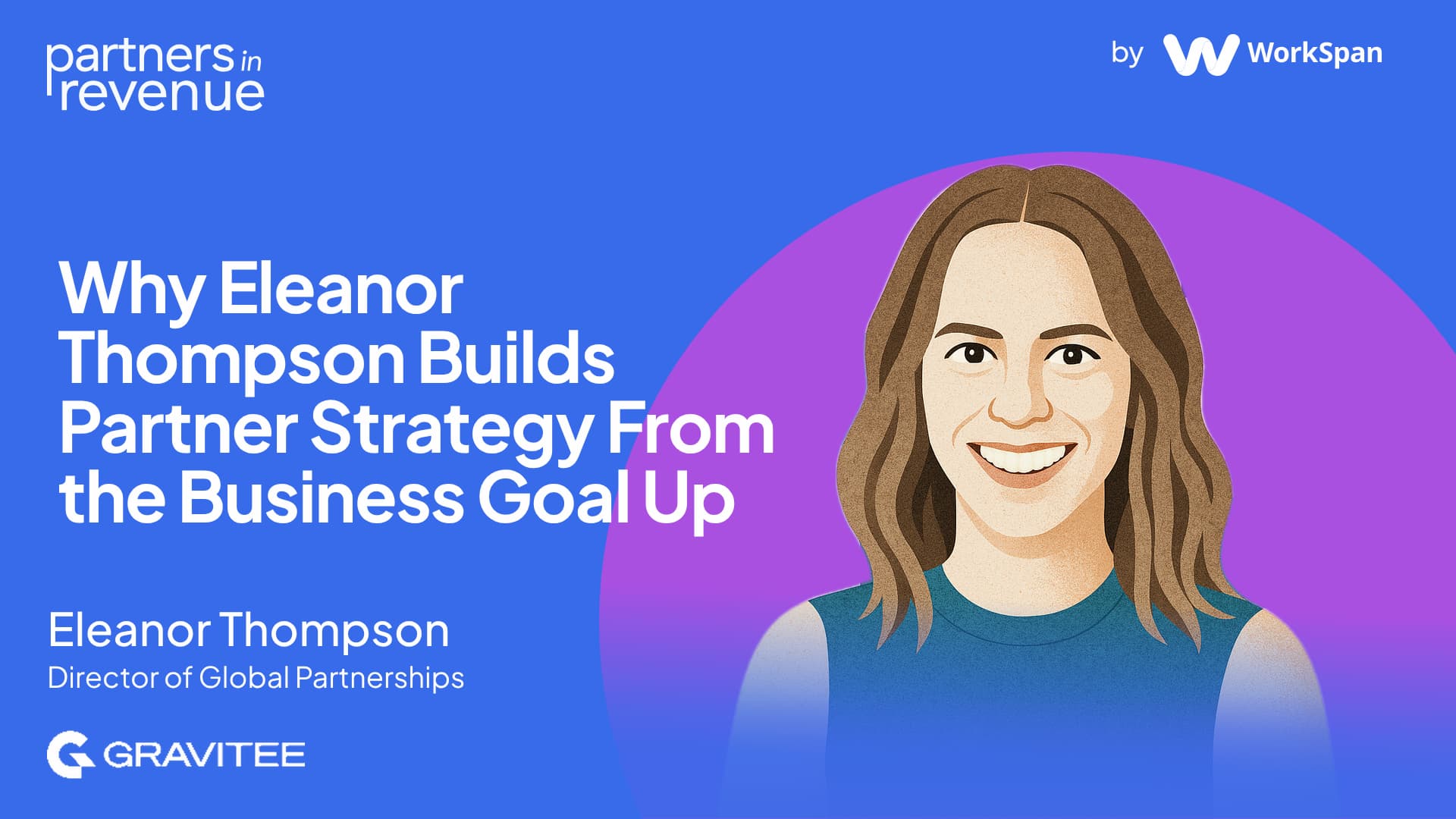
Eleanor Thompson, Director of Global Partnerships at Gravitee, ran her own partnerships consultancy before joining the company full-time. Gravitee was actually one of her clients. Here is how she gets sales teams enrolled in partnerships, and why she builds every partner plan starting from company objectives rather than partner activity.
Working across regional SIs, GSIs, and tech partners, including marketplaces and complementary technology, Eleanor Thompson's view is blunt:
Just because an organization hires a partnerships person doesn't mean they understand the value of partnerships. That belief has to be built, person by person, team by team, and it never stops needing reinforcement.
In fact, that's the hardest part about partnerships. But it's necessary to enable partnerships to align with business goals.
This is the playbook Eleanor uses to align partnerships with the business, get sales teams enrolled, and turn AI into leverage for building stronger partner plans.
Why "Leadership Said Partnerships Matter" Isn't Enough
Eleanor used to assume that once an organization hired a partnerships person, the rest of the company would naturally follow suit. It doesn't work that way.
Salespeople are often in the role long before a partnerships team ever arrives, which she notes is the right order of operations. But it means every one of them has to be actively enrolled in why partners matter, especially if working with a partner might cost them margin on a deal.
"Don't assume just because you've been brought in and leadership have said partnerships are important, that every single person on the sales team is going to get it. They don't naturally get it, and you have to actively get them on board."
The New Hire Advantage
The clearest wins, Eleanor says, come from new salespeople. The reps with no baggage. No one in their ear talking about partnerships negatively or positively.
She tells the story of one new hire she worked with early and closely, helping bridge the relationship between him and his counterpart at a partner with an actual sales team of its own (something that isn't a given when working with technical consultancies).
The two teams ran early account mapping, found low-hanging fruit together, and the rep closed his largest deal to date, around half a million dollars. He then told the story himself, at the company all-hands and in QBR deal reviews, to a sales team that hadn't necessarily bought into partnerships yet.
"If you can have someone within your organization being an advocate for working with partners that isn't you, that's such a fantastic win."
Eleanor Thompson's Playbook for Aligning Partnerships With the Business
1. Show Up Where Pipeline Gets Reviewed
Eleanor sits in on every pipeline or RAG call with the sales team, not just to support deals partners are already in, but to spot the deals where they aren't. She's listening for problems in accounts that a partner could solve, and for opportunities to bring in a services partner before the deal stalls.
2. Make Enablement a Habit, Not an Event
Beyond pipeline calls, Eleanor runs monthly one-to-ones with her sales team (often a walk and a coffee rather than a formal deal review), checking on targets, challenges, and where partnerships could help.
At QBRs, she gets a dedicated slot to reinforce partner value, sometimes running live workshops where reps draft a real outreach message to a partner's sales team on the spot.
3. Diagnose Partner Need From the Business Goal
Rather than chasing buyer signals, Eleanor starts from the company's targets.
If the goal is getting customers live within a set number of months, or improving that in a specific region, the question becomes whether internal teams can hit that alone, or whether partners are the lever.
"If you have a business goal to get customers live within a certain number of months, can you do that alone with the team that you have internally, or do you need partners in order to do that?"
She backs that up with an Ideal Partner Profile. Partners need to fit the profile, but more importantly, they need visible or signaled opportunity within their own accounts. A partner that fits on paper but can't point to real pipeline potential isn't the priority.
She also builds one buyer-facing signal directly into every sales call: asking whether the prospect is already working with a partner, or interested in working with one.
"That gives you a good target list, if they're already working with people, and also tells you very early on if this prospect is gonna have a partner in their ear recommending software to them."
4. Use AI to Build Joint Business Cases From Every Interaction, Not Just Your Own
Every core partner gets a joint business case, which is reviewed quarterly. It covers why the partnership works for both sides, tier status targets, revenue goals, events, and certification targets.
The problem is that so much of the relevant information lives outside any one partnership rep's own conversations: sales calls, services engagements, customer success handoffs.
Her fix is to use the AI already built into the CRM and call recording software to pull every interaction with a partner over the last quarter or six months, then hand that to a second AI to draft the business case itself.
"If you're basing it just off one person, A) it's gonna take you a really long time, B) you're not gonna capture all of the information... but if you can use the AI built within the tools that are already capturing so much data, then you're gonna have a business plan that is, you know, with a lot more substance."
What This Approach Produces
Eleanor's approach doesn't rest on a single dashboard metric. It rests on alignment becoming reflexive.
Sales reps ask about partners on calls because it's been drilled in repeatedly. New hires become advocates because they got an early, supported win. Business cases stay current because they're built from every interaction with a partner, not just the ones the rep personally has.
Her advice to anyone starting in partnerships today is the same principle she's applied to her own career:
"Get aligned to business goals and to business leaders' goals very quickly, and keep getting realigned to them... very clearly articulate how partnerships will help them hit their goals, and as a byproduct, you will hit yours."
Staying a Human Being, Not Just a Human Doing
Even with AI doing more of the operational lifting, Eleanor is clear about what shouldn't change.
"Partnerships are still fundamentally built on relationships and being a good human being. Remembering to spend time with your partners and really build those relationships is so powerful and will not go out of fashion in the world of AI."
WorkSpan helps partner and revenue teams operationalize this kind of motion, embedding partner intelligence and co-sell workflows into CRM so partner signals reach every seller and the highest-potential opportunities get attention without manual chasing. Learn how →