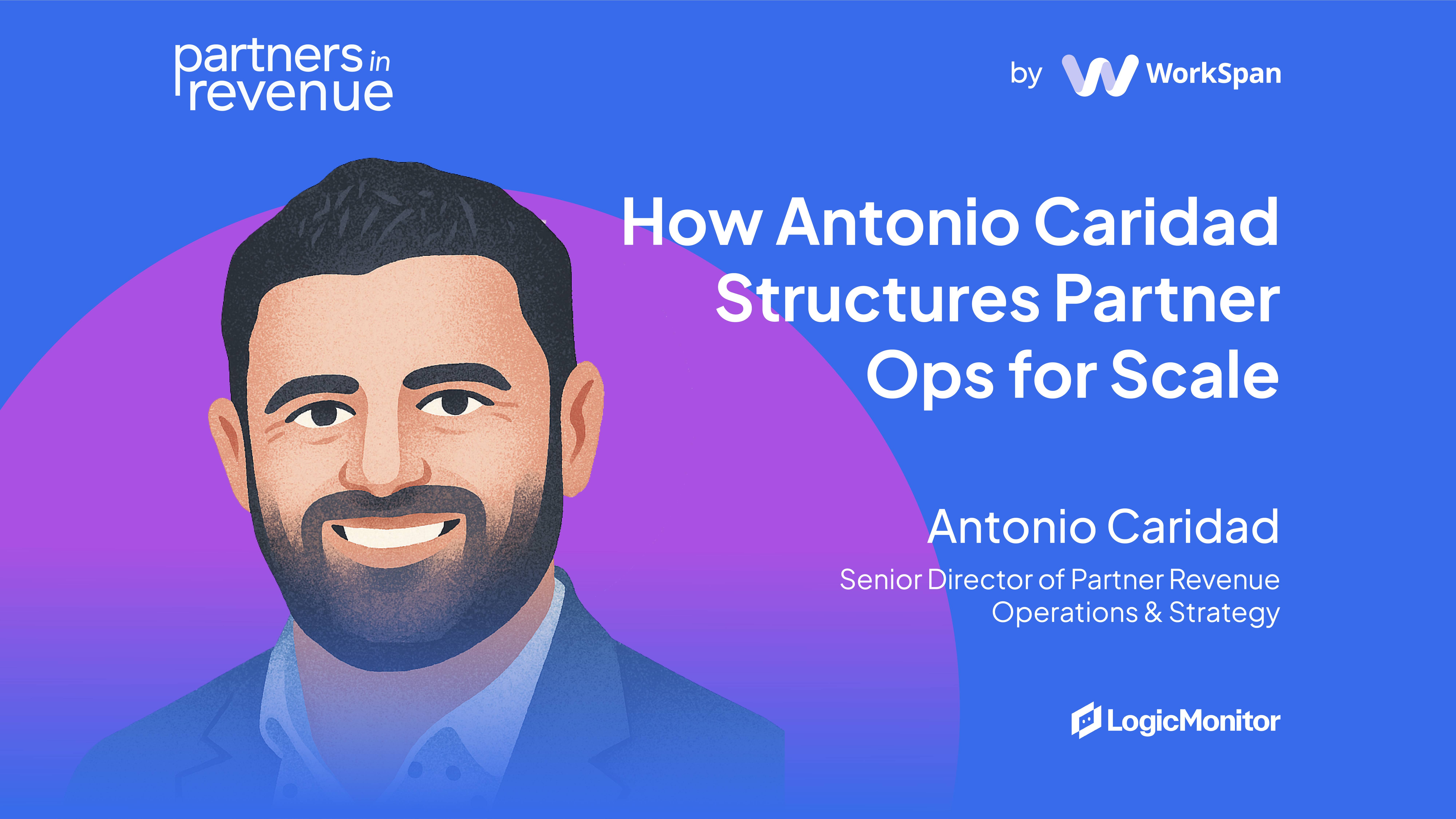
Antonio Caridad, Sr. Director of Partner Revenue Operations at LogicMonitor, shares the operational playbook he uses to build partner programs that hold up under pressure and scale without breaking.
Most companies build their partner programs the same way they build their sales teams. Antonio Caridad has learned that this is where things start to break.
"Where a lot of companies tend to miss the mark is trying to measure and control partnerships the same way you measure and control your sales team. It just doesn't work that way."
As Sr. Director of Partner Revenue Operations at LogicMonitor, Antonio has spent years building and fixing partner operations across multiple organizations. His core belief is that ops and strategy cannot be separated. "Partner ops and partner strategy go hand by hand and side by side and are together. It's hard to separate them, and I think folks or companies that tend to separate them into two different roles tend to struggle."
What follows is the operational playbook he uses to structure partner programs for scale: the foundational framework, the day-one priorities, and the structural decisions that determine whether a partner program produces real revenue or stalls out.
Why Partner Programs Stall
The most common failure Antonio sees is not a lack of effort. It is a misalignment of expectations.
Partnership cycles are longer than sales cycles. Trust takes time. And the expectation that a new program will generate pipeline in 90 days ignores how partner relationships actually work.
"You cannot just say, I'm going to stand up a partner program, and if you build it, they will come. And especially if they happen to come, I want your partners producing deals in three months. It just doesn't work like that."
The pressure to show fast results leads to shortcuts: loose agreements, undefined goals, no shared accountability. The partner team gets squeezed between executive expectations and the reality that trust-based relationships take time to produce.
The Four Pillars That Hold Everything Up
Antonio structures partner operations around four pillars: programs, systems, metrics, and enablement. Partner experience sits at the center, dependent on all four.
"If any of those pillars are crooked or cracked or nonexistent, basically that foundation of that house tends to be crooked and at any point of time it will fall."
When any of the four breaks down, partner experience is the first casualty. And when partner experience suffers, customer experience follows.
What's the first thing that suffers? Your partner experience. And your partner experience drives customer experience.
"When you lose that trust of the partner, you lose the trust of a bunch of customers underneath that partner."
Antonio points to Microsoft as the benchmark. "95% of their business comes through partners. That is a blueprint for everybody." The lesson is not that every company should mirror Microsoft's model. It is that partner experience is operational infrastructure, and it only works when all four pillars are standing.
Antonio Caridad's Playbook for Structuring Partner Ops
With the four pillars as the foundation, Antonio's approach comes down to four operating priorities: aligning incentives, building data infrastructure, structuring for accountability, and creating economic value that draws in larger partners.
1. Align Every Partnership Around a Triple Win
Before building any operational structure, Antonio starts with incentive alignment.
"It's not only a mutual win. It's a triple win. Customer wins first and foremost, then the partner wins, then you win."
Most programs skip this step. Leadership sees partners as a pipeline generation channel. The partner sees no clear return. And without mutual value, the relationship becomes transactional before it ever becomes strategic.
"If you don't have mutual understanding and a mutual win, if there's nothing in there for the partner, maybe you'll be lucky that a partner brings you a couple deals." But that luck does not last.
Very fast, you'll find out like, here he comes again, wanting me to bring him another lead or to help him close the deal. I don't understand what's in there for me other than he's winning here.
"In the ecosystem, you have to learn to be the person that gives before you get, and that reciprocates."
2. Make Data Your Day-One Priority
Antonio's second move is tactical and immediate: get the data infrastructure in place before anything else.
"Day one in your new job, you should be asking: where's the data and how can I get the data? And how can I start tracking and measuring things?"
Every partner leader will eventually be asked what the program has produced. Without data, that conversation becomes a liability.
If you say that, in your CRO's mind, they just hear cost, cost, cost, cost, cost and time, time, time, time. What do you have to show for?
The goal is not a perfect dashboard on day one. It is a system that captures deal velocity, average deal size, and win rates from the start, so that when leadership asks for proof, you have a trend, not a pitch.
"If you don't have the data, start working towards getting your CRM in line to capture all of that."
Antonio proved the value of this approach at a former employer where the partner team's impact was being questioned. By taking consistent snapshots month over month and quarter over quarter, the data told a clear story.
"We consistently kept coming up with the same story: our deals are 2.5 to 3 times larger, our win rates are three to four times better, our deal velocity is 30 to 35 percent faster."
The key was not a single report. It was consistency. "It was not a fluke. We see a trend, we see consistency."
3. Structure Partnerships for Mutual Accountability
Antonio draws a hard line between partnerships that exist only as signed agreements and partnerships that are operationally structured for results.
"Ensure that whenever you are going to go into a partnership with a partner, first and foremost, that you have an IPP and that that's the right partner, that's the right fit. You are the right fit for them. They're the right fit for you."
But fit alone is not enough. Antonio pushes for operational depth: MOUs, shared goals, defined cadences, and deliberate multi-threading across both organizations.
"Go beyond that and ensure you have MOUs if possible, that you have goals, that you have targets, that you have a very defined cadence. That you're in constant communication, that you're doing your proper multi-threading."
You are basically connecting AEs to AEs, marketing to marketing, customer success to customer success, executives to executives. You are attacking from all sides.
Antonio emphasizes that this structure protects both sides. Your partner counterpart faces the same internal pressure.
"Your counterpart, meaning the partner manager on the partner side, they're gonna be asked to do the same. Their CEO, their CRO is gonna tell them, you've been spending a lot of time with Antonio. What do you have to show for that?"
When both sides have documented goals, QBR cadences, and cross-functional connections, both partner managers can defend the relationship internally. Without that structure, even strong relationships become vulnerable.
WorkSpan embeds partner intelligence, co-sell workflows, and attribution directly into CRM, helping partner teams structure the kind of operational accountability Antonio describes. See how →
4. Build Value That Attracts Larger Partners
Once the operational foundation is set, Antonio focuses on creating the kind of economic value that draws in GSIs and RSIs.
At a former employer, he built a services delivery program that partners had been requesting. Internal stakeholders questioned whether partners would engage. Antonio had seen this work before.
"If you want to attract the attention of the large SIs, the large RSIs, the large GSIs, this is where they make their money. A large GSI doesn't make their money on a 25% margin. Let's not kid ourselves."
The results validated the approach on two fronts. First, partners implementing the product improved time to value by five to six months compared to internal teams. Second, the data revealed a compelling economic story for the partners themselves.
For every dollar that they helped us close in a normal deal cycle, they had the ability to basically earn 10 to 12X on top of that dollar. That is what catches the attention of the GSIs.
This is the triple win operating at scale. The customer gets faster implementation. The partner gets a meaningful revenue multiplier. And the company gets higher-quality deployments and deeper partner commitment.
What Structured Partner Ops Produces
When the operational foundation is in place, the results compound.
Antonio's data told a consistent story across multiple quarters: partner-attached deals were 2.5 to 3 times larger, win rates were three to four times better, and deal velocity improved by 30 to 35 percent. The consistency of those numbers is what earned executive confidence.
"It was that the story was continued. There was a trend of consistency that eventually they're like, okay, I get it. We're using the same data. We're benchmarking the same way."
The shift is not just in the metrics. It is in how the organization thinks about partnerships. Structured, data-backed partner operations move the conversation from cost justification to growth investment.
Antonio captures the distinction in a phrase he uses with sellers and customer success teams:
Channels help you close deals, while true partnerships and well-built partnerships build businesses.
WorkSpan helps partner and revenue teams structure scalable, CRM-native partner operations, turning partnerships into a repeatable revenue motion. See how it works →
Antonio Caridad is the Sr. Director of Partner Revenue Operations at *LogicMonitor. He is a veteran partnership operations and strategy leader with deep experience building and scaling partner programs across the technology ecosystem.*
WorkSpan's series spotlighting expert partner leaders in the industry and the valuable insights and proven playbooks that helped them drive scalable. partner-driven revenue
Heading
Heading 1
Heading 2
Heading 3
Heading 4
Heading 5
Heading 6
Lorem ipsum dolor sit amet, consectetur adipiscing elit, sed do eiusmod tempor incididunt ut labore et dolore magna aliqua. Ut enim ad minim veniam, quis nostrud exercitation ullamco laboris nisi ut aliquip ex ea commodo consequat. Duis aute irure dolor in reprehenderit in voluptate velit esse cillum dolore eu fugiat nulla pariatur.
Block quote
Ordered list
- Item 1
- Item 2
- Item 3
Unordered list
- Item A
- Item B
- Item C
Bold text
Emphasis
Superscript
Subscript

%20(1).jpg)
%20(1).jpg)
%20(1).jpg)