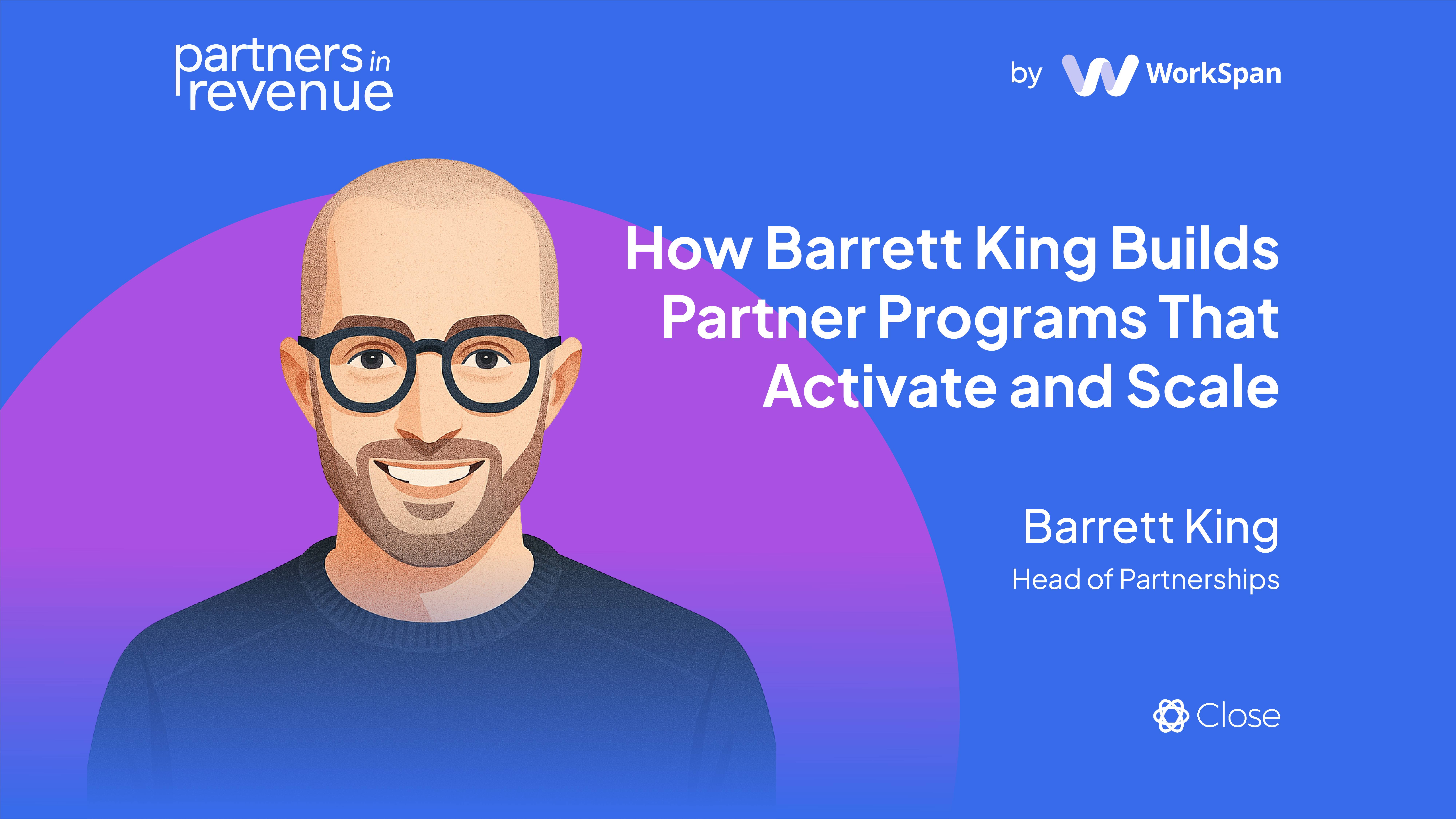
Barrett King, Head of Partnerships at Close, shares the operating playbook he has used at HubSpot, Ramp, and Close to turn partner programs into repeatable activation and growth engines.*
Most partner programs start with the same ambition: generate revenue through partners. The problem is not the ambition. It is the assumption that a single goal and a list of partners will produce results.
Barrett King has spent 15 years building and scaling partner programs at companies like HubSpot, Ramp, and now Close, the CRM for small businesses and growing organizations. Across every stage and company size, he has seen the same pattern: teams skip the foundational work and end up stuck. Activity without activation.
What follows is Barrett's end-to-end playbook for building a partner program that does not just exist on paper, but activates and scales in practice.
The Problem with One-Dimensional Partnership Thinking
The most common mistake Barrett sees is not a lack of effort. It is a lack of dimension.
"Most organizations that I've interacted with in my career show up and say, we want partners because they generate revenue, single dimension, it's single focus. And they don't think about the material impact in terms of whether that increases retention or product expansion or whatever it might be as far as other KPIs."
This single-dimension approach forces teams into a single persona, collapses every partner type into one bucket, and makes it nearly impossible to build the right motions for the right partners.
Barrett defines partnerships explicitly across three categories:
- Go-to-market partnerships. Agencies, SIs, and implementation partners. The businesses that package, price, sell, and service alongside you. These are the tacticians doing the work with you and your team.
- ISV and platform partnerships. Other platforms connected to your system that extend product value, expand usage, and deepen the customer relationship. This is how you extend your platform and deliver more value at the decision stage.
- Ecosystem reach partnerships. Marketplaces, communities, and VC/PE relationships. This is the awareness layer, what Barrett describes as "early inbound marketing or your awareness stage from a go-to-market perspective."
"If I were to reverse engineer this, I'd say the ecosystems, the sort of reach partners are important in terms of awareness. Consideration becomes much more applicable when you think about your agencies, your SIs. And then the sort of end stage decision and ongoing service is more of the ISV. How do we extend our platform? How do we deliver more value?"
Without this categorization, teams default to treating every partner the same way and expecting the same outcome. That is where programs stall before they even begin.
The Discipline Gap That Kills Partner Programs
Even when teams get the categorization right, Barrett sees a second failure point: the absence of sales-level rigor.
"Whether you are small or you are Fortune 500, the rigor, the diligence, the attention to detail, and really the focus is the most common challenge that you see across partnerships."
In direct sales, KPI discipline is table stakes. How many calls were made. How many emails were sent. How many opportunities were created. The funnel is measured at every stage. Partnership teams rarely build that same infrastructure.
Barrett uses a framework he calls reach, frequency, and yield. How many partners do you have? How often are they selling? How much are they selling at? Three levers, but the key insight is that you should only pull one at a time.
"I've worked at big companies where they try and pull all of those levers. We need more partners and we need more of them selling and they just sell at a higher level. And there's no focus there."
The temptation to chase all three at once is what creates the noise that drowns out real progress. Barrett applies a time-bound approach instead.
"I had a smart leader that once said to me, 'You're making a decision about the next year. Stop making this the rest of your life.' I applied the same ideology to partnerships. When I want to use some sort of a lever here in terms of reach or frequency or yield, I want to do that in a single dimension. What am I going to do for the next 12 months or even the first half or second half of the year?"
This creates the measurement clarity that most partner programs lack. One lever. One time horizon. Real data to make the next decision.
WorkSpan helps partnership teams build this kind of operational rigor into their programs from day one, with attribution, reporting, and pipeline visibility that makes partner motions measurable and repeatable. Learn how →
Barrett's Playbook for Activating Partners at Scale
With the right categories defined and the right discipline in place, Barrett moves to the work that most teams rush into too early: activation.
1. Start with Partner Conversations, Not Assumptions
Barrett's first move at every company, including Close, is the same: talk to partners.
"As silly as it sounds, a lot of partnership leaders, a lot of revenue leaders get sucked up into their world. It's my experience and my background. And we're going to tell them what to do. The first thing I did is started meeting with partners. What value are you getting? Why are you a partner?"
The goal is to find the intersection of value between the partner, your organization, and your customer. Barrett frames it with a simple test.
"If tomorrow my business didn't pay my partners, do they get enough value to still care?"
At HubSpot, the answer was clear. When a partner sold the platform, they got a 5x return on that dollar in recurring services revenue. The story was not about the software commission. It was about the multiple on services and the ability to grow their business.
"That multiple became really valuable in telling the story of why you should be a HubSpot partner. It wasn't about the software and the commission. It was about the multiple on services and the ability to grow your business more effectively."
This intersection of value becomes the foundation for everything that follows. Without it, activation efforts are guesswork.
2. Package What Already Exists
Once the value story is clear, Barrett does not build a new enablement program from scratch. He packages what the company is already doing.
"I love to call it a business model in a box. I'm going to take what my marketing team's already doing. I'm going to package that up. I'm going to give that to my partners, and I'm going to do it at scale."
This is not a metaphor. At HubSpot, Barrett literally built a Google Drive folder called "Barrett's Business Model in a Box." It included lazy copy for social media, blog articles partners could repurpose and backlink to, and a simple sales qualification framework.
"Take what your team is doing, give it to your partners, empower them to be successful."
No new enablement hire. No reinventing the wheel. Just repackaging existing resources in a way partners can use immediately.
For ISV partners, Barrett adapts this into a "campaign in a box" focused on helping technology partners evangelize the integration. Recognition moments like carousel features on the website, C-suite reposts on LinkedIn, and invitations to present at internal all-hands for the sales team.
3. Distribute Across Every Channel
Activation does not happen through a single touchpoint. Barrett pushes the business model in a box through every available channel.
"I'm going to get in front of them as often as I can. And I'm going to do this through webinars. I'm going to do it through email. I'm going to do it through live Q&As. I'm going to do it through Slack, all these different mediums."
For Barrett, Slack is the most valuable channel for sustained partner engagement.
"Slack is your best friend. I create channels for all my partners. I engage with them live. It's the quick touch points, the stay in front of the moments, the 'Hey, I saw this article and thought of you.' At the end of the day, our job is to remain relevant and timely."
These micro-touchpoints compound over time. They keep the relationship warm and the partner engaged between formal reviews.
4. Advocate Internally for Partners Who Show Up
Barrett builds a reciprocal loop into the activation model: partners who act on the resources they are given get internal advocacy in return.
"We're going to give you resources and when you act on them, we're going to go and actually advocate for more opportunity for you internally. We always hear our partners say, we want more leads, we want more business from you. Great. Do your part and I'll do mine."
That means putting partners in front of leadership, bringing them into QBRs with the sales org, and telling their story to anyone who will listen. Not a nice-to-have. Part of the operating system.
"Putting your partners on a pedestal in front of your leadership wherever you can, putting them in front of your sales or CS orgs, like being much more of their advocate matters as well. And I developed that part of the relationship early."
5. Ask the Questions No One Else Asks
Barrett's playbook extends to ecosystem and marketplace partners with a different tactic: radical directness about incentives.
In a recent call with a large web provider's partner manager, Barrett asked a question that caught the person off guard.
"I said, well, how do you get compensated? He was blown away out of his chair. He goes, no one's ever asked me that. I said, it's really simple, man. You're here to make money. I'm here to make money. We want to help our customers win together. How do we do more of that? We ensure we both get paid."
The partner manager's compensation was based on usage. Barrett already knew that, but he wanted to hear the person say it. Once it was in the open, they could align on driving product awareness through the marketplace in a way that served both sides.
Finding the intersection of value at every level. Not just the program level. The individual human level.
What Changes When You Build This Way
Barrett's clearest proof point comes from early in his career. He was working with a three-person agency led by a smart, capable CEO who lacked resources.
He asked his marketing team what they had that he could redistribute. Lazy copy for social posts. Blog articles that could be repurposed. Nothing proprietary. Then he built a simple sales qualification framework.
"Three years later, they went from three people to 15. They went from call it $250,000, give or take of revenue to well north of 2 million. And I didn't do anything at the time that I thought was revolutionary. I just took what I was doing and being asked to do at my company and did it with my partner."
The lesson is not that one success story proves the model. It is that the building blocks of activation compound in ways that are hard to see in the first quarter but impossible to ignore over time.
"We talk a lot about partnerships as this big, grand, heavy rock to move. That said, I think what's important to acknowledge is that the little things, the every day, the every week, makes a big difference."
From Manual Heroics to a Repeatable Activation Engine
Barrett's playbook is a case study in what happens when partner teams stop improvising and start operationalizing. Define the dimensions. Build the discipline. Discover the real value. Package what exists. Distribute relentlessly. Advocate loudly. Measure closely.
The pattern underneath all of it is the same shift driving the best partner organizations today: from individual effort to systematic execution. From scattered activity to a repeatable revenue motion.
But Barrett's frameworks need infrastructure to run at scale.
His reach, frequency, and yield model only works when you can actually measure those levers. His "business model in a box" only scales when partner intelligence reaches every seller, not just the ones a partner manager has time to brief. His internal advocacy loop only sustains when leadership can see real attribution data.
That is the gap WorkSpan closes.
WorkSpan embeds partner intelligence directly into CRM workflows so sellers know which partners to engage and when. It gives partnership leaders the attribution, reporting, and pipeline visibility to measure exactly which lever is moving. And it turns the kind of playbook Barrett describes into repeatable infrastructure across every opportunity, every account, and every seller.
Ready to turn your partner activation playbook into a scalable system? See how WorkSpan operationalizes partner revenue →
WorkSpan's series spotlighting expert partner leaders in the industry and the valuable insights and proven playbooks that helped them drive scalable. partner-driven revenue
Heading
Heading 1
Heading 2
Heading 3
Heading 4
Heading 5
Heading 6
Lorem ipsum dolor sit amet, consectetur adipiscing elit, sed do eiusmod tempor incididunt ut labore et dolore magna aliqua. Ut enim ad minim veniam, quis nostrud exercitation ullamco laboris nisi ut aliquip ex ea commodo consequat. Duis aute irure dolor in reprehenderit in voluptate velit esse cillum dolore eu fugiat nulla pariatur.
Block quote
Ordered list
- Item 1
- Item 2
- Item 3
Unordered list
- Item A
- Item B
- Item C
Bold text
Emphasis
Superscript
Subscript

%20(1).jpg)
%20(1).jpg)
%20(1).jpg)