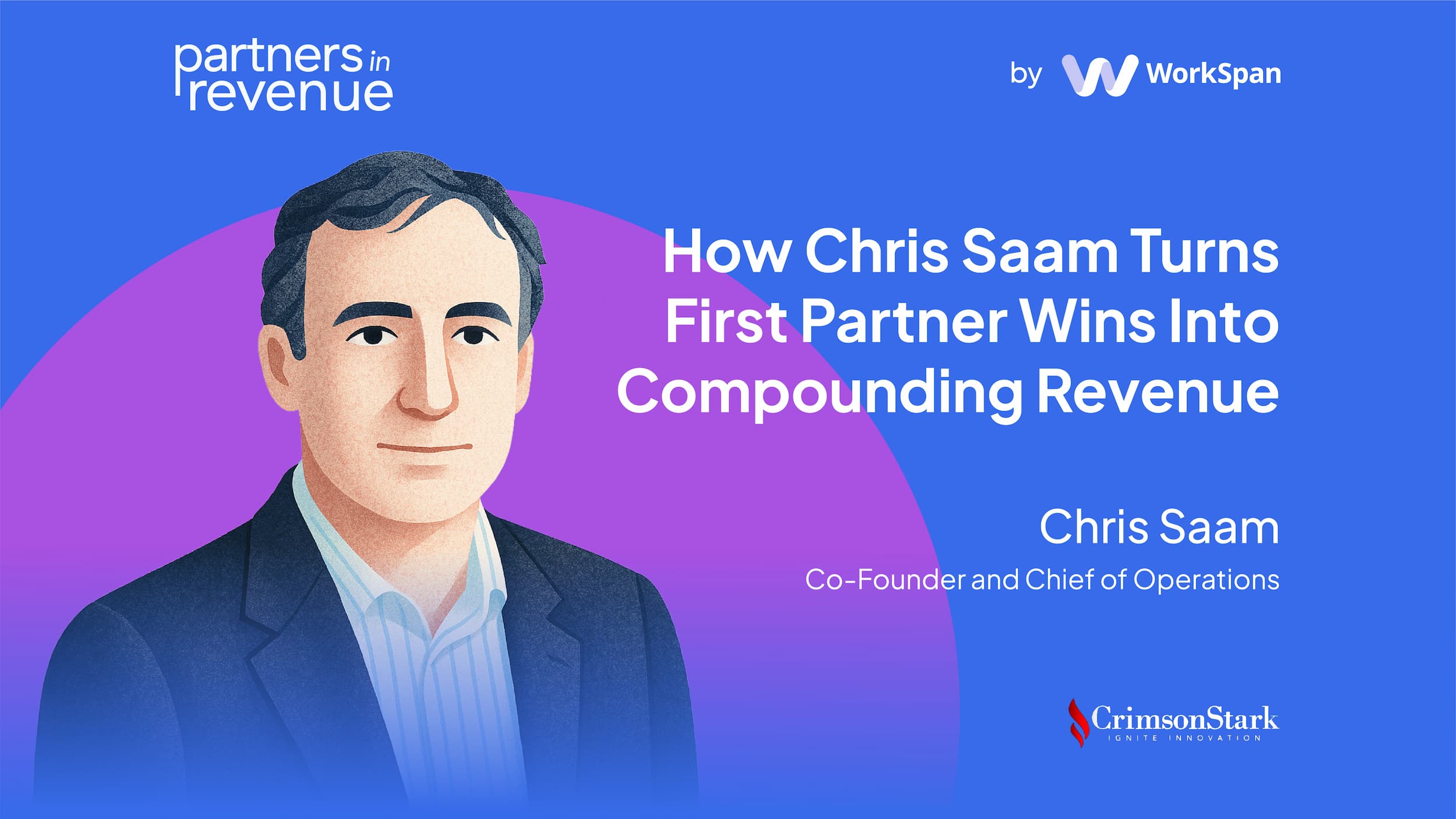
Chris Saam, Co-Founder and Chief of Operations at CrimsonStark, shares the operating playbook he has used across 13 years in partnerships, including 8 years at SAP, to turn first partner wins into repeatable, compounding revenue.
Most partner programs don't fail because the wrong partners were chosen. They fail because the partnership never turns into a motion.
Chris Saam has seen this pattern across more than a decade of partner work, including managing strategic partnerships at SAP and now running CrimsonStark, where he helps B2B companies set up the foundations of partnerships that drive real revenue.
"It is work to get there. And I don't want to undersell, like you can't just go to a partner, get a win, and then there it is. There's a lot of work that goes into getting there and there's a lot of work that goes into capitalizing on those first wins to build repeatable sales motions."
What follows is Chris's playbook for the work that actually turns a partnership into compounding revenue: how to onboard, how to capitalize on the first win, how to operate, and how to know when it is working.
Why Most Partner Programs Stall
The most common failure Chris sees is a misunderstanding of what onboarding actually means.
Most teams treat onboarding like procurement. Sign the agreement. Share a few docs. Schedule the kickoff. And expect the deals to follow.
"Onboarding is really about the activation of that partner. Paperwork is part of that. You need to agree on the terms and how you will engage with each other. But at the end of the day, if you don't enable and activate that partner to know when to position you and to know when to bring you into a customer, the paperwork isn't going to get you very far."
The second failure is mistaking activity for progress. Chris sees this constantly: teams that point to ten partner meetings as a sign the program is working.
"I've had 10 meetings with partners, like that isn't... okay, what were the outcomes of those meetings? Did they lead to additional opportunities? Did they lead to conversations with new and different people? Just having meetings that don't go anywhere, meetings that don't advance a partnership, is not very productive."
Meetings aren’t momentum. Outcomes are.
The Work That Compounds
Chris's view of what makes partnerships compound is precise. Instead of focusing on getting more partners, he believes it’s about doing the work that turns the partners you already have into a repeatable motion.
"It's really about getting to that first sale. And it's about leveraging that first sale to open up the door to the next five to ten sales. When you get that, that's where you get that hockey stick moment, and that's where you get the partnership to really take off."
The work breaks into four operating priorities.
Chris Saam's Playbook for Building a Compounding Partner Motion
1. Treat Onboarding as Activation, Not Paperwork
The first move on every partnership is treating activation, not paperwork, as the starting line.
That means partners need to know:
- the customer profile you are actually trying to reach
- the problems you solve, in plain language
- when to position you in a conversation
- how to pull you into a deal without adding friction
"I've yet to see a partnership work where you just have paper in place without constant communication, constant enablement, and really working that partner channel to uncover opportunities."
The collateral that supports activation is intentionally simple:
- a one-pager for customer-facing context
- a battle card so the partner knows when to position you and what is in it for them
- a customer story that proves the one-pager and battle card are real
- a short intro deck to open the door to discovery
None of this is meant to make the partner sell your product. It is meant to make it easy for partner sellers to recognize fit and route opportunities to the right place.
"Just arm them with enough that they can go out and uncover opportunities. If they hear certain pain points, if they hear about certain problems, if they internalize what the problems that you solve are, they can kick opportunities back to you."
2. Capitalize on the First Win Immediately
This is the step Chris says most teams miss.
Getting the first sale matters. But the first sale is not the finish line. It is the moment the real work starts.
"This is the thing that I think a lot of people miss. Once you have that win, immediately capitalizing on that, telling that story, promoting that story within that partner, and using it to recruit other partners. That does take work."
That means:
- telling the story inside the partner organization the day the deal closes
- recruiting more internal champions on the back of the proof point
- staying consistent in your message and repeating it across the partner org
- using the win to make the next five to ten deals easier
Chris does not assume one win will translate into more pipeline on its own.
"Don't assume that one win with a partner is going to lead to that partner introducing you to additional opportunities. They have their own sales quotas to hit. They have their own KPIs. You as their partner are very likely a secondary or even a tertiary concern of theirs."
The work, in his words, is almost like selling within the partner so your sales team can then sell within the customer.
3. Get Sales Talking to Sales
The partnership starts to compound when the conversation moves from partner managers talking to partner managers to AEs talking to AEs.
"What really works is when you have sales teams speaking with sales teams, and now you've got a lot of cross mapping of opportunities. You're looking at how you can help each other win in each other's accounts. When you see that type of behavior, that's generally where you're going to get that hockey stick."
Chris's job at that stage is to broker introductions, equip both sides with context, and then get out of the way. When the partner does extend something valuable, an intro, a warm handoff, internal advocacy, the worst thing you can do is sit on it.
"It is critical that the partner capitalizes on those. They don't sit on those, they don't wait. There needs to be that immediate fast follow and appreciation of someone going out of their way to help."
4. Operate With Sales-Level Cadence
Chris is unsentimental about what it takes to run a real partner motion.
For most opportunities, weekly attention is the floor. For the highest-potential deals, the cadence shifts.
"For those opportunities that have the highest potential, now you're talking daily. Especially if you're trying to get that first win or you're trying to get the first win that's over a hundred thousand, five hundred thousand. Those are the all-hands-on-deck type of opportunities where if that needs attention, you drop what you're doing and you focus on that."
Without that focus, the motion fails in a predictable way.
"If you're not on top of the most critical opportunities, if you're not on top of the overall activity, the partnership will lag. Things will fall by the wayside. And then any momentum that you had built will be lost. That's the type of thing you see all the time with partnerships and organizations that go stale. It's a lack of focus and a lack of attention, like 90% of the time."
WorkSpan helps partner and revenue teams operationalize this kind of partner motion, embedding partner intelligence and co-sell workflows into CRM so the most critical partner opportunities get the attention they need without manual chasing. Learn how →
What It Looks Like When the Work Pays Off
Chris's clearest proof point comes from his time at SAP, managing the SAP-Pricefx partnership.
When Pricefx first came under his management, the relationship was new and unproven. The work followed the playbook above: identify the ideal customer profile overlap, get the first wins, get account executives on both sides incentivized and aligned, and tell the story to a wider audience.
"Today, I believe there are over a hundred million in total contract value within SAP accounts, from close to zero seven or eight years ago. It took a little bit of time, took a lot of work, but it was quite a successful partnership."
Chris has run the same playbook with CrimsonStark clients. One client, an existing but dormant SAP partner, was reactivated through sales enablement, pre-sales enablement, and a focused push around SAP Sapphire. That work produced an asUG speaking session in front of 200 attendees, which produced five to six new opportunities, which laid the foundation for three to five million in pipeline this year.
"It's a lot of work, but a lot of fun. When it really works well and it really clicks, it justifies the work that goes into it."
How You Know It's Working
Chris has a simple test for whether a partnership is becoming real.
"It's when you have the unsolicited kudos. When you have a co-founder, a VP of sales, a VP of marketing, individual reps saying, would they have that lightbulb moment, especially if they were originally skeptical of a partnership. When they actually see the value of working with partners. When they realize that, had it not been for this partner, we would not be talking to the people we are in this account."
Those are the moments, in his words, that make the work worth it.
From Activity to a Repeatable Partner Motion
The pattern underneath Chris's entire playbook is the same pattern showing up across the strongest partner organizations today: a shift from activity to system.
Meetings turn into outcomes. First wins turn into the next five to ten. Partner managers turn into a cross-functional motion that spans both sales orgs.
That shift only holds up if the operating layer underneath it can scale. Reach, frequency, activation, attribution, focus on the right opportunities, all of it depends on partner intelligence reaching every seller, not just the ones a partner manager has time to brief.
That’s the gap WorkSpan closes.
WorkSpan embeds partner intelligence and co-sell workflows directly into CRM, so the work Chris describes, telling the story, recruiting champions, capitalizing on every win, focusing on the highest-potential opportunities, becomes repeatable infrastructure across every seller, every account, and every deal.
Ready to turn your first partner wins into a compounding partner motion? See how WorkSpan operationalizes partner revenue →
WorkSpan's series spotlighting expert partner leaders in the industry and the valuable insights and proven playbooks that helped them drive scalable. partner-driven revenue
Heading
Heading 1
Heading 2
Heading 3
Heading 4
Heading 5
Heading 6
Lorem ipsum dolor sit amet, consectetur adipiscing elit, sed do eiusmod tempor incididunt ut labore et dolore magna aliqua. Ut enim ad minim veniam, quis nostrud exercitation ullamco laboris nisi ut aliquip ex ea commodo consequat. Duis aute irure dolor in reprehenderit in voluptate velit esse cillum dolore eu fugiat nulla pariatur.
Block quote
Ordered list
- Item 1
- Item 2
- Item 3
Unordered list
- Item A
- Item B
- Item C
Bold text
Emphasis
Superscript
Subscript

%20(1).jpg)
%20(1).jpg)
%20(1).jpg)