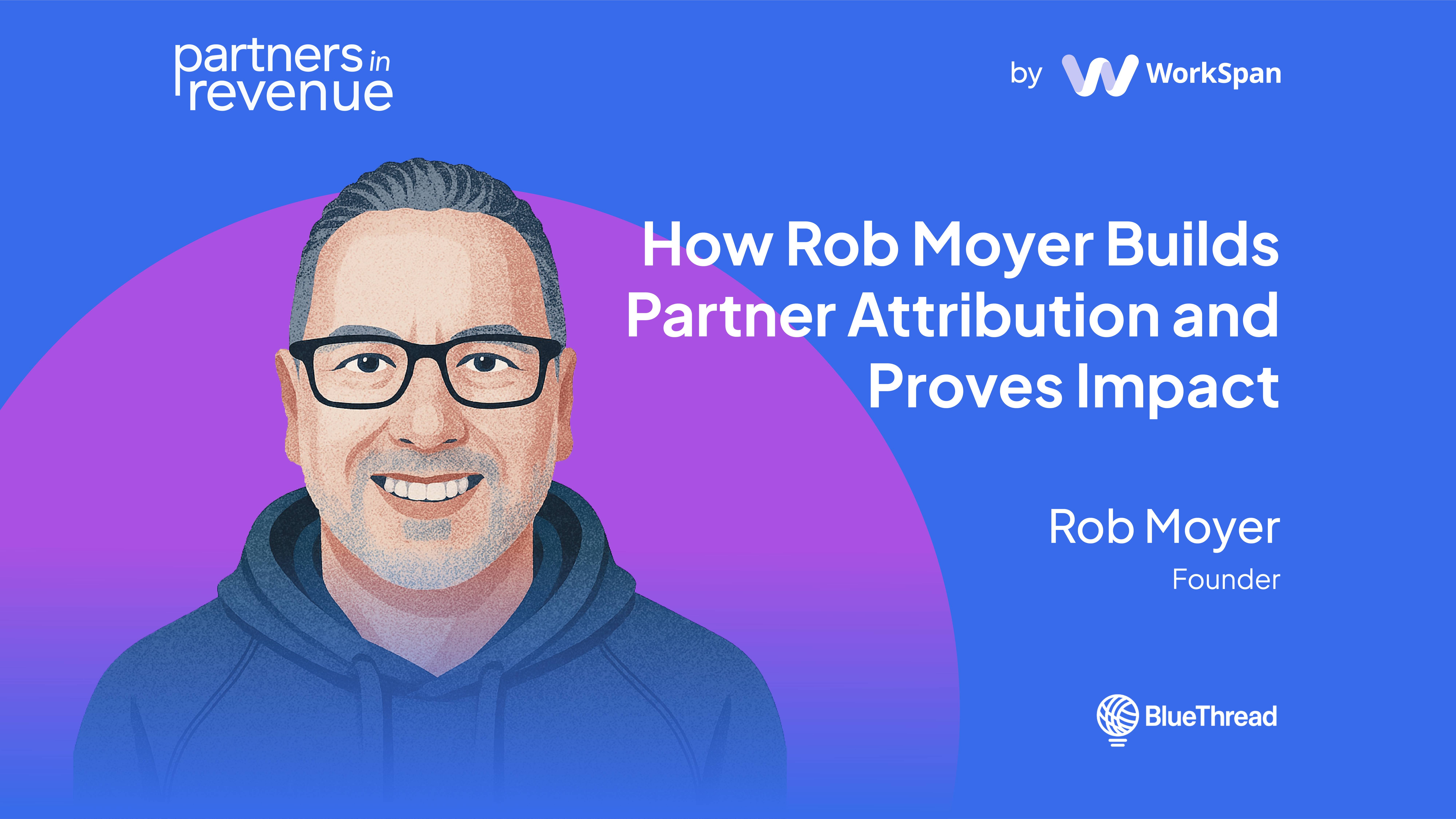
Most partner leaders know partnerships drive revenue. Rob Moyer, founder of BlueThread and former Global Head of Partnerships at Gong, has built a repeatable framework to prove it in a language the entire business understands.
Partner attribution is one of the most persistent challenges in partnerships. The team is creating real value in deals, but the business cannot see it clearly enough to invest further.
Rob Moyer has spent years solving this problem. As the former Global Head of Partnerships at Gong and now founder of BlueThread, he has built a partner attribution framework he deploys with every client.
"If you can't speak the language of your RevOps teams, your Sales Ops team, or finance, you're dead in the water before you even get going."
This is his playbook.
The Proof-Before-Scale Problem
Most ISVs begin as direct sales businesses. By the time a partner function is added, the CRM and operational workflows are already designed around a direct model.
"Every company starts out direct. So they do all their tooling based on a direct model. Then when partnerships come in, that budget's already taken," Rob explains. "So you have to somehow adapt to the direct model in a way that is a win-win."
Without a defensible model, partner teams struggle to secure resources or earn executive confidence. The gap between creating partner value and proving it is what keeps many partnership organizations from scaling.
"It's generally because they're spending six months trying to figure it out. But if you don't implement a model, it's going to be hard to prove your actual impact."
The Internal VC Pitch
Partner leaders are not just managing relationships. They are pitching for internal investment, and most are walking in without the data to back it up.
"I think of the C-suite as the venture capital and all the departments are companies pitching for funding. If you set up your partnership kind of like that, where you iterate fast and prove your point, that's the way you get successful."
"I have yet to see a client once they put it in place... it probably was already happening. They just couldn't prove it."
The role now demands more. "The new skill set for a partner leader needs to be strategist, architect, orchestrator," Rob says. "Bad data is worse for you than no data."
Rob's Five-Step Attribution Framework
Rob's framework connects partner contribution directly to the CRM and the direct sales funnel.
1. Start with Your System of Record
The first step is always the CRM.
"It starts with your CRM or your system of record, and then how do you cascade your partner tech stack to fit your processes," Rob says. "I'm adamant about this."
When partner data lives inside the same system sellers and revenue leaders use every day, it becomes part of the revenue conversation rather than a separate report. Without that connection, attribution will always feel like a parallel, less credible data set.
"I think for the first time ever, at least in my career, partner tech stack is actually ahead of the capabilities of the people using it," Rob says. "What you can do with these partner tools now, they're mind blowing."
2. Map Partner Value Across Three Tiers
Rob breaks partner contribution into three tiers, each mapped to a stage of the funnel:
Top of funnel: Partner source. The clearest form of attribution. "Partner source is really easy. It's literally deal registration," Rob explains.
Middle of funnel: Co-sell. This is where it gets complex. "If you broke down the opportunity model from MQL to close won, did the partner do two or more activities within that model? That I consider co-sell."
Those activities could include executive introductions, solution validation, or integration support. Capturing them requires partner engagement data flowing into the opportunity record, not sitting in a separate system.
Bottom of funnel: Influence. "I don't pay for it, but I want to know," Rob says, "because the next step in this model is now compare partner-attached to direct."
3. Compare Partner-Attached Deals to Direct
Once the three tiers are mapped, the next step is a direct comparison between partner-attached and direct-only deals.
"I love going in this model, once you've established it, what is your win rate?" Rob says. "When you put win rate with partner in any of these attribution models, they're usually two to three X."
The same applies to deal size and cycle time. "You can really break it down because now you've established a connection to the direct seller's funnel model with an attribution to what the impact of the partner was."
This data also changes how sellers engage with partners. When attribution shows partner-attached deals winning at two to three times the rate, seller adoption of partner motions tends to follow.
4. Build the Forecasting and Storytelling System
The framework must feed into a forecasting system that lets partner leaders defend their numbers.
"The most immediate value most clients say is, 'Wow, I can defend my number and impact much clearer than I could six months ago.'"
Rob also recommends building this into the team structure: "Get that hybrid go-to-market partner engineer, or a strategy RevOps person that can run your forecast and your attributions so the team can actually tell the story."
The goal is making attribution sustainable as a system, not dependent on one person running the numbers.
5. Set Up the System So the Data Tells the Story
The final principle is operationally critical. Let the data lead.
"Set up the system so the data tells a story, good or bad, because sometimes bad is just as good as good, because you can adjust your strategy."
This discipline is what separates a defensible attribution model from a reporting exercise.
WorkSpan embeds partner attribution directly into CRM workflows so partner teams can prove impact without building parallel systems. See how →
What Changes When Attribution Is in Place
Rob's clients consistently report two shifts once the framework is in place.
First, they can prove what was already happening. "I have yet to see a partnership org have win rates less than their direct side," Rob says. "And for the most part, average deal size generally goes up as well." The value was always there. The framework makes it visible.
Second, the conversation with leadership changes. Partner-attached deals closing at two to three times the win rate of direct deals is no longer a belief. It is a data point. The case for investment becomes clear.
Attribution also changes how partners engage. "I always worked with my partners and said, this is how I view you." When partners see how their contributions are tracked, the relationship deepens.
Rob's approach reflects what the strongest partnership organizations are building toward: attribution that is embedded in revenue operations, not bolted on as an afterthought.
"Don't worry about next year. We're about this year. I'm focused on how am I going to hit my number this year, and how do I prioritize using the tools available?"
WorkSpan helps partner and revenue teams operationalize partner attribution, co-sell execution, and seller activation inside CRM-native workflows. See how it works →
Rob Moyer is the founder of BlueThread, an advisory practice specializing in partner strategy and tech stack optimization. He is also the founder of Blue Thread Collective, an open-source community for partnership professionals. Previously, he served as Global Head of Partnerships at Gong.
WorkSpan's series spotlighting expert partner leaders in the industry and the valuable insights and proven playbooks that helped them drive scalable. partner-driven revenue
Heading
Heading 1
Heading 2
Heading 3
Heading 4
Heading 5
Heading 6
Lorem ipsum dolor sit amet, consectetur adipiscing elit, sed do eiusmod tempor incididunt ut labore et dolore magna aliqua. Ut enim ad minim veniam, quis nostrud exercitation ullamco laboris nisi ut aliquip ex ea commodo consequat. Duis aute irure dolor in reprehenderit in voluptate velit esse cillum dolore eu fugiat nulla pariatur.
Block quote
Ordered list
- Item 1
- Item 2
- Item 3
Unordered list
- Item A
- Item B
- Item C
Bold text
Emphasis
Superscript
Subscript

%20(1).jpg)
%20(1).jpg)
%20(1).jpg)