Two sellers from partner companies walk into a customer meeting. Neither has seen the other's value proposition. Neither knows the account's funded priorities. Neither can articulate the joint outcome they're supposed to deliver. The meeting isn't a disaster — it's just forgettable. And the deal doesn't die in the pipeline. It dies in that room, thirty seconds in, when the customer realizes the two people sitting across from them haven't done the work.
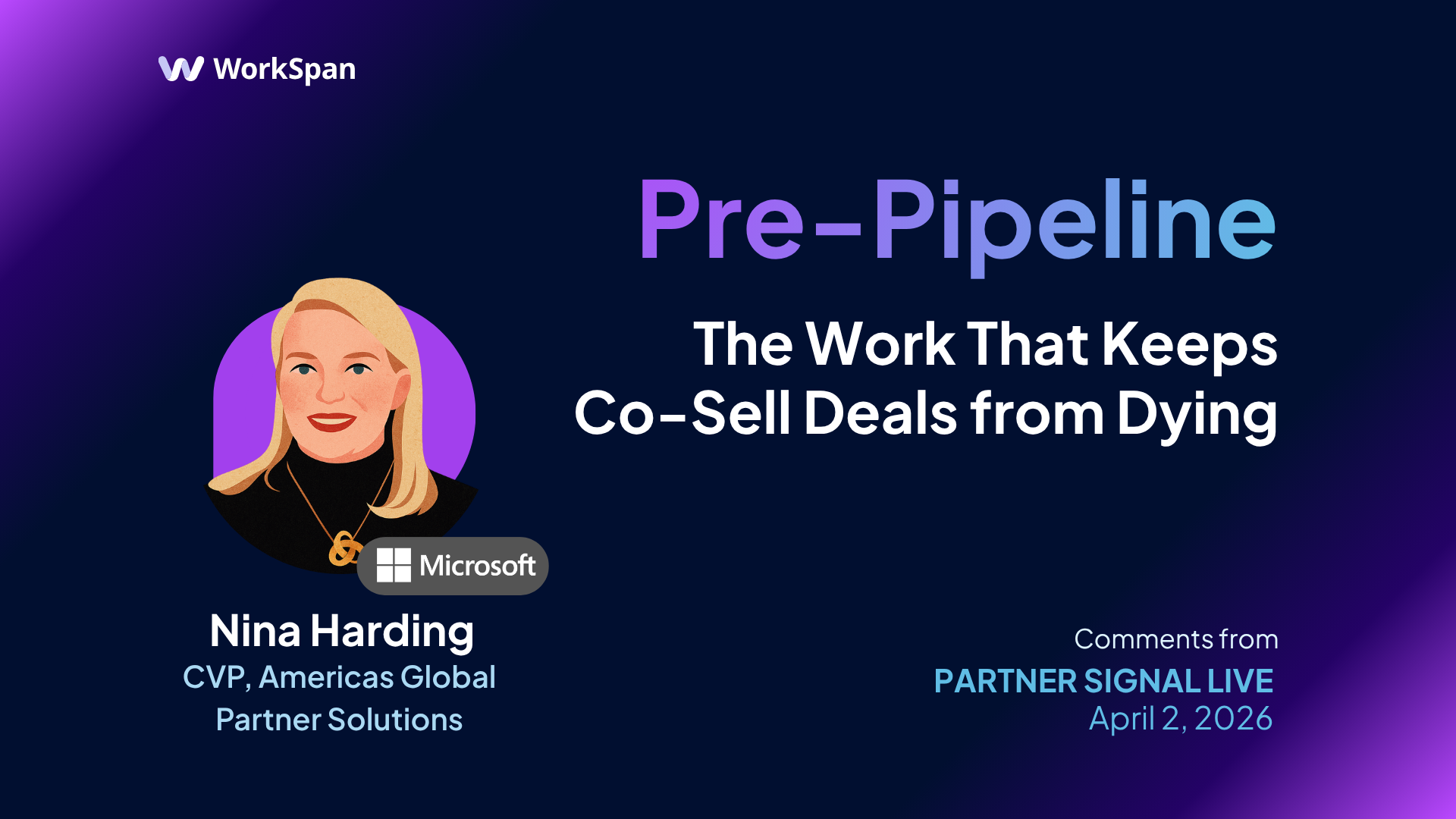
Most alliance teams obsess over what happens inside the pipeline: stage management, deal velocity, conversion rates, pipeline hygiene. Almost nothing is written about the work that keeps deals alive — the phase before the pipeline even starts. Nina Harding, CVP of Americas Enterprise Partner Solutions at Microsoft, was direct about what separates the partners who activate her field from those who don't: "That pre-alignment is everything in today's world."
We call this pre-pipeline — the structured discipline of aligning positioning, context, and relationships before a deal exists, and repeating it for every major partnership.
Three Pre-Pipeline Needs Most Teams Defer
Three activities kept surfacing across a recent Partner Signal Live session that most alliance teams defer to the sales cycle — each one quietly killing the deal before anyone notices.
Joint value proposition alignment. Most teams assume sellers from both sides understand the joint story. They don't. They understand their own product story and bolt the partner on. Nina described the standard that's replaced the old "art of the possible" conversations: "We've moved beyond the art of the possible. Now it's the art of precision and value." That precision — industry-specific, persona-specific, mapped to concrete use cases and outcomes — cannot be built on the fly in a sales meeting. When it's deferred to mid-deal, both sellers default to their own pitch, and the customer sees two vendors instead of a joint solution.
Seller-to-seller introductions and context sharing. Most co-sell motions start with a referral submission. The seller-to-seller relationship starts cold. Nina framed the investment required: "Take extra time when you're working with a sales rep — Do you actually know the account? Do you understand their business problem? Can you articulate your particular value together with Microsoft and what outcome you could drive?" Those aren't questions you answer during the deal. They're questions you answer so the deal starts from shared understanding rather than mutual discovery.
Account context and customer priority mapping. Nina described the partners who win as "leading with experience, a tailored story around clear use cases, clear customer adoption, with outcomes that map to funded customer priorities." You can't map to funded priorities if you don't know what they are. When account homework is deferred to the sales cycle, the first joint meeting becomes an intake call — and the customer loses confidence that either partner understands their business.
In practice, these three activities become four operational habits: joint account mapping across overlapping territories, persona-level value proposition alignment for specific buyer roles, seller activation that ensures both sides know the joint story and economics before an opportunity surfaces, and shared account context so the first conversation is informed, not exploratory.
This is what Nina means when she says partners should "do your homework and start with that value proposition first to the seller that you want to engage, rather than just saying, ‘Hey, what are you seeing?’" She was specific about what that value proposition needs to contain:
"Make your unique value proposition simple for the sellers to understand... a clear story, succinct, talks about customers, what the upside for the deal is. Understand what the economics are for the sales rep... and how you transact it."
That's not a pitch deck. It's a pre-pipeline deliverable — built for every strategic partnership and refreshed regularly.
How Pre-Pipeline Primes Marketplace Success
Nina put the shift plainly: "Marketplace is becoming the commercial backbone of co-sell. It's not an optional channel anymore, and our field is paid off of marketplace transactions." Fewer steps from opportunity to close — that's what marketplace-compensated sellers want. Pre-pipeline alignment delivers exactly that.
The partners who clear Nina's combined bar — "co-sell ready solutions that are also marketplace ready, with aligned pricing and incentives and deal mechanics" — are the ones who've already done the pre-pipeline work. Their deals flow because the positioning, the economics, and the seller relationships were built before the opportunity existed. The failure mode is a partner who submits a marketplace-ready listing but has never pre-aligned with the field. The listing sits. The field doesn't know when to trigger it or why.
Is Your Team Prioritizing Pre-Pipeline Alignment?
- For your top three partnerships, could you articulate the joint value proposition at the persona level — not just the company level — right now, without looking anything up?
- When was the last time your sellers and your partner's sellers were introduced and briefed before an opportunity triggered it — not after?
- If a new seller joined the partner's team tomorrow, how quickly could they execute a co-sell motion with your team? Days? Weeks? Months? That gap is your pre-pipeline debt.
- What percentage of your co-sell referrals are submitted with full account context — customer priorities, relevant services, relationship map — vs. just the opportunity basics?
The Fix Compounds
Every pre-aligned account, every pre-briefed seller, every pre-mapped value proposition removes friction from every future deal in that partnership. Pre-pipeline is the compound interest of co-sell — and skipping it is the compound debt.
Pick one partnership this quarter. Build the pre-pipeline deliverable Nina described — the clear story, the economics, the customer proof points, the transaction mechanics — and put it in your sellers' hands before the next opportunity shows up. That's not planning. That's the work.
Watch Nina Harding’s Partner Signal Live Session

WorkSpan powers sales partnerships to help businesses achieve more together. With WorkSpan AI, the 15,000 companies on the WorkSpan network leverage AI teammates, integrated partner workflows, partner planning, reporting and attribution to scale their revenue generating partnerships.
Heading
Heading 1
Heading 2
Heading 3
Heading 4
Heading 5
Heading 6
Lorem ipsum dolor sit amet, consectetur adipiscing elit, sed do eiusmod tempor incididunt ut labore et dolore magna aliqua. Ut enim ad minim veniam, quis nostrud exercitation ullamco laboris nisi ut aliquip ex ea commodo consequat. Duis aute irure dolor in reprehenderit in voluptate velit esse cillum dolore eu fugiat nulla pariatur.
Block quote
Ordered list
- Item 1
- Item 2
- Item 3
Unordered list
- Item A
- Item B
- Item C
Bold text
Emphasis
Superscript
Subscript