Your co-sell program has a single point of failure, and it's you.
Not your process. Not your playbook. Not the templates or the CRM fields or the enablement decks. You. The person who knows which AWS personas respond to which incentives. How to read a customer's cloud commitment. How to frame the referral so the partner rep actually responds. Which relationships are warm, which introductions have been made, which accounts are worth the fight this quarter. That knowledge is long, it is specific, and it exists in exactly one place.
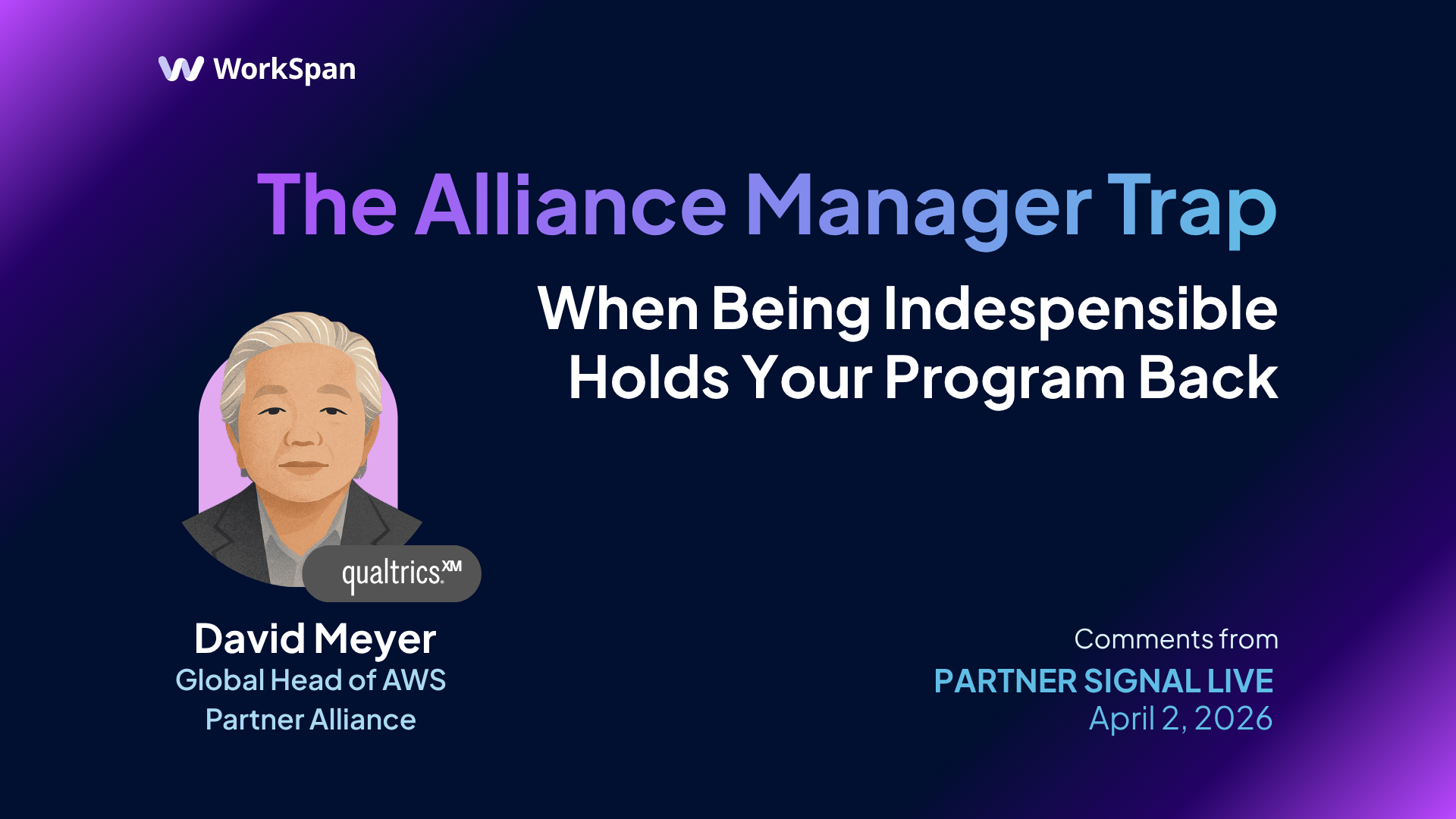
David Meyer runs the AWS alliance at Qualtrics across three regions. At a recent Partner Signal Live, he listed the vast responsibilities of a successful partner manager, then put a name to the problem: "Everything I just shared is commonly known by AWS partners as tribal knowledge. Scaling these co-selling tribal knowledge, that is the challenge."
That challenge isn't about process documentation. It's about a trap that forms inside every successful co-sell program — one that only becomes visible when the person holding everything together isn't available.
Your Process Is Documented. Your Practice Isn't.
Most alliance teams have process down. There's a playbook for submitting referrals. A template for ACE submissions. A slide deck that explains the co-sell motion to new hires. On paper, the program is systematized.
But the knowledge that makes those processes produce outcomes is a different layer entirely. The referral submission is the process. Knowing which AWS persona to target for this specific deal, what language will resonate with that rep, which incentive matters given the account tier and the quarter, and how to frame the customer's cloud commitment so the partner sees the opening — that's the practice. One can be written down in a wiki. The other lives in the accumulated judgment of whoever has been running the partnership long enough to pattern-match across hundreds of deals.
During the session, David reacted live to WorkSpan's Partner Advantage Card — an AI layer inside Salesforce trained on the Qualtrics-AWS partnership. His response was immediate: "The card absolutely does what I do today. They answer my daily inquiries: Should I send this opportunity to AWS? And what do I expect in return? How do I send this off to AWS?... Which one of our products do you think AWS can help us co-sell?" Those aren't process questions. They're judgment calls that require knowing both sides of the partnership simultaneously — your product positioning and your partner's internal incentive structure.
Most alliance teams mistake process documentation for knowledge transfer. Handing someone a referral template without the practice layer is like giving a new surgeon the operating manual without the residency.
Three Areas Where Tribal Knowledge Hides
The tribal knowledge problem isn't monolithic. Across David's description of his daily work, three areas kept surfacing where critical knowledge exists only in someone's head.
Persona-level incentive maps. Every hyperscaler partnership runs on a web of incentives that shift by persona, deal type, account tier, and quarter. Knowing that the AWS account manager for this particular customer cares about marketplace commitment, while the partner sales manager on a different deal is motivated by a new service launch — that's not in your CRM. It lives in the alliance manager who's had enough conversations to internalize the map.
Most alliance teams have never systematized this tribal knowledge.
Account context signals. The accumulated understanding of a customer's current state — their cloud commitment, marketplace propensity, services stack, and how those intersect with your product. David described what happens when this knowledge isn't externalized: "When I have an opportunity that's urgent, I have to stop everything. I have to do exactly the same things in manual effort to review the opportunity, to figure out which team in AWS, discuss with our AE on the current status. Find strategies. Find stakeholders. And Alex, I do this every day for every deal across hundreds of conversations in three regions, while also trying to run the Alliance program."
He's not describing an occasional fire drill. He's describing his daily operating rhythm — repeated across three regions while simultaneously running the strategic program.
Relationship mapping between field teams. Who knows whom across company boundaries. Which seller-to-seller relationships are warm. During David's session, Qualtrics had a CMO connection at an account where AWS was trying to expand. That relationship context — that it existed, that it was relevant, that it could be leveraged — lives only in the alliance manager's memory. If David hadn't been in that conversation, the connection might never have surfaced.
These three areas aren't the complete taxonomy. But they represent the categories where the gap between what your program knows and what your people carry is most dangerous.
How the Trap Forms
The tribal knowledge problem isn't caused by bad alliance managers. It's caused by good ones. That's what makes it a trap.
When you're the person who holds the context, involving you in every deal is the rational decision. Your sellers call you because you actually do know which AWS persona to engage. Your leadership asks you to pull the QBR numbers because you're the only one who can reconcile two systems. Your reps forward urgent opportunities because you're the fastest path to a formatted ACE submission with the right positioning.
David named this pattern directly: "That also fostered a do-it-yourself culture with siloed tribal knowledge across different partner ecosystems." The lack of systems that carry the practice layer doesn't just slow things down. It creates a culture where the alliance manager becomes the program. Every decision routes through them. The ceiling of the program becomes their personal bandwidth.
But the real loss isn't operational. When David described what would change if the tribal knowledge were externalized, he didn't lead with efficiency: "That gives me the time to lead the alliance strategies and build relationships. I'm no longer just evangelizing and running operations."
That's the trap in full: the time you spend being indispensable is time you're not spending on strategy, relationship building, and program architecture.
What Breaking Out Looks Like
The fix is a system where the practice layer surfaces at the point of decision — inside the workflow the seller is already in, at the moment they need it, with the context of both sides of the partnership built in. Not by searching a wiki or Slack-ing you.
After watching a demo where his sellers' entire co-sell workflow — from opportunity assessment to incentive mapping to ACE submission — was replicated without his involvement, David's reaction cut to the core of the tribal knowledge problem:
"What you have just shown here is that my sellers can do this without me. They don't have to call me. They don't have to Slack me. They don't need me for any incentive discussions. They don't need me for ACE submissions. They don't need me to figure out how to persuade an AWS rep to engage. This is what scaling looks like to me."
"Without me" is the key phrase. Not because the alliance manager doesn't matter, but because the alliance manager's knowledge matters too much to be locked in one person. Scaling a co-sell program means making that knowledge accessible to every seller on every deal, independent of whether you're available.
The Diagnostic
- If your top alliance manager left tomorrow, how many deals in your pipeline would stall because no one else has the context?
- Can a seller on your team submit a strategically sound co-sell referral without involving anyone from your alliances team?
- When was the last time a deal was delayed because your team didn't know the right partner persona to engage, or used the wrong incentive framing?
- David's litmus test: is your QBR data assembled by a person the night before, or is it live and accessible to any leader at any time?
If you answered honestly and the results are uncomfortable, that's the point. David has spent his career trying to scale partnership programs. His closing reflection at Partner Signal Live wasn't about technology: "I've spent my career trying to scale partnership programs. This is the first time I've seen something that actually changes what my workflow looks like."
The question for every alliance leader reading this is the same one David was answering: what knowledge is locked in you that your program needs to run without you?
Watch David Meyer’s Partner Signal Live Session

WorkSpan powers sales partnerships to help businesses achieve more together. With WorkSpan AI, the 15,000 companies on the WorkSpan network leverage AI teammates, integrated partner workflows, partner planning, reporting and attribution to scale their revenue generating partnerships.
Heading
Heading 1
Heading 2
Heading 3
Heading 4
Heading 5
Heading 6
Lorem ipsum dolor sit amet, consectetur adipiscing elit, sed do eiusmod tempor incididunt ut labore et dolore magna aliqua. Ut enim ad minim veniam, quis nostrud exercitation ullamco laboris nisi ut aliquip ex ea commodo consequat. Duis aute irure dolor in reprehenderit in voluptate velit esse cillum dolore eu fugiat nulla pariatur.
Block quote
Ordered list
- Item 1
- Item 2
- Item 3
Unordered list
- Item A
- Item B
- Item C
Bold text
Emphasis
Superscript
Subscript