Most co-sell playbooks assume two parties. Partner A refers to Partner B. Partner B closes with Partner A's support. Pipeline is shared, credit is split, and the program is declared a success. It's clean. It's manageable. And in most enterprise accounts that matter today, it's a fiction.
Jay McBain's research has established what senior alliance leaders already sense: in any larger enterprise customer, at least six other partners are active at any given time. Not six potential partners. Six already in the account, already influencing decisions, already shaping outcomes.
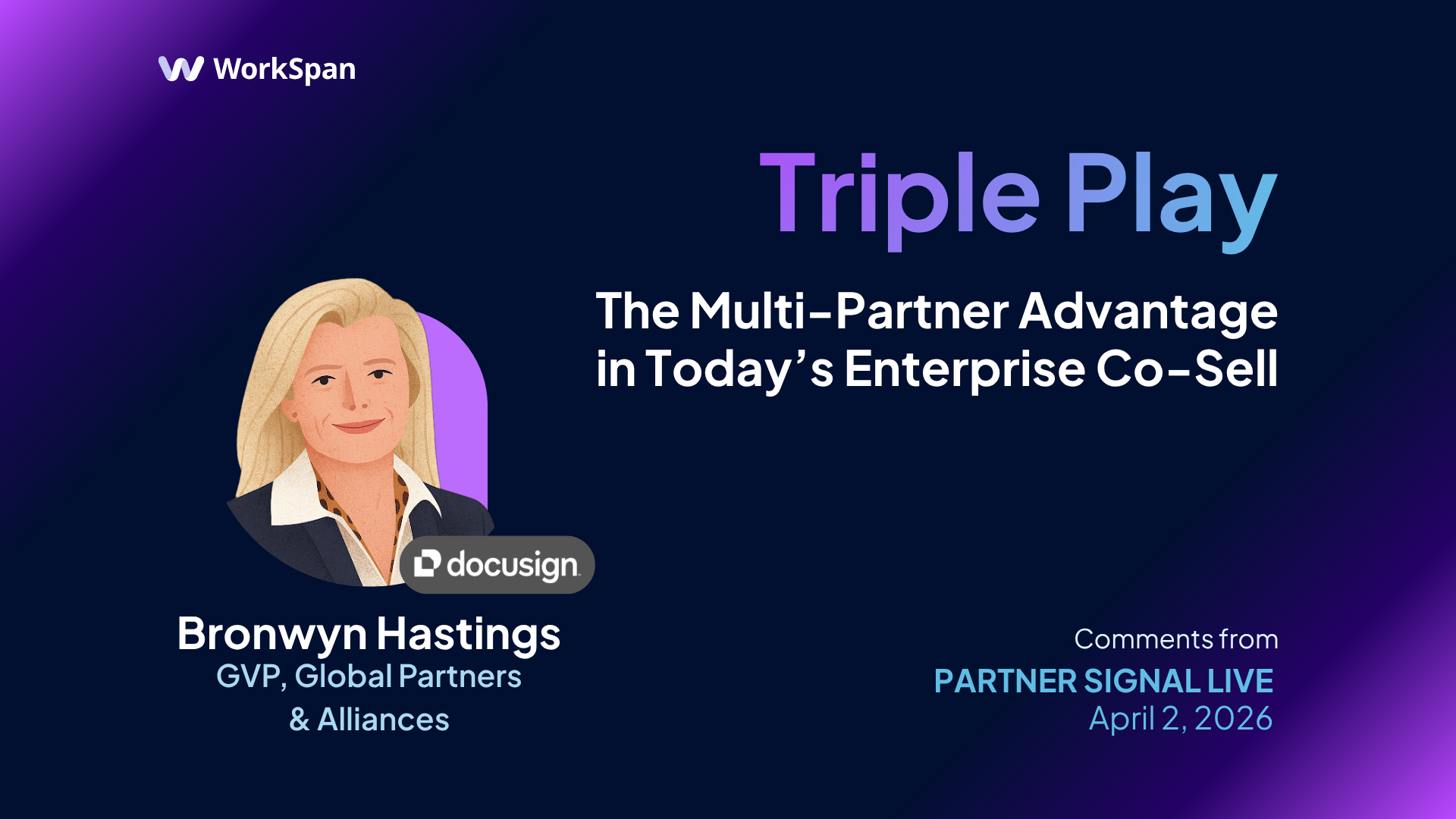
Bronwyn “Bron” Hastings, SVP of Global Partnerships at DocuSign, drew on that research during a recent Partner Signal Live session to pose the question most co-sell programs aren't designed to answer: "What happens if we call it a triple play? What happens if there's three partners? We know the win rate's higher. We know the deal sizes are bigger. We know that the adoption is higher when we're orchestrating it from meeting the customer where they are."
Higher win rates, larger deals, stronger adoption. That's what happens when multiple partners coordinate rather than coexist. The question is why so few programs are built for it.
The Two-Party Assumption
Almost everything written about co-sell assumes a two-party model. Partner A and Partner B share pipeline, coordinate on accounts, and submit referrals to each other. The programs, the platforms, and the playbooks all follow this architecture. It works for simple motions. It falls apart in the enterprise.
Consider a typical modernization deal. A hyperscaler provides the platform and cloud commit structure. An ISV delivers the core solution the customer is buying. An SI handles implementation, change management, and often holds the deepest customer relationship. Potentially a second ISV provides adjacent capability. The bilateral model forces alliance managers to handle each of these relationships in parallel, independently, with no shared context across them. Every conversation is a separate thread. No one holds the full picture.
Bron's observation about six active partners isn't a prediction. It's a description of what's already happening in every large enterprise account. The difference between high-performing programs and everyone else is whether those partners are being orchestrated or left to collide.
Amit Sinha, CEO of WorkSpan, grounded the observation in a specific partnership: the success of Avanade in the Microsoft ecosystem comes from the expertise they bring about the customer combined with the solution they co-sell together. When a hyperscaler partnership and a services partnership are coordinated rather than running in parallel, the value compounds. But that coordination doesn't happen by default. It has to be designed.
What a Well-Designed Triple Play Looks Like
A triple play isn't three bilateral co-sell motions stacked on top of each other. It's a single coordinated motion where each partner's contribution is distinct and the customer sees one coherent story. Based on the programs running multi-partner motions today, three components separate a coordinated triple play from three partners who happen to be in the same account.
First, clear role delineation. Each partner knows what they bring and what they don't. Bronwyn was direct about why this matters: "Neither of us want to be interchangeable when we are co-selling. The one thing we want to do is have an offering that makes us undeniably the choice of value together."
When three partners are in a deal and two of them sound interchangeable to the customer, the customer cuts one. In practice, this means the hyperscaler provides the platform, the marketplace transaction mechanism, and the cloud commit burn-down. The ISV provides the core capability the customer is buying. The SI provides industry-specific delivery, change management activation, and the customer relationship that opens the door. Each contribution is irreplaceable. Remove any one, and the deal either doesn't close or closes smaller.
Second, no value overlap. The customer sees three distinct contributions, not three versions of the same pitch. This is Bronwyn's interchangeability warning scaled to a third dimension. In a bilateral motion, overlap means one partner gets marginalized. In a triple play, overlap means the whole structure loses coherence — the customer can't articulate why all three are in the room.
Third, a single coordinated customer-facing narrative. The customer experiences one solution story with three contributors, not three separate conversations that reference each other. This is the hardest component to execute and the one most programs skip entirely. When it works, the customer sees a complete answer to their problem. When it doesn't, they see three vendors jockeying for position.
When Triple Plays Outperform
Not every deal needs three partners. The framework matters most under conditions that are becoming increasingly common in enterprise sales.
Multi-workload deployments, where the customer is modernizing multiple systems simultaneously. A single ISV can't cover the full scope. An SI brings integration expertise and organizational change management. The hyperscaler provides the platform. The more workloads in play, the more a specialist at each layer outperforms a generalist trying to cover two.
Industry-specific use cases, where domain expertise determines whether the solution actually works. A healthcare payer modernization might need an ISV for the workflow automation, an SI with payer-specific delivery experience, and a hyperscaler for AI/ML services and marketplace transaction. The deeper the industry specificity, the more likely that no two partners can cover all three roles.
Change management requirements, where adoption — not just deployment — defines success. When a customer measures outcomes by user activation rather than go-live dates, a pure ISV-plus-hyperscaler motion leaves a gap. The SI or services partner fills it. Their involvement directly increases the adoption rates that make the other two partners' solutions stick.
These conditions share a common thread: complexity that exceeds what any bilateral motion can address. When the deal requires platform, solution, and delivery expertise simultaneously, two partners can't cover it. Three can.
Who Holds the Context?
Triple plays are rare because the orchestration exceeds human capacity at scale. Someone has to hold the shared context across all three partners, and in most programs, no one does.
In a bilateral co-sell, the alliance manager on each side can track the full picture. Two parties, two perspectives, manageable complexity. Add a third partner and the context becomes three-dimensional. Across a portfolio of accounts running simultaneously, no individual can maintain that level of coordination without something breaking. The risk is exactly what Bron warned about: two of the three partners become indistinguishable from the customer's perspective. The interchangeability problem compounds with each additional partner.
Bron framed both the challenge and the direction:
"Imagine putting all of those together and trying to maintain that value. The partner managers have a big challenge, but this is where AI can enable these orchestrated, agentic moments that are really bringing these partnerships to life in your core CRM systems."
The answer isn't fewer partners. It's better infrastructure. Amit's architecture points to what that looks like: "It's not my agent or your agent, it's our agent put together." In a triple play, the shared intelligence layer needs to hold context from all three parties. A bi-directional, trusted execution pathway between partners is what makes orchestration possible at scale. Without it, alliance managers remain the bottleneck, and triple plays remain the exception.
Test Your Own Program
- In your top ten enterprise accounts, how many partners are already active? Are you coordinating with them or competing with them?
- When you co-sell with your hyperscaler partner, is there an SI in the deal? If so, are you running one three-way motion or two bilateral motions that happen to share an account?
- Can you articulate what your SI partner brings that you don't — and vice versa — in one sentence? If not, you're not ready for a triple play.
- Does your co-sell platform show you more than one partner relationship per account? If it only shows the bilateral view, you're missing the dynamics that are already shaping your deals.
The Design Challenge
For your most important enterprise accounts, what would a deliberately orchestrated triple play look like? Which three partners, with which roles, telling which story? And what's missing from your program to make that motion repeatable?
The programs that answer those questions now will have a structural advantage as deal complexity accelerates.
Watch Bronwyn Hastings’ Partner Signal Live Session

WorkSpan powers sales partnerships to help businesses achieve more together. With WorkSpan AI, the 15,000 companies on the WorkSpan network leverage AI teammates, integrated partner workflows, partner planning, reporting and attribution to scale their revenue generating partnerships.
Heading
Heading 1
Heading 2
Heading 3
Heading 4
Heading 5
Heading 6
Lorem ipsum dolor sit amet, consectetur adipiscing elit, sed do eiusmod tempor incididunt ut labore et dolore magna aliqua. Ut enim ad minim veniam, quis nostrud exercitation ullamco laboris nisi ut aliquip ex ea commodo consequat. Duis aute irure dolor in reprehenderit in voluptate velit esse cillum dolore eu fugiat nulla pariatur.
Block quote
Ordered list
- Item 1
- Item 2
- Item 3
Unordered list
- Item A
- Item B
- Item C
Bold text
Emphasis
Superscript
Subscript